
Governments are taking wildfire threat seriously
Advertisement
Read this article for free:
or
Already have an account? Log in here »
We need your support!
Local journalism needs your support!
As we navigate through unprecedented times, our journalists are working harder than ever to bring you the latest local updates to keep you safe and informed.
Now, more than ever, we need your support.
Starting at $15.99 plus taxes every four weeks you can access your Brandon Sun online and full access to all content as it appears on our website.
Subscribe Nowor call circulation directly at (204) 727-0527.
Your pledge helps to ensure we provide the news that matters most to your community!
To continue reading, please subscribe:
Add Brandon Sun access to your Free Press subscription for only an additional
$1 for the first 4 weeks*
- Enjoy unlimited reading on brandonsun.com
- Read the Brandon Sun E-Edition, our digital replica newspaper
*Your next Free Press subscription payment will increase by $1.00 and you will be charged $20.95 plus GST for four weeks. After four weeks, your payment will increase to $24.95 plus GST every four weeks.
Read unlimited articles for free today:
or
Already have an account? Log in here »
Ian Bushie’s prognostication of a less intense fire season seems to be holding true. So far.
In his comments while here in Brandon in April during the release of the province’s 2025 Wildfire Interim After Action Review, the Manitoba Natural Resources and Indigenous Futures Minister said last year’s frenetic wildfire season wasn’t expected to repeat itself this year.
Manitobans will remember that it was in late May of 2025 that the first wave of evacuations began, after rapidly spreading fires and worsening fire conditions forced northern communities to order mandatory evacuations. Only a few days later, the NDP ordered a province wide state of emergency on May 28.
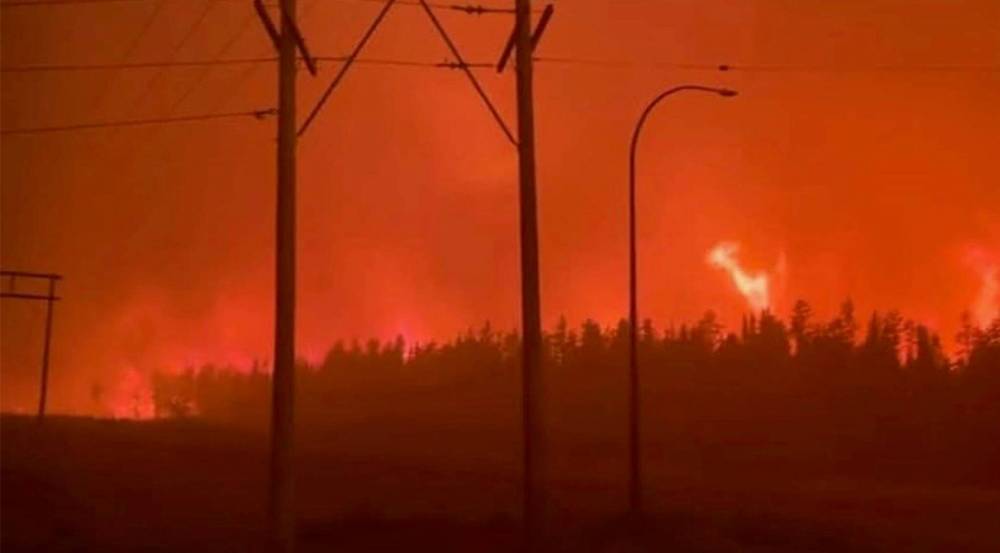
A wildfire burns near Leaf Rapids in July 2025. (Government of Manitoba)
In total, more than 22,000 people had to be evacuated in that first wave, and Winnipeg and Brandon hosted many of them, along with several other communities that were brought on board to provide aid.
This spring — and what has recently become known as “fire season” in Manitoba — has gone somewhat differently.
According to the Province of Manitoba’s FireView map, there is currently only one wildfire burning in the province at the present time, located right along the Dauphin River north of Lake St. Martin in the Interlake region. And as of Monday afternoon, the province reports that this human-caused fire is under control.
The northwest and Interlake regions of the province have seen precipitation accumulations close to normal, and in some parts above normal. But that does not mean we are out of the woods just yet, so to speak.
Precipitation levels in southern Manitoba are currently below normal according to the Manitoba Government website, with agricultural regions at least than 50 per cent of their normal spring rainfall.
At the same time, Environment and Climate Change Canada predicts that 2026 will be one of the hottest years on record globally, with a warmer-than-normal summer predicted for Western Canada and the Prairies in particular. An extended dry period in Manitoba could still plunge the province into drought conditions and wildfires if temperatures remain high.
With this in mind, we’re glad to see our provincial and federal governments taking the wildfire threat seriously.
On Monday, the federal government announced that it has leased 10 new aircraft as part of Canada’s first national aerial firefighting fleet. The fleet, which comes directly out of a $317-million spending allocation in the federal budget, is designed to help provinces and territories respond to the 2026 wildfire season.
As reported by The Canadian Press, provincial and territorial wildfire agencies will be able to request the use of four air tankers, one spotter plane and five heavy lift helicopters to fight wildfires.
“These additional aircraft will strengthen Canada’s wildfire response, protect front-line personnel and protect communities across the country,” Emergency Management and Community Resilience Minister Eleanor Olszewski told reporters.
While this decision falls short of the establishment of a permanent Canadian wildfire-fighting fleet — the aircraft are leased for 150 days starting this month — this is a good step forward. Olszewski said the wait for new aircraft can exceed five years, and by leasing aircraft, the government is saving money by not paying for a plane sitting unused during the winter months.
This announcement comes follows the Kinew government announcement of several actions to improve Manitoba’s fire preparedness.
In March, the province allocated nearly $5 million to add 19 new firefighters, 15 more Emergency Management Organization staff and four more conservation officers. That funding is also meant to pay for upgrades to the Manitoba Wildfire Services weather information and fire mapping systems, as well as the cost of a new initial attack and fire base near Thompson, as well as improvements to the province’s own aerial firefighting services.
All of these efforts are certainly needed. If climate scientists are right — and we have no reason to discount their warnings — bad fire seasons will become the norm for the foreseeable future.
A quiet spring season may just be the calm before the firestorm.