
Government dragged its heels with HIMARS announcement
Advertisement
Read this article for free:
or
Already have an account? Log in here »
We need your support!
Local journalism needs your support!
As we navigate through unprecedented times, our journalists are working harder than ever to bring you the latest local updates to keep you safe and informed.
Now, more than ever, we need your support.
Starting at $15.99 plus taxes every four weeks you can access your Brandon Sun online and full access to all content as it appears on our website.
Subscribe Nowor call circulation directly at (204) 727-0527.
Your pledge helps to ensure we provide the news that matters most to your community!
To continue reading, please subscribe:
Add Brandon Sun access to your Free Press subscription for only an additional
$1 for the first 4 weeks*
- Enjoy unlimited reading on brandonsun.com
- Read the Brandon Sun E-Edition, our digital replica newspaper
*Your next Free Press subscription payment will increase by $1.00 and you will be charged $20.95 plus GST for four weeks. After four weeks, your payment will increase to $24.95 plus GST every four weeks.
Read unlimited articles for free today:
or
Already have an account? Log in here »
The worst-kept secret in military procurement just got officially confirmed by the federal Liberal government this week. But it appears the federal government has been dragging its heels in making it known.
Defence Minister David McGuinty told reporters in Ottawa this week that 26 M142 High Mobility Artillery Rocket Systems (HIMARS) from the United States will be acquired for the Canadian Army.
Of course, the Department of National Defence confirmed the purchase in an email to the Sun nearly two weeks ago, while simultaneously confirming that CFB Shilo has been chosen to operate the newly procured rocket technology.
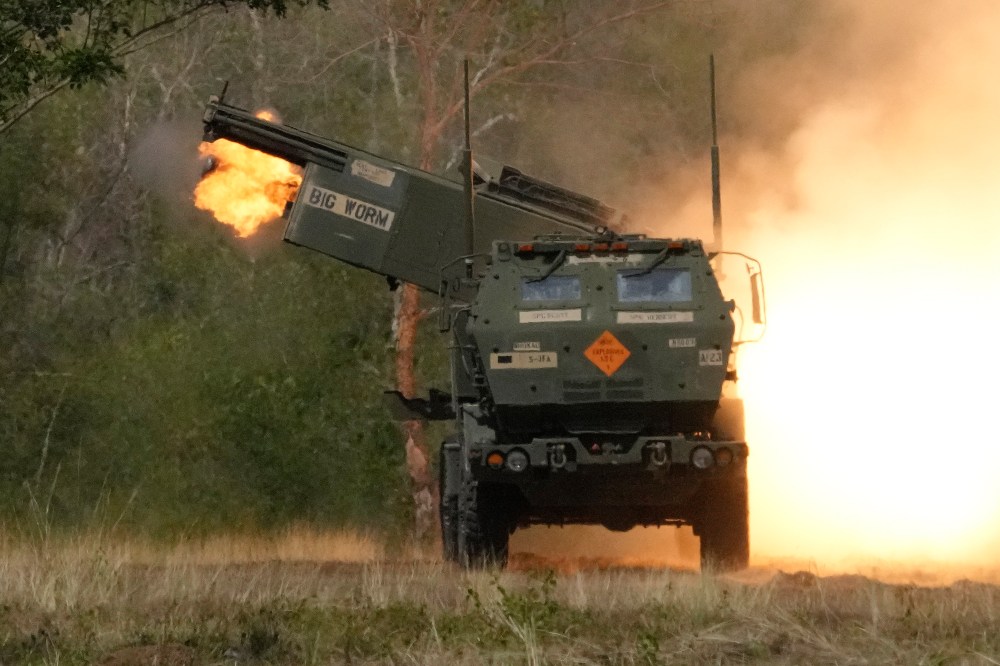
The rockets will be “leveraged” by CFB Shilo’s existing 1st Regiment, Royal Canadian Horse Artillery to start, but will “establish the foundation for the eventual formation of a new unit, the 9th Rocket Regiment, RCA,” Andrée-Anne Poulin, media relations officer for the DND, told the Sun.
It is certainly curious that DND chose to divulge that information to the Sun before taking the news to the national media.
It’s not like national reporters weren’t asking all the right questions.
News of the HIMARS purchase had been taken up by Canadian media earlier this spring after the Pentagon announced on May 1 that it had secured a $1.1-billion contract with U.S. defence giant Lockheed Martin to manufacture HIMARS for several allied countries — including Canada.
And before that, on Oct. 1, 2025, the U.S. State Department had announced that it had tentatively approved a possible foreign military sale of HIMARS tech to the government of Canada.
“This proposed sale will support the foreign policy and national security objectives of the United States by helping to improve the military capability of Canada, a North Atlantic Treaty Organization (NATO) ally that is an important force for ensuring political stability and economic progress and is a contributor to military, peacekeeping and humanitarian operations around the world,” read a public news release by the Defense Security Co-operation Agency.
“Implementation of this proposed sale will require multiple trips to Canada involving up to twenty U.S. Government and up to fifteen contractor representatives for program management reviews to support the program.”
The information was already out there in the public sphere. The fact that it took nearly eight months for the Canadian government to confirm that it has even made the purchase request of the United States says a lot about the current state of politics in our country.
Certainly the news was not urgent — deliveries for the HIMARS systems to Shilo are not expected to begin until 2029. But for a government that seemed determined to overhaul the Canadian forces as swiftly as possible, with an eye to correct critical operational and capability gaps, the delayed announcement seems out of character.
Think of all the rapid-fire announcements that have been made over the past year. Pushing to achieve Canada’s two per cent GDP defence expenditure target. The implementation of a huge pay increase for CAF members. Multibillion-dollar investments in modern equipment and drone infrastructure. A commitment to a year-round military presence in the Arctic, with $40 billion dedicated to northern infrastructure.
Just last March, the feds announced $84 million to build about 180 homes at CFB Shilo as part of a national housing expansion for Canadian military bases.
And arguably the most important — and perhaps controversial — comment Carney made this year was a promise to buy less military equipment directly from the United States, instead looking to purchase from domestic suppliers where possible.
The HIMARS deal was apparently finalized in January. Carney’s formal statement — “the days of our military sending 70 cents of every dollar to the United States are over” — was made on April 12. Keeping it quiet allowed the Carney government to release that domestic defence procurement strategy without facing immediate contradiction.
No doubt, the federal government has also taken into consideration the growing anti-American sentiment that many Canadians are feeling toward the United States. That antipathy grows every time U.S. President Donald Trump utters the phrase “51st state” when referring to Canada’s future relationship with our southern neighbours.
Threatening Canadian sovereignty tends to do that.
The reality is that Canada will still purchase equipment and munitions from the United States into the future, no matter how much we would rather find alternatives — the U.S. maintains some of the world’s most advanced weaponry, and it would be counterproductive to ignore that fact.
But the optics of an “elbows-up” Canadian government purchasing American-made weapons has become unhelpfully impolitic.