
Tory MPs must lead way on Alberta issue
Advertisement
Read this article for free:
or
Already have an account? Log in here »
We need your support!
Local journalism needs your support!
As we navigate through unprecedented times, our journalists are working harder than ever to bring you the latest local updates to keep you safe and informed.
Now, more than ever, we need your support.
Starting at $15.99 plus taxes every four weeks you can access your Brandon Sun online and full access to all content as it appears on our website.
Subscribe Nowor call circulation directly at (204) 727-0527.
Your pledge helps to ensure we provide the news that matters most to your community!
To continue reading, please subscribe:
Add Brandon Sun access to your Free Press subscription for only an additional
$1 for the first 4 weeks*
- Enjoy unlimited reading on brandonsun.com
- Read the Brandon Sun E-Edition, our digital replica newspaper
*Your next Free Press subscription payment will increase by $1.00 and you will be charged $20.95 plus GST for four weeks. After four weeks, your payment will increase to $24.95 plus GST every four weeks.
Read unlimited articles for free today:
or
Already have an account? Log in here »
At a time when Canadians need the nation’s leaders to commit to working toward maintaining national unity and defeating Alberta’s separatist movement, too few of Canada’s big-C Conservatives are giving their full-throated support to the cause.
Many prominent Conservatives — most notably former prime minister Stephen Harper, former Alberta premier Jason Kenney and former Harper-era cabinet minister Monte Solberg — have voiced their strong opposition to separation, but other leading Conservatives say they support the idea of Alberta leaving Canada.
For example, it was reported earlier this week that former Conservative MPs Jay Hill, Leon Benoit, Val Meredith and Alan Kerpan each favour separation, and Hill says he is willing to help campaign for the pro-separation side if asked to do so. They are joined by MLAs in Alberta’s United Conservative Party caucus, who admit they signed the separation petition.
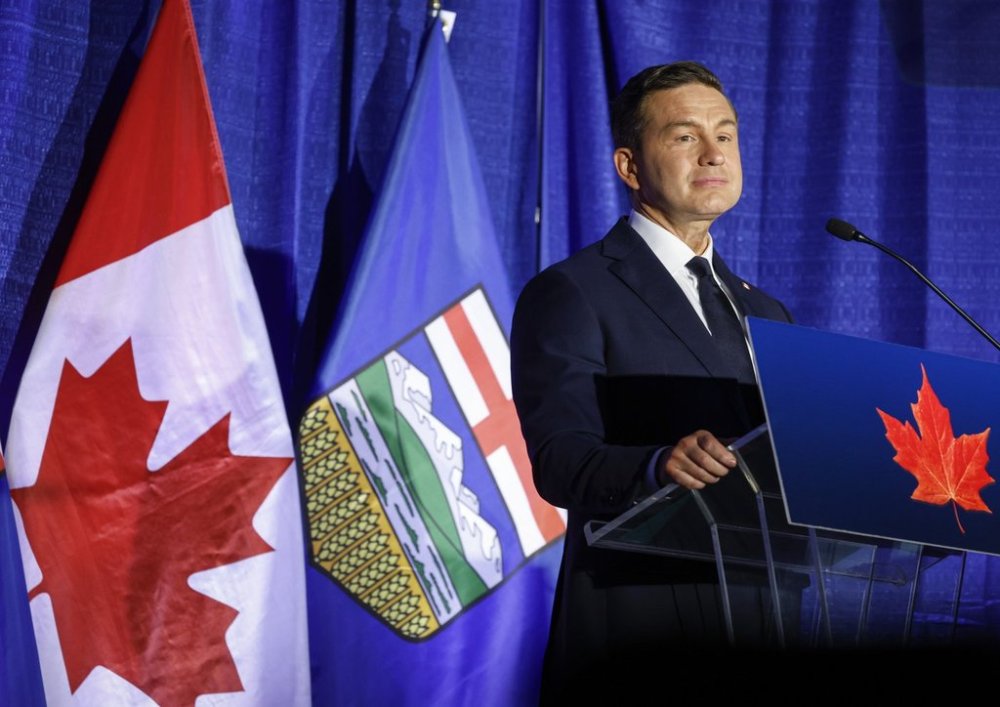
There are also Conservatives who appear to be on both sides of the issue, depending on who the audience is. Alberta Premier Danielle Smith says she will be encouraging Albertans to vote against the referendum question in October, but her rhetoric often includes arguments in favour of separation.
For example, her oft-stated goal of having a “sovereign Alberta within a united Canada” can only be viewed as an argument in favour of transforming the nation into some loose confederation of largely independent provinces, with a weak or non-existent federal government.
Like Smith, federal Conservative Leader Pierre Poilievre says he will be working to convince Albertans to vote against separation, but repeats many of the separatists’ core arguments in favour of leaving. He told an Alberta audience this week that Albertans “are looking for Ottawa to get out of the way and off their backs; for the province to finally have respect within Confederation,” and that they must “Lock arms with Quebec to restore the constitutional autonomy of the provinces.”
That is far from a strong, unambiguous message of national unity. To the contrary, it can only be regarded as a vision for the nation that is far different from the model that has served Canadians well since Confederation in 1867 — a structure that would quickly make it all but impossible for Canada to function as a unified nation.
Poilievre argues “We do not need a different country in Alberta. We need different government policies in Ottawa,” which can only be regarded as the specious argument that the separatist issue wouldn’t exist if Canadians had elected a Conservative government, led by Poilievre, in the federal election 14 months ago.
He may honestly believe that, but his enduring bitterness over the outcome of last year’s election will not quell the separatist sentiments within Alberta. To the contrary, his partisanship and willingness to amplify, legitimize and pander to the grievances of the separatists — the vast majority of whom are supporters of his party — will only make things worse.
That brings us to a fourth group of Conservatives, who are conspicuously silent and invisible on the Alberta separation issue, most notably the members of Poilievre’s Conservative Party caucus in Ottawa. That includes Westman’s two Conservative MPs, Grant Jackson and Dan Mazier, who are yet to say anything of note regarding Alberta separation.
If their silence is based upon a belief that the issue should be settled by Albertans alone, and that the rest of Canadians should passively sit on the sidelines — an argument that has materialized over the past few weeks — they are not merely wrong. They are failing their nation and their constituents.
Canada is a nation of more than 41 million people. Just 11 per cent of that total resides in Alberta, and only a small fraction of Albertans support separation. Given that reality, it is ridiculous that such a small portion of the population should be permitted to threaten our nation’s future, and that so many of our elected leaders have so little to say on the issue.
Now is not a time for silence; it is a time for the kind of strong, visible leadership that Harper, Kenney and Solberg — and Manitoba Premier Wab Kinew, for that matter — are providing on the Alberta issue. We encourage Jackson and Mazier to speak up and stand up for Canada, by doing all they can to encourage Albertans to reject this dangerous, divisive referendum.