
Weather forecasts well worth the investment
Advertisement
Read this article for free:
or
Already have an account? Log in here »
We need your support!
Local journalism needs your support!
As we navigate through unprecedented times, our journalists are working harder than ever to bring you the latest local updates to keep you safe and informed.
Now, more than ever, we need your support.
Starting at $15.99 plus taxes every four weeks you can access your Brandon Sun online and full access to all content as it appears on our website.
Subscribe Nowor call circulation directly at (204) 727-0527.
Your pledge helps to ensure we provide the news that matters most to your community!
To continue reading, please subscribe:
Add Brandon Sun access to your Free Press subscription for only an additional
$1 for the first 4 weeks*
- Enjoy unlimited reading on brandonsun.com
- Read the Brandon Sun E-Edition, our digital replica newspaper
*Your next Free Press subscription payment will increase by $1.00 and you will be charged $20.95 plus GST for four weeks. After four weeks, your payment will increase to $24.95 plus GST every four weeks.
Read unlimited articles for free today:
or
Already have an account? Log in here »
“Radar engineers and scientists don’t grow on trees. They are very hard to come by, especially the ones that have a lot of experience in Canada and with the Canadian system. Once that expertise is gone, it’s pretty much gone for good; you have to start from scratch if you want to build that team again.”
— David Sills, director of the Northern Tornadoes Project at McMaster University
Rossburn-area residents Brian and Bernadine Brown witnessed firsthand the awesome and terrifying power of a tornado this week when it ripped off the southeast corner of their century-old brick farmhouse.
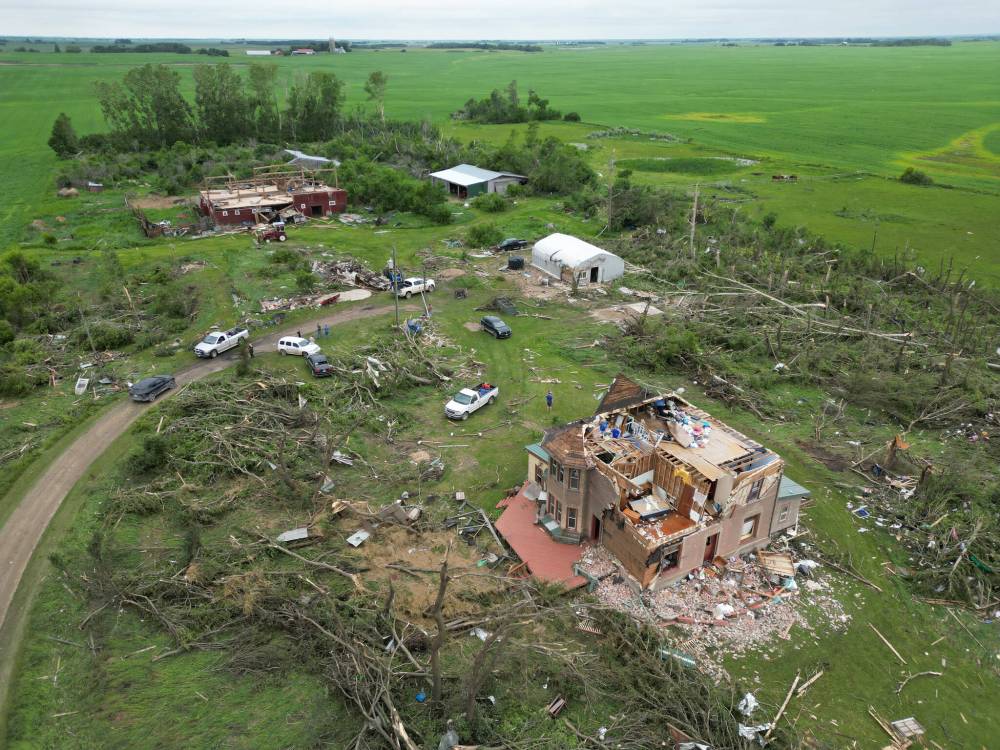
The devastation to the home and property belonging to Brian and Bernadine Brown south of Rossburn is visible on Monday after a powerful tornado hit the property on Sunday. The couple only received a notification of the tornado after it struck. (Tim Smith/The Brandon Sun)
The couple was going about their regular evening business on Sunday. Brian was working in his shop when it started hailing, while the yard was surrounded by thunder and lightning. As the Sun reported, he headed for the house while Bernadine was putting clothes in the dryer on the northeast side of the house.
When he saw a big tree fall out of the corner of his eye, he yelled for his wife to get away from the windows, and then grabbed her and pulled her to the floor with him just as the tornado struck.
He said the thrash of the tornado lasted about 10 seconds. But it wasn’t until after the tornado hit that he received a notification about it on his phone.
That little detail is important. The couple is lucky to be alive. Had the tornado struck a little differently, or had they been in a different part of the house, this story would have been far more tragic.
Having that safety warning ahead of time could have been the difference between life and death. And the Browns are not alone in that experience.
On June 29, an EF-1 tornado touched down in Winnipeg’s Whyte Ridge neighbourhood and caused considerable damage to property and homes. But local residents wondered aloud why the storm caught them by such surprise.
“There was absolutely no notification about any tornadoes or any high winds or things like that,” resident Jodi Dare told CTV News.
Yet it was a different story on June 9, when a severe thunderstorm that moved across the province sparked numerous alerts in that city, even though no tornado actually touched down within Winnipeg.
“I’m not saying that storm wasn’t violent either,” Dare said, “but to get that many notifications and none when an actual tornado went through was pretty alarming, actually.”
In the wake of some wild weather to hit the province over the last two months, Manitobans have been warned to brace themselves for even more severe weather into the early summer.
Dave Sills, the director of the Northern Tornadoes Project based out of Western University in London, Ontario told the Winnipeg Free Press this week that if the current weather patterns hold, “it’s going to be probably up in the high end of tornado totals.”
He said crews have been swamped assessing the destruction from a range of massive storms across the country. So far this year, Manitoba alone has recorded seven tornadoes, and there has been a total of 45 across Canada.
While the number of tornadoes is still about average, he said the pattern of storms doesn’t bode well for the rest of the summer.
But it’s not just tornadoes that are the problem. Many people were caught off guard by Monday afternoon’s torrential rains that dumped more than a month’s worth of rain in a matter of hours, and flooded streets up and down Westman, from Boissevain to Neepawa and beyond.
As a result, there are 35 municipalities and towns in southern Manitoba — a great many of them in western Manitoba — that are currently in local states emergency, and at least three First Nations.
John Hanesiak, a professor of atmospheric science at the University of Manitoba, told the Free Press that residents in Winnipeg did not receive an emergency alert to warn them about the severe weather because Environment Canada’s radar did not properly detect the system in time.
In 2016, the federal government spent $180 million to install 33 weather radar systems across the country. It took until 2024 to install them all. While Hanesiak said the system’s technology is already outdated, the problem has been amplified by the fact that Environment and Climate Change Canada quietly disbanded the team behind upgrading that radar network.
Sills told the Globe and Mail back in May that the ECCC’s radar research team was “reorganized out of existence” — part of the Carney government’s Comprehensive Expenditure Review that looked to find $60 billion in internal savings over a period of five years. While the department will still have staff dedicated to the radar system’s maintenance, there will no longer be a full team of climate scientists and meteorologists focused on advancing the technology, according to the Globe’s report.
Instead, they have decided to focus on an artificial intelligence forecasting model called GEML. And while AI has proven effective at predicting large-scale atmospheric conditions that lead to tornado and storm outbreaks, critics say the technology struggles with the so-called “last-mile” of detection — where tornadoes touch down in real time.
Certainly, Canadian taxpayers should applaud efforts to curb unnecessary government spending. But programs and technology that are meant to improve and address public safety aren’t largess that should easily come under the knife without good reason. Timely warnings and accurate predictions should be the goal when it comes to weather forecasting.
And with climate change making our weather ever more unpredictable and extreme, the need for more and better technology has become obvious. And so, too, the need for scientists who can help interpret the data produced.
What we need going forward is better investments into weather forecasts, not shortsighted government cuts.