
Carney plays well on the road
Advertisement
Read this article for free:
or
Already have an account? Log in here »
We need your support!
Local journalism needs your support!
As we navigate through unprecedented times, our journalists are working harder than ever to bring you the latest local updates to keep you safe and informed.
Now, more than ever, we need your support.
Starting at $15.99 plus taxes every four weeks you can access your Brandon Sun online and full access to all content as it appears on our website.
Subscribe Nowor call circulation directly at (204) 727-0527.
Your pledge helps to ensure we provide the news that matters most to your community!
To continue reading, please subscribe:
Add Brandon Sun access to your Free Press subscription for only an additional
$1 for the first 4 weeks*
- Enjoy unlimited reading on brandonsun.com
- Read the Brandon Sun E-Edition, our digital replica newspaper
*Your next Free Press subscription payment will increase by $1.00 and you will be charged $20.95 plus GST for four weeks. After four weeks, your payment will increase to $24.95 plus GST every four weeks.
Read unlimited articles for free today:
or
Already have an account? Log in here »
Bankers are detail-oriented, pragmatic types. They seek to maximize assets incrementally, without taking big swings or big risks.
Bankers who run central banks — controlling the monetary policy of nations and states — must also think strategically and geopolitically, taking care of the details of national monetary policy, protecting assets and minimizing risk while also positioning and protecting their nations in a global economy fraught with financial and political pitfalls.
Given that Canadian Prime Minister Mark Carney has been head of both the Bank of Canada and the Bank of England, it should be no surprise that, since he entered the political realm and became prime minister in 2025, he has governed like a careful national banker — the sort who raises or lowers interest rates a quarter-point at a time while carefully plotting a course through choppy geopolitical seas.
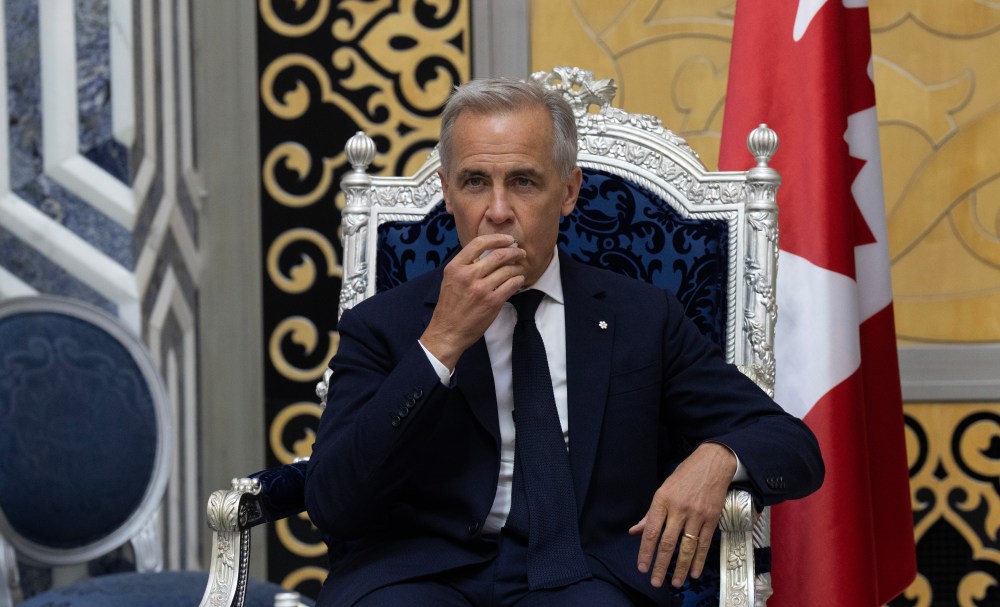
Domestically, Carney’s economic policies have focused on realizing the value of Canada’s assets in a post-COVID, inflationary global economy disrupted by the trade chaos of U.S. President Donald Trump, the U.S. and Israel’s war on Iran, and Russia’s continuing war with Ukraine.
Hence Carney’s quest for self-reliance through “nation-building” projects, most of which will enable Canada to extract the monetary value of its natural resources while boosting economic activity. That’s why we have seen announcements of investment funds, infrastructure deals and MOUs coming one after the other, even as Canada’s First Nations, environmentalists and various politicians raise their legitimate concerns.
On the global stage, Carney has followed the “elbows up” rallying cry that swept him to electoral victory with a measured and thoughtful approach to redefining Canada’s relationships with its trading partners and geopolitical allies.
Carney eloquently expressed the country’s path in January at the 2026 annual meeting of the World Economic Forum in Davos, Switzerland. After he made his speech pointing out that the world’s middle powers must unite to form a new world order in a post-Great Powers world, Canada’s trade and foreign relations efforts have been focused on strengthening relationships with similar positioned countries and trading blocs, including most of our NATO allies.
Carney’s most recent, carefully measured step in that direction came last week in Halifax when, on the eve of the two-day NATO summit in Ankara, Turkey, he confirmed that German defence and shipping manufacturer TKMS had been selected as preferred bidder to supply the Royal Canadian Navy with 12 new TKMS 212CD submarines.
TKMS has promised delivery of the first four of these subs by 2034, and Carney spoke glowingly of the stealth and Arctic capabilities of the 74-metre submarines, which will hold up to 30 crew members.
Choosing a German shipbuilder, which also just happens to be building the same submarines for the German and Norwegian navies, was a masterstroke — a finely-tuned detail.
In Turkey, Carney was able to bask in the bonhomie of a deal with a NATO partner while also showing Trump that Canada is serious about raising its defence expenditures to the levels the U.S. president has demanded. (The PM also announced an $800 million purchase of missiles from Norway’s Kongsberg Defence and Aerospace while in Turkey.)
If a contract with TKMS is successfully negotiated and production proceeds on schedule, the Arctic-capable submarines of Canada, Norway and Germany will be patrolling northern polar seas together in about a decade’s time.
The subs will bolster NATO efforts to protect the alliance’s Arctic territories — and may even put Greenland-coveting U.S. President Donald Trump at ease for a few minutes (not likely, but we can hope).
So, yes, Carney played well on the international stage last week — a performance reflective of his geopolitical experience.
Whether he can perform here at home will depend on how well he protects assets, mitigates risk and handles the details.
» Winnipeg Free Press