
Can the mouse survive an attacking elephant?
Advertisement
Read this article for free:
or
Already have an account? Log in here »
We need your support!
Local journalism needs your support!
As we navigate through unprecedented times, our journalists are working harder than ever to bring you the latest local updates to keep you safe and informed.
Now, more than ever, we need your support.
Starting at $15.99 plus taxes every four weeks you can access your Brandon Sun online and full access to all content as it appears on our website.
Subscribe Nowor call circulation directly at (204) 727-0527.
Your pledge helps to ensure we provide the news that matters most to your community!
To continue reading, please subscribe:
Add Brandon Sun access to your Free Press subscription for only an additional
$1 for the first 4 weeks*
- Enjoy unlimited reading on brandonsun.com
- Read the Brandon Sun E-Edition, our digital replica newspaper
*Your next Free Press subscription payment will increase by $1.00 and you will be charged $20.95 plus GST for four weeks. After four weeks, your payment will increase to $24.95 plus GST every four weeks.
Read unlimited articles for free today:
or
Already have an account? Log in here »
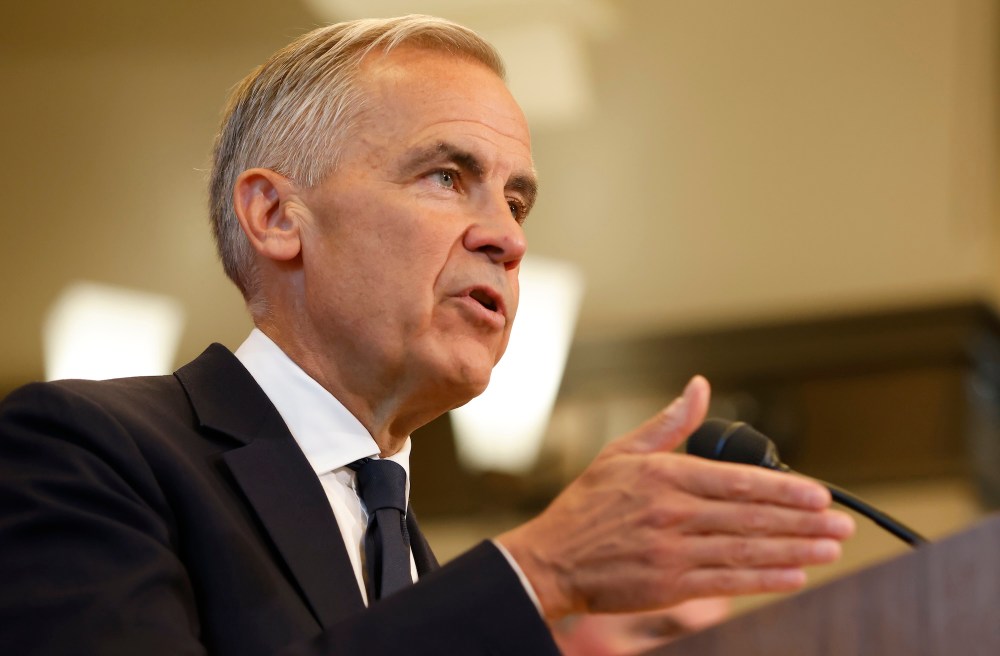
“We are entering a phase where fiscal strength, discipline, focus is going to be very important. It’s going to be scrutinized. Markets sometimes ignore these fundamentals and then all of a sudden they focus on them. And when they focus on them, if you don’t have your house in order, it’s too late. We have our house in order and we’re getting stronger.”
— Prime Minister Mark Carney
Question: So how does a mouse survive an attack from a rampaging elephant?
Answer: By refusing to fight on the elephant’s terms.
In case you’re wondering, yes, this is an allusion to the Canada-U.S. trade war.
Following the breakdown of trade negotiations last Friday, the U.S. implemented 50 per cent tariffs on about $28 billion worth of Canadian goods, including dairy, alcohol, building materials and electronics. This is a significant attack on Canada’s economy, one meant to force Canada into compliance with demands made by the Trump administration.
Quite honestly, this is a rather thoughtless road for the United States to take, and not just because they’re attacking a trustworthy ally and trading partner.
Under Donald Trump — and thanks to decades of unwise tax cuts that have benefited those with deep pockets — the United States has been significantly increasing its debt load. Just recently, the total U.S. national debt surpassed US$40 trillion, with annual interest on this debt now costing the U.S. treasury US$1 trillion every year. In fact, the annual interest has become the U.S. government’s second-biggest expense, behind only Social Security.
As a result of this excessive government spending, the U.S. Treasury has been forced to respond to bond-market pressure by buying back more of its own older securities. According to a pair of senior Treasury officials who spoke with CNBC, the Treasury could use its near US$1-trillion general account to help fund this bond buyback as a way to calm an increasingly jittery market.
By running up a staggering amount of debt in its rampage, the elephant is creating chaos in its own bond market and damaging its ability to respond to market downturns. It will be dangerously exposed in the next major crisis.
And while the long-term economic forecast for the United States suggests it will avoid a major recession, these proposed tariffs on Canada and other nations — and the resulting trade friction — (not to mention the war in Iran) create an ongoing uncertainty around the U.S. economy, limiting investor confidence, and, as the Globe and Mail suggests, could push inflation even higher and raise prices for consumers.
Essentially stated, the elephant is a heavy lumbering beast with a fiscal house that is in disarray. And it’s not sustainable.
Canada, by comparison, is in better financial shape, and our banker-in-chief, Prime Minister Mark Carney, has seemingly been positioning Canada’s more disciplined balance sheet as a competitive advantage over the heavily indebted United States. That’s what he was alluding to last Saturday when he talked about having Canada’s “house in order” going into this trade war.
When global investors panic — and a full-blown trade war between our two countries could well trigger such a panic — investors look to park their money in safer markets. And Carney believes that by maintaining the strongest fiscal position in the G7, Canada can survive that market scrutiny when it comes.
That fiscal discipline is one of the reasons why Canada currently leads the G7 in per capita foreign direct investment, relative to its size of course.
If you believe the prime minister — and the Global Infrastructure Investor Association — Canada is now the most attractive country in the world for infrastructure investment. We are a top destination for doing international business, and that gives this mouse an edge. In the last year, it would seem Carney has been preparing for this very eventuality, with the ultimate goal of diluting America’s hold on the Canadian economy by expanding our international market footprint.
By expanding trade pacts across Europe, Asia and South and Central America, we ensure that we’re not trapped in a corner with a single aggressive trade partner.
Most importantly, the mouse needs to avoid getting stepped on.
Canada doesn’t have the economic heft of the United States, and matching or even absorbing the scale of Trump’s tariffs is a little foolhardy. In its announcement, the Carney government did unveil plans to tariff a list of nearly 900 U.S. products in retaliation, including plans to hike American steel and aluminum tariffs from 25 to 50 per cent.
But the government has provided a shield of sorts — $7.5 billion in aid, meant to help Canadian businesses impacted by the trade war, including new loan programs and more flexibility to apply for employment insurance.
Of course, Carney’s push for fiscal discipline means there won’t be much more of a cushion made available by the Canadian government.
The point here is that the mouse is attempting to outlast the elephant. The U.S. tariffs are acting as a heavy, self-inflicted tax on American factories and consumers, with rising interest rates weighing down the federal budget. The mouse just needs to stay nimble, and find a way to endure the rampage until Trump exhausts his options — and the patience of American voters.
Put simply, we use our fiscal agility to redirect our economy, and wait for the massive lumbering beast to trip over its own weight.
Well, that seems to be the hope, at any rate.