
Bad news continues to pile up for Poilievre
Advertisement
Read this article for free:
or
Already have an account? Log in here »
We need your support!
Local journalism needs your support!
As we navigate through unprecedented times, our journalists are working harder than ever to bring you the latest local updates to keep you safe and informed.
Now, more than ever, we need your support.
Starting at $15.99 plus taxes every four weeks you can access your Brandon Sun online and full access to all content as it appears on our website.
Subscribe Nowor call circulation directly at (204) 727-0527.
Your pledge helps to ensure we provide the news that matters most to your community!
To continue reading, please subscribe:
Add Brandon Sun access to your Free Press subscription for only an additional
$1 for the first 4 weeks*
- Enjoy unlimited reading on brandonsun.com
- Read the Brandon Sun E-Edition, our digital replica newspaper
*Your next Free Press subscription payment will increase by $1.00 and you will be charged $20.95 plus GST for four weeks. After four weeks, your payment will increase to $24.95 plus GST every four weeks.
Read unlimited articles for free today:
or
Already have an account? Log in here »
If there’s one thing to take away from the Liberal Party’s sweep of three federal byelections on Monday evening, it’s that the federal Conservative Party may be in the market for a new leader.
Well, among other things, of course.
Prime Minister Mark Carney secured his government’s majority on Monday, with all three Liberal candidates securing resounding wins. Not only did the Liberals hold onto the ridings of Beaches-East York in Ontario and North Vancouver-Capilano in B.C., but they also scored another win against the embattled Conservative Leader Pierre Poilievre by taking Chicoutimi-Le Fjord in Quebec.
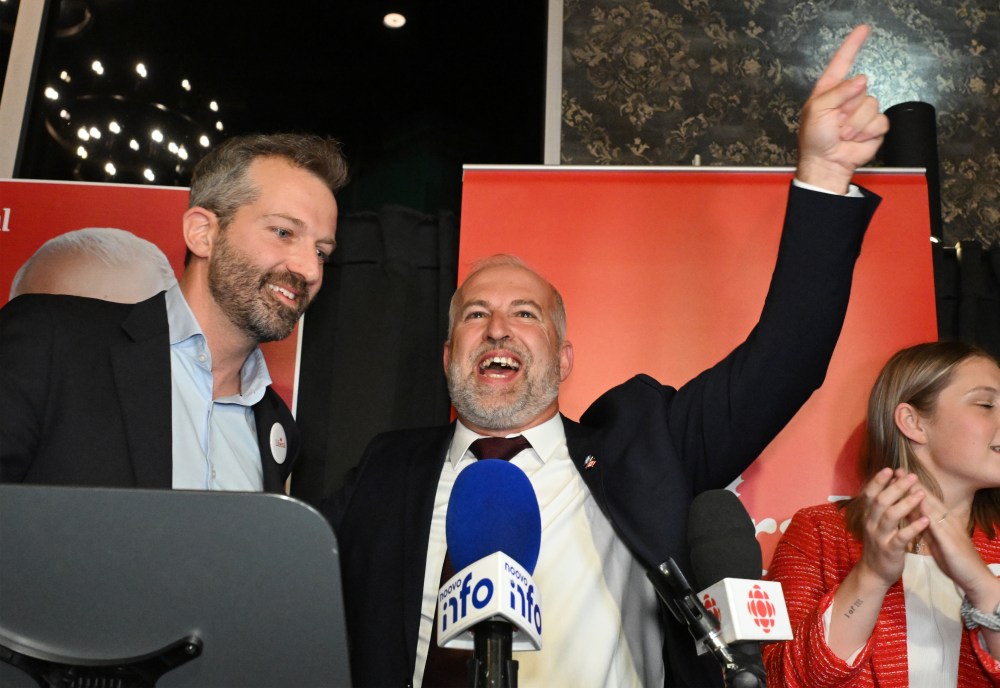
Ordinarily, byelections are not considered a reliable sign of overall government popularity. They tend to suffer from chronically low voter turnout, heavy protest voting and a complete lack of high-stakes general election dynamics.
But Monday night’s results moved the needle, particularly when it comes to Parliamentary control. The trio of wins moved the Liberals back up to 173 seats in the House of Commons — one seat more than required to keep the party’s majority.
The Liberals managed to claim more than 50 per cent of the voters in each of the three ridings — Tanveer Shahnawaz secured 55.7 per cent of the vote in Beaches-East York, Braeden Caley took North Vancouver-Capilano with around 58 per cent of the vote, and Quebec dairy farmer Daniel Gobeil flipped Chicoutimi-Le Fjord with 51.3 per cent. Not only did Conservative candidate Régis Gaudreault lose the Quebec riding on Monday night, support for the Conservatives dropped to 13 per cent from the 34 per cent they received in 2025, for a distant third place behind the Bloc Québécois’ 32.9 per cent.
These are exceedingly strong numbers across the country for the Liberals, a fact that gives Carney some political ballast as the Canada-U.S. trade war continues. Voters have signalled strong support for Carney’s decision to walk away from the negotiation table, and his government’s impending retaliatory tariffs against American imports.
In fact, much like what happened during the full federal election in April 2025, it’s quite clear that the external threat to Canada’s sovereignty from U.S. President Donald Trump’s ongoing tariff threats and aggressive rhetoric has unified voters to “rally around the flag.”
That phenomenon cannot be understated. The so-called “Trump Effect” is real, and has become a unifying threat for Canadian voters who look south with a mixture of anger and regret.
Of course, the public mood could change incredibly quickly if this trade war drags on, particularly if retaliatory measures lead to domestic layoffs, business closures and economic damage.
But for now, the Liberals are riding a wave of solid public support and Canadian resolve. And that support appears incredibly strong. A recent Angus Reid poll issued just last week suggests that three in four Canadians are endorsing the government’s decision to walk away from negotiations with the U.S. Even among those who voted Conservative in the 2025 federal election, half (53 per cent) said Carney was right to walk away rather than accept a bad deal.
Not only have a clear majority of Canadians decided to support the banker-in-chief, they have also chosen to reject Poilievre’s divisive campaign style during a time of national crisis.
And that leaves the Conservative leader having to face some serious and difficult discussions when Parliament returns on Sept. 21.
Since the 2025 spring election, Poilievre has been fighting an uphill battle inside a divided caucus, with a historic number of Conservative MPs choosing to desert the party entirely. The federal Tories have suffered a devastating exodus of MP talent, including four high-profile floor crossings directly to Carney’s Liberals. Other veteran MPs like Ontario’s Larry Brock and Saskatchewan’s Cathay Wagantall have opted to resign or retire early rather than continue to serve out their terms under Poilievre — Wagantall officially resigned from the House of Commons this past Monday.
And while no other floor crossings have taken place, there continue to be rumours of still other Conservative MPs looking to change political colours.
Frustration with Poilievre is mounting into a kind of quiet revolt, and the results of these byelections — particularly the voter collapse in Quebec — will have certain “safe” rural and blue-collar ridings currently held by Conservatives in a regional panic this week.
Again, this can all change in a heartbeat. Carney is clearly taking Canada into dangerous territory with his gamble of our collective futures in an game of economic chicken with Trump. Voters can be fickle when their pocketbooks and livelihoods begin to suffer, and we may see the effects of that sooner rather than later.
For all his troubles, Poilievre continues to have high-profile loyalists like Conservative House Leader Andrew Scheer, who publicly backs his leadership. And in political circles, that does count for something.
But unless he finds a way to change the narrative — and soon — MPs will increasingly view Poilievre as an electoral liability.