
Switch to daylight time creates needless hazard
Advertisement
Read this article for free:
or
Already have an account? Log in here »
We need your support!
Local journalism needs your support!
As we navigate through unprecedented times, our journalists are working harder than ever to bring you the latest local updates to keep you safe and informed.
Now, more than ever, we need your support.
Starting at $15.99 plus taxes every four weeks you can access your Brandon Sun online and full access to all content as it appears on our website.
Subscribe Nowor call circulation directly at (204) 727-0527.
Your pledge helps to ensure we provide the news that matters most to your community!
To continue reading, please subscribe:
Add Brandon Sun access to your Free Press subscription for only an additional
$1 for the first 4 weeks*
- Enjoy unlimited reading on brandonsun.com
- Read the Brandon Sun E-Edition, our digital replica newspaper
*Your next Free Press subscription payment will increase by $1.00 and you will be charged $20.95 plus GST for four weeks. After four weeks, your payment will increase to $24.95 plus GST every four weeks.
Read unlimited articles for free today:
or
Already have an account? Log in here »
“Not having the change in times twice a year is a good thing. But I think as we progress into the winter months and have prolonged periods of no sunlight in the morning … that might lead to issues with academics and depression.”
— Dr. Michael Mak, psychiatrist and sleep medicine specialist at the Centre for Addiction and Mental Health in Toronto.
When Premier Wab Kinew announced earlier this week that Manitoba will officially adopt permanent daylight time starting this November, it was framed as a democratic victory.
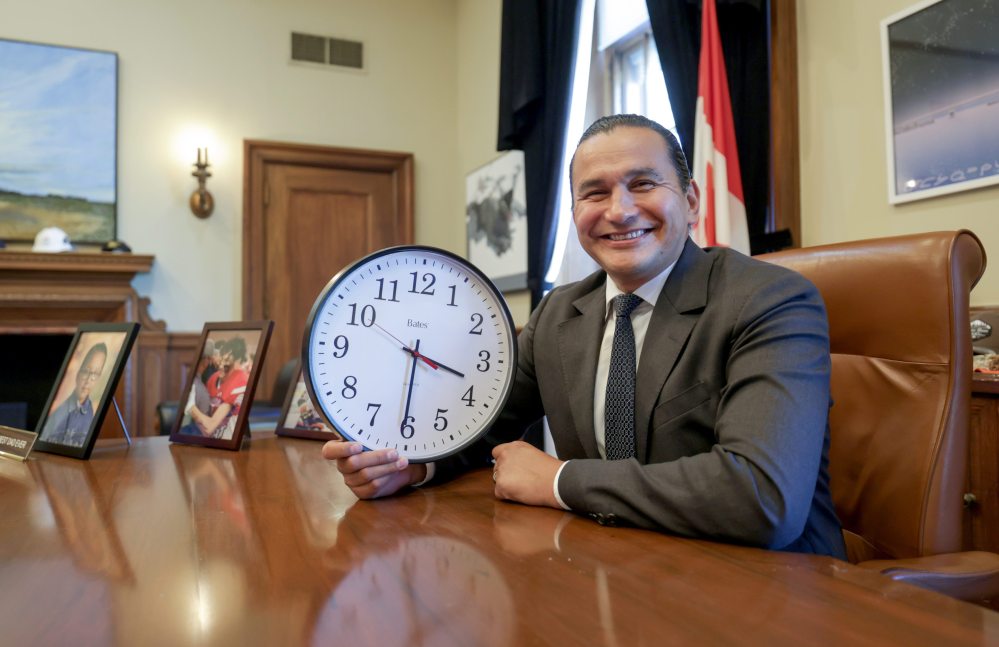
The government pointed to an online public consultation in which 92 per cent of respondents voted to end the biannual clock change. It certainly sounds decisive, until you look at the math and realize that most of the province was left out of the conversation.
Manitoba has a population of more than 1.4 million souls, with roughly 1.1 million of them of adult age. Yet the government’s decision hinges on an online survey that drew just 72,000 responses. Of those who participated, only 58 per cent specifically chose permanent daylight time.
So let’s be clear about what this means: a policy that fundamentally alters the daily lives of every single person in this province was decided by roughly 41,000 individuals. That’s about 3.8 per cent of Manitoba’s adult population.
To upend our entire time system based on such a tiny, self-selected sample isn’t just lazy governance, it’s reckless. Had a broader cross-section of Manitobans participated — particularly the thousands of exhausted parents rushing to get young children out the door every morning — the results likely would have looked very different.
Under permanent daylight time, the sun will not rise in Winnipeg or Brandon until nearly 9 a.m. during much of the winter. On Dec. 21, for example, the sun will rise over Brandon at around 9:35 a.m. and set at 5:40 p.m.
For parents of school-aged children, this is a potential nightmare. It means that all winter long, elementary and high school students will be forced to wake up, walk to the bus stop, navigate streets and arrive for their first-period classes in pitch-black darkness. As sleep advocate Dilk Salyn pointed out to a Winnipeg CTV reporter following the announcement, some children will even spend their first recess of the day playing in the dark.
By prioritizing a few thousand online survey votes, the government has completely ignored the physical reality of a northern winter.
We don’t disagree that an extra hour of evening light sounds wonderful on a warm June evening. But it offers zero comfort on January mornings when temperatures plummet and road conditions deteriorate.
The primary concern here is the acute danger to pedestrian and traffic safety when mornings go dark. Anyone who has driven a vehicle during a Manitoba winter knows that visibility can already be severely compromised. Blinding snow, frosted windows, ice-slicked pavement and unplowed snowbanks already make morning commutes treacherous. Now, add thousands of children walking to school or waiting at neighbourhood intersections in the freezing darkness of 8 a.m.
Young children are small, unpredictable and often difficult for drivers to spot in ideal conditions. Dressed in heavy winter parkas — which are rarely bright or reflective — they will be difficult for drivers to see as they navigate dark, icy residential streets. Dark mornings mean drivers are operating with compromised reaction times on slippery roads, drastically increasing the risk of tragic pedestrian accidents in school zones.
This isn’t just a Manitoba concern. When B.C. Premier David Eby announced last March that his province would move to permanent daylight time, critics argued that sleep patterns will be adversely affected, particularly for children and adolescents. Camosun College psychology instructor Dr. Michael Pollock told the Times Colonist earlier this year that the increased brain fog for school-aged kids in B.C. would lead to more morning vehicle and pedestrian crashes.
“I think it’s just going to be a disaster,” he said.
History has shown that attempts to eliminate twice-yearly time changes haven’t gone so well.
When the United States experimented with permanent daylight time in the winter of 1974, the experiment was cut short and wildly revoked after just a few months. Why? Because a rash of school children were struck and killed by vehicles during those pitch-black morning commutes.
Parents revolted, and the government was forced to pivot back to standard time.
Strictly speaking, there was no definitive statistical proof linking the student fatalities directly to permanent daylight time. But as any good political scientist will tell you, the facts don’t always prevent fear and anger from driving politics, particularly when the public is looking to place blame.
To be fair, based on what experts are saying this week, parental concerns in this regard are valid. Yet our Manitoba government is willingly walking into the exact same trap.
It’s also worth pointing out that this decision directly defies the medical community. Sleep scientists from organizations like the Canadian Sleep Society have repeatedly warned that the human body physiologically requires morning light to anchor our biological clocks. Depriving children of morning sun doesn’t just make them groggy. It disrupts their sleep cycles, impairs classroom performance and elevates the risk of seasonal depression.
Kinew said this move would mean “one less adjustment families have to deal with.” But by catering to a tiny group of survey participants, the government has traded a twice-yearly minor inconvenience for a permanent, unnecessary winter-long hazard.
And all of it based on what is arguably a flawed survey.
As Mak told the CBC this week, there may be a need to rethink this.