
Land purchase a step toward reconciliation
Advertisement
Read this article for free:
or
Already have an account? Log in here »
We need your support!
Local journalism needs your support!
As we navigate through unprecedented times, our journalists are working harder than ever to bring you the latest local updates to keep you safe and informed.
Now, more than ever, we need your support.
Starting at $15.99 plus taxes every four weeks you can access your Brandon Sun online and full access to all content as it appears on our website.
Subscribe Nowor call circulation directly at (204) 727-0527.
Your pledge helps to ensure we provide the news that matters most to your community!
To continue reading, please subscribe:
Add Brandon Sun access to your Free Press subscription for only an additional
$1 for the first 4 weeks*
- Enjoy unlimited reading on brandonsun.com
- Read the Brandon Sun E-Edition, our digital replica newspaper
*Your next Free Press subscription payment will increase by $1.00 and you will be charged $20.95 plus GST for four weeks. After four weeks, your payment will increase to $24.95 plus GST every four weeks.
Read unlimited articles for free today:
or
Already have an account? Log in here »
The joint purchase of the former Turtle Crossing Campground by the Province of Manitoba and the City of Brandon was a necessary step toward realizing the aims of the Truth and Reconciliation process here in western Manitoba.
For decades, a painful contradiction existed just five kilometres northwest of the city. While Indigenous communities grieved the children who never returned from the Brandon Indian Residential School, vacationers were camping, installing utilities and swimming directly adjacent to an unmarked burial site.
By stepping in to buy this land, governments have finally corrected a historical wrong, ensuring that the resting place of at least 56 children — possibly more — is protected, respected and never forgotten.
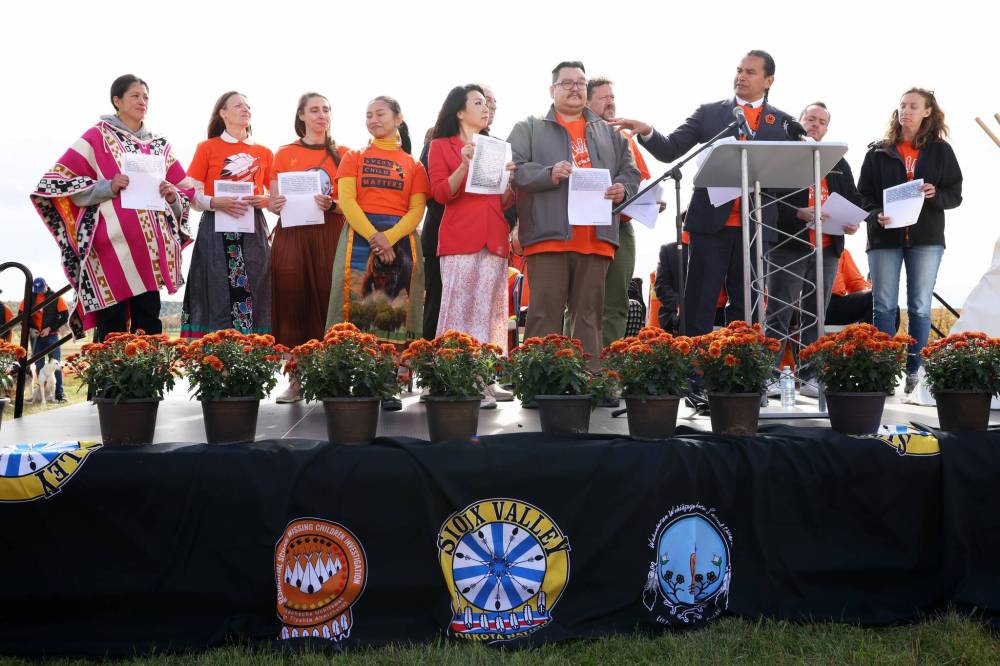
Premier Wab Kinew speaks about the historical record of children who died while at the Brandon Residential School during National Day for Truth and Reconciliation events at the site of the former school on Wednesday. (Tim Smith/The Brandon Sun)
The story of the Grand Valley Road property is a stark reminder of how easily history can be systematically erased.
The Brandon Indian Residential School operated between 1895 and 1972. And in that time, it required cemetery space near the Assiniboine River for children who died during their time at the facility.
Those who ran the Brandon Residential School took Indigenous children from their home communities in an attempt to assimilate them into European-Canadian society. Many of them were from northern reserve communities located far from the city of Brandon.
There is documented evidence that students lived in poor conditions, were made to perform manual labour on the school’s farm and frequently got sick and died from diseases such as tuberculosis.
Before the development of Turtle Crossing, the City of Brandon had decided to develop the land for recreational use. In the 1920s, the city leased land around the school to turn it into a park. Local residents would use the park for decades as a celebrated spot for sports and swimming, and it was even used for celebrations.
But in order to create the development, grave markers for the deceased students were removed and the location forgotten as the property changed hands.
In more recent years, research teams at the site, in conjunction with Sioux Valley Dakota Nation, have found indications of potentially up to 100 unmarked graves in the area that span over at least a few locations.
As Premier Wab Kinew noted in his address in Brandon this week, this is exactly what happens when memory is not actively preserved.
Leaving this land in private hands allowed the ongoing desecration of a cemetery, feeding into an era where residential school history is too often minimized or denied. Even this week, denialists on social media actively questioned the joint decision to buy the private property and hold it in trust, with posts stating that Indigenous people were lying and that there were “no bodies” buried at the site.
These callous denials ignore historic reality.
It has been public knowledge that children were buried near the Brandon Indian Residential School since at least the 1970s when a memorial was erected by local Girl Guides to commemorate them. And historic public records — although apparently incomplete — document the existence of a school cemetery.
Over the course of the school’s history, there were two cemeteries associated with the Brandon Residential School, though recent research suggested there were three potential locations.
As we reported in 2021, one of the locations is on land owned by the First Nation, one at the nearby Brandon Research and Development farm and one at what eventually became Turtle Crossing Campground.
Beyond the symbolic weight of the purchase of the property, the land’s transition out of private hands carries immense practical importance for Sioux Valley and its ongoing Missing Children Investigation.
It guarantees access for researchers, who previously faced immense hurdles accessing the site. There is a need for sustained, unrestricted physical access for a thorough investigation.
Archeologists on scene can now bring forth non-invasive tech, such as ground-penetrating radar and electromagnetic equipment, to help map the true boundaries of the cemetery. That work is already underway.
And the purchase allows for the reclamation of the land for the good of Indigenous survivors and their families, with an eye to finding some closure from generations of trauma.
The unveiling of the black granite monument — engraved with the names of dozens of impacted First Nations communities that span several provinces, including Manitoba, Ontario, Saskatchewan, Alberta, Quebec and Nunavut — serves as a permanent visual reminder of the need for public education and remembrance.
Though the long-term vision for the property has yet to be decided, the actions of the province and the City of Brandon show a genuine commitment to confronting the dark shadows of our community’s past.
And a hopeful step forward for all of us.