
Canada must prepare for U.S. election fallout
Advertisement
Read this article for free:
or
Already have an account? Log in here »
We need your support!
Local journalism needs your support!
As we navigate through unprecedented times, our journalists are working harder than ever to bring you the latest local updates to keep you safe and informed.
Now, more than ever, we need your support.
Starting at $15.99 plus taxes every four weeks you can access your Brandon Sun online and full access to all content as it appears on our website.
Subscribe Nowor call circulation directly at (204) 727-0527.
Your pledge helps to ensure we provide the news that matters most to your community!
To continue reading, please subscribe:
Add Brandon Sun access to your Free Press subscription for only an additional
$1 for the first 4 weeks*
- Enjoy unlimited reading on brandonsun.com
- Read the Brandon Sun E-Edition, our digital replica newspaper
*Your next Free Press subscription payment will increase by $1.00 and you will be charged $20.95 plus GST for four weeks. After four weeks, your payment will increase to $24.95 plus GST every four weeks.
Read unlimited articles for free today:
or
Already have an account? Log in here »
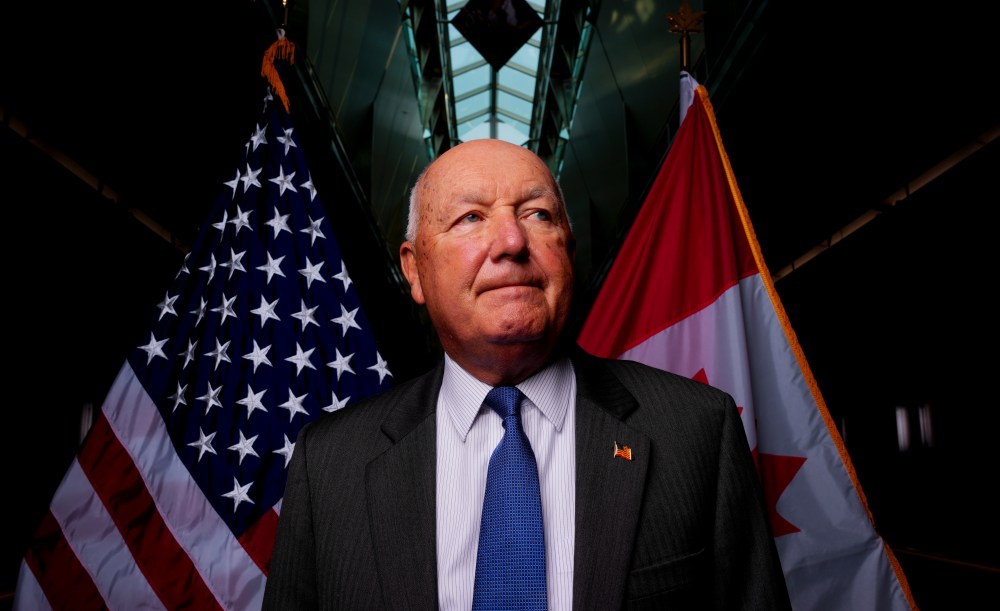
“We appreciate foreign-policy leaders coming into the United States and those types of things, but you know, keep your nose out of American politics. We’re monitoring it, we’re evaluating it, and if some of it becomes election interference, you know, then America will respond to it.”
— U.S. Ambassador to Canada Pete Hoekstra
We are cursed by interesting times.
And the November midterm elections in the United States should be particularly interesting — though not just for the Americans.
Trump Republicans may be in electoral trouble come November, and Canada may be an all-too-convenient scapegoat.
The warning from U.S. Ambassador Pete Hoekstra was not at all subtle — not that he has ever done subtle very well — but it was highly telling. As President Donald Trump’s approval ratings drag down Republican candidates across the United States, Washington Republicans are looking for anywhere else to point the finger.
And Canada, it seems, is the new and useful target.
Prime Minister Mark Carney walked Canada away from the negotiating table with the United States after being handed a last-minute poison pill toward the end of high-pressure trade negotiations last August.
In the wake of that action, the trade war — originally triggered by the Trump administration’s aggressive 50 per cent tariffs and import bans on Canadian goods — has sparked a fierce counter-offensive from Ottawa.
Canada’s strategic $20-billion retaliatory package was carefully designed to squeeze politically sensitive swing states — and it appears to be working. From Michigan to Maine, vulnerable Republican candidates are breaking ranks with their own president, feeling the acute economic pain of a trade war they clearly did not want.
But rather than acknowledging the predictable consequences of poorly thought out protectionist policies, the administration is trying to shift the blame. By framing Canada’s defence of its own economic interests as “election interference,” Washington is setting up a narrative to justify potential Republican losses.
During a podcast interview this week, Hoekstra explicitly called out Industry Minister Mélanie Joly, pointing to her past comments about applying targeted pressure to those specific battlegrounds.
His comments built upon those of White House trade adviser Peter Navarro, who stated during an economic conference in Washington last month that Canadian lobbyists need to “get the hell out of our country,” even while he further weaponized our fractured trade relationship.
“The problem you have is you lobby this country and you’ve been successful in the past and you think you can keep doing that,” Navarro said. “Memo to Canada: You cannot do that. That game is up, and if you interfere in our elections in Maine or Michigan, you will pay even more dearly.”
If the generic ballot and prediction markets hold true, and a sweeping Democratic wave takes the House and flips the Senate, Canada should expect to be cast as the primary antagonist in the Republicans’ post-election autopsy.
This week, Joly directly and firmly dismantled Hoekstra’s accusations while speaking to reporters in Ottawa. When asked if it was fair to suggest Canada was meddling, Joly responded, “Absolutely not, and would never do that, and we never accept that also being done to us in Canada.”
She clarified that her recent travels south of the border have been strictly about economic diplomacy, adding, “Fundamentally, what I’ve done in the U.S. is to attract investment. I think I’ll be able to have good news of investments by different American companies to Canada.”
Later, at a Globe and Mail fireside chat, Joly reinforced Canada’s boundaries by stating that she does not need to answer to the ambassador’s comments. And she reinforced the perception that it’s actually the United States that is interfering in Canadian affairs by meeting with separatist elements from Quebec and Alberta.
“We won’t get involved in internal politics in this country,” she said, “we don’t want them to.”
For Canadians, the stakes of this U.S. domestic battle could not be higher. A total flip in congressional control could fundamentally alter our economic reality, likely defusing the immediate trade war as a Democratic majority takes over key legislative committees.
We can hope it would bring a welcome return to predictability for Canadian steel, aluminum, and automotive sectors, among others.
But a cornered and targeted White House is a highly unpredictable animal. Stripped of domestic power, the Trump administration may well double down on its unilateral executive authority, using further punitive border measures, stalled trade negotiations and aggressive campaign-trail rhetoric to punish a neighbour that refuses to bend the knee.
Even this week, Trump renewed his “51st state” rhetoric during yet another political rally.
“They’ll end up being the 51st state because that’s the only way it works,” he said.
Protecting our jobs and industries means standing our ground and practising standard economic diplomacy, but we must also prepare for the potential fallout of an American administration looking to blame anyone else for its own electoral misfortunes.
Canadians need to be ready for what may come.