
A long and winding road
Advertisement
Read this article for free:
or
Already have an account? Log in here »
We need your support!
Local journalism needs your support!
As we navigate through unprecedented times, our journalists are working harder than ever to bring you the latest local updates to keep you safe and informed.
Now, more than ever, we need your support.
Starting at $15.99 plus taxes every four weeks you can access your Brandon Sun online and full access to all content as it appears on our website.
Subscribe Nowor call circulation directly at (204) 727-0527.
Your pledge helps to ensure we provide the news that matters most to your community!
To continue reading, please subscribe:
Add Brandon Sun access to your Free Press subscription for only an additional
$1 for the first 4 weeks*
- Enjoy unlimited reading on brandonsun.com
- Read the Brandon Sun E-Edition, our digital replica newspaper
*Your next Free Press subscription payment will increase by $1.00 and you will be charged $20.95 plus GST for four weeks. After four weeks, your payment will increase to $24.95 plus GST every four weeks.
Read unlimited articles for free today:
or
Already have an account? Log in here »
As theatre goes, Wab Kinew’s stand against the historically ill-conceived Indian Act sent a strong message.
There was the premier, standing in front of microphones and television cameras, holding up his Indigenous status card and saying that he didn’t feel Canada should have “a race-based form of identification in this country.”
Then he noted that this is the reality, and added that it was time to discard it, once and for all.
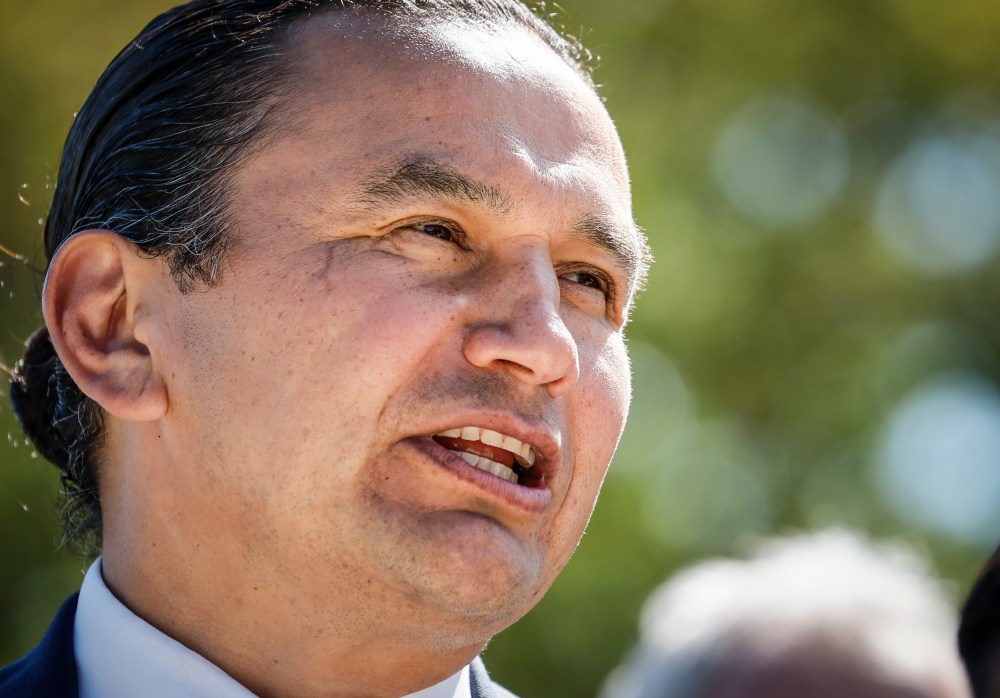
“I think it’s time to abolish the Indian Act, get rid of the Indian Act, move past the Indian Act, and it needs to be done with First Nations people and First Nations governments, of course. I think it’s long overdue that we have a relationship with Indigenous Peoples in Canada that reflects who we are as Canadians today,” he said.
The Indian Act — the name alone suggests how out-dated and out of place the law has been for so many years.
Originally dating from 1876, the law was put in place to “amend and consolidate the laws respecting Indians” and gave the Minister of the Interior the responsibility to “control and management of the reserves, lands, moneys and property of Indians in Canada.”
It enshrined in law — and still does, despite amendments over the years — different treatment for a racially-identified group.
Prime Minister Mark Carney has said he is “very open to” getting rid of the act.
“Not everybody, but other participants raised the desirability. So it’s already starting from the right place in that it’s not the federal government deciding something should be done. It’s responding to a request,” Carney said.
“I think this was the spirit of this meeting — certainly the spirit I took — the ability to sit down together and develop that co-development, gives me hope that we can we can finally move forward from this.”
But even among First Nations leadership there are differences of opinion about how changes to the Indian Act should be handled — and whether the Assembly of First Nations should be leading the process.
“First Nations must determine their own path toward self-determination. That cannot be a process designed in Ottawa and presented to our nations for approval. It must be developed with us, respect our treaty relationships and proceed only with our free, prior and informed consent,” Chief Pete Chief of the Onion Lake Cree Nation said in a media statement on Oct. 26. “But that future must be determined by First Nations themselves, not dictated by the federal government or negotiated on our behalf by organizations we have not authorized to represent us.”
Attempts have been made before to remove the act, but they have bogged down under the sheer weight and complexity of the range of different goals sought by the many different parties involved.
The first attempt was in 1969 by another Liberal prime minister — Pierre Trudeau and his Minister of Indian Affairs, Jean Chretien, who introduced the Statement of the Government of Canada on Indian Policy, also known as the White Paper.
First Nations leadership was fiercely opposed to it, viewing it as an attempt at forced assimilation rather than any kind of liberation or government respect for sovereign rights. First Nations leaders spent the next year organizing before publishing their own paper called Citizens Plus — also dubbed the Red Paper — emphasizing the importance of treaties and the distinct rights of First Nations.
While the Red Paper heavily criticized the Indian Act and it’s paternalistic treatment of Indigenous people, it also concluded that it was “neither possible nor desirable to eliminate the Indian Act.”
That statement now more than five decades old, should serve as a warning to those who would move too quickly and carelessly into forcing the act’s replacement or outright abolishment.
With more than 630 recognized First Nations in Canada, opening the door to changing or outright eliminating the Indian Act would create an epic tangle that can only be undone with great care and careful attention.
The temptation may be to address this knot the way that Alexander the Great was mythologized to have used to untie the legendary Gordian Knot — by simply cutting through its tightly-tied twists and turns with the edge of his sword.
But that would be a colossal mistake.
Dramatic gestures like Kinew’s are only the very start of what should be a broad range of consultations and negotiations between the federal government, First Nations leadership, and First Peoples themselves.
To be fair, Kinew said that too.
It will be difficult and complex — much akin to opening up the Canadian constitution. Considering the disaster that was the failed Charlottetown Accord in 1992, it’s easy to see how this could all go so badly wrong.
But that doesn’t mean it shouldn’t be attempted.
While holding up a status card and calling for change may be a great way to focus attention on the issue, it is only the latest beginning of what has been, and will be, a very long — and necessary — process.
» Winnipeg Free Press and The Brandon Sun