
Balance crucial to fixing province’s staffing woes
Advertisement
Read this article for free:
or
Already have an account? Log in here »
We need your support!
Local journalism needs your support!
As we navigate through unprecedented times, our journalists are working harder than ever to bring you the latest local updates to keep you safe and informed.
Now, more than ever, we need your support.
Starting at $15.99 plus taxes every four weeks you can access your Brandon Sun online and full access to all content as it appears on our website.
Subscribe Nowor call circulation directly at (204) 727-0527.
Your pledge helps to ensure we provide the news that matters most to your community!
To continue reading, please subscribe:
Add Brandon Sun access to your Free Press subscription for only an additional
$1 for the first 4 weeks*
- Enjoy unlimited reading on brandonsun.com
- Read the Brandon Sun E-Edition, our digital replica newspaper
*Your next Free Press subscription payment will increase by $1.00 and you will be charged $20.95 plus GST for four weeks. After four weeks, your payment will increase to $24.95 plus GST every four weeks.
Read unlimited articles for free today:
or
Already have an account? Log in here »
When so-called government “efficiencies” are applied with a blunt instrument, they often fail to deliver the results the public needs.
Finding a budgetary balance sheet that works is one of the toughest jobs in politics, and for years, the debate in Manitoba has swung between two partisan extremes — deep public-service cuts on one side, and unchecked bureaucratic growth on the other.
While it is easy for political campaigns to focus entirely on head counts, the real measure of a government’s success is not how many people are on the payroll, but where those people are deployed.
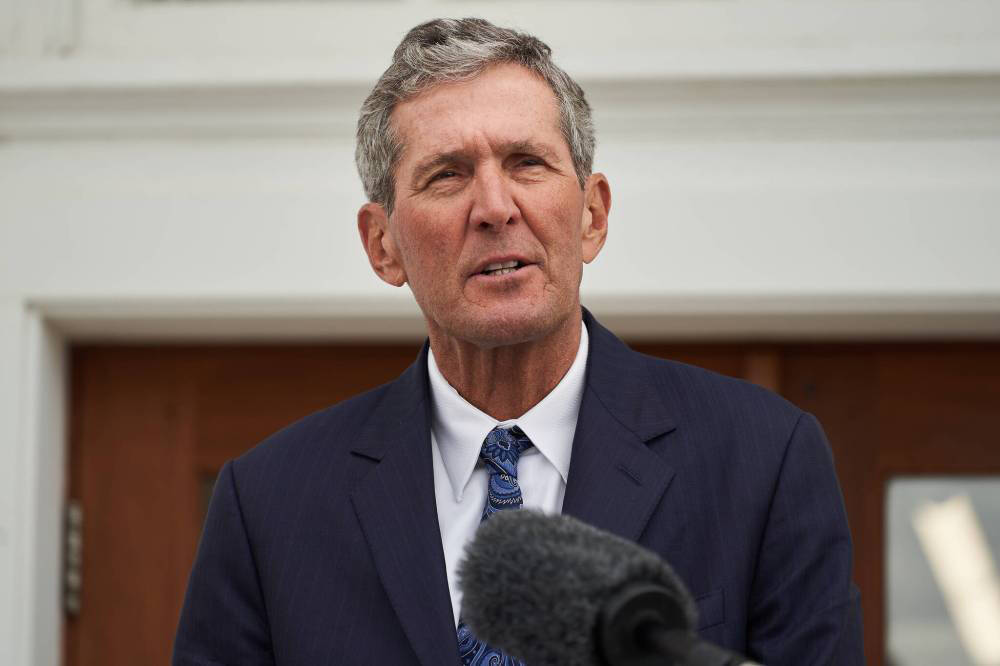
Former Manitoba premier Brian Pallister makes an announcement in August 2021 during one of his last public appearances. (File)
The province is currently wrestling with notable vacancy rates in several key sectors, the result of the Brian Pallister government’s strict austerity measures of the late 2010s.
When they first came to power in 2016, the Progressive Conservatives vowed to reduce the civil service by 1,200 positions — though by 2020 that number swelled to more than 2,500 cut positions, a reduction of more than 16 per cent according to the civil service commission’s annual report for 2020.
The Winnipeg Free Press reported this week that the public service continues to struggle with recruitment and retention. As of the end of March, figures from the Manitoba Government and General Employees’ Union suggest 2,203 full-time equivalent positions remained vacant. One rather extreme example showed that nearly 20 per cent of equipment operator positions in the province — 73 out of 379 — are vacant, according to a freedom of information request obtained by the MGEU.
When critical front-line positions are left vacant, the consequences are immediate and visible to every Manitoban.
Fewer people on the ground means snowplows take longer to clear major highways, health-care wait times remain lengthy, and infrastructure projects may be delayed. Front-line workers face burnout, institutional knowledge evaporates, and recruitment lags behind the private sector. It’s fair to say that the province cannot succeed if it lacks the hands required to deliver the core services that Manitobans rely upon.
But there is a distinct difference between hiring a heavy equipment operator to keep Manitoba’s winter roads safe and adding further layers of administrative middle management. While the front-line workers directly impact public safety and the province’s economy, larger bureaucracies tend to slow the work of government by increasing red tape, and force a heavier burden on the taxpayers who fund the system.
A large public service is not really a sign of economic health. It’s a direct cost. Excessive public sector growth can drag down the province’s economy.
Every dollar spent maintaining an over-inflated, top-heavy bureaucracy is a dollar taken out of the pockets of working families — or worse, a dollar diverted away from infrastructure projects that are needed across the province.
There is a need to avoid blind partisanship here. Recall why past fiscal corrections were initiated in the first place. Prior to Pallister’s austerity era, years of unchecked expansion under the governments of Gary Doer and Greg Selinger had left Manitoba facing structural deficits, rising taxes and a top-heavy system. The cuts that came after were deep — too deep for a growing province. But the solution to past over-correction is not to return to an era of unmonitored growth.
True efficiency isn’t about blind cost-cutting, nor is it about throwing warm bodies at every systemic issue. A modern public service should use the tools in hand — innovation, technology, and workflow improvements — so it can do more where it counts on the ground.
It’s worth noting that the most recent incarnation of the NDP seems to be following this playbook. The Kinew government has promised to clean up a sizable fiscal deficit, with Finance Minister Adrien Sala doubling down on his promise to balance Manitoba’s books before the next provincial election.
And one of the ways to control spending and cut the deficit without announcing unpopular layoffs is by leaving non-essential bureaucratic positions unfilled, and allowing natural attrition to thin out office staff. In spite of the hiring difficulties it may be facing, the fact that the provincial civil service has grown marginally between 2023 and 2026 — from 11,893 employees to 12,710 this year — suggests there is at least some effort by the province to keep those costs down.
At the same time, the province has deliberately prioritized front-line health care in Manitoba, pouring its resources into nurses, doctors and other health-care workers to shore up a system that has been under duress. That, too, has come at both a financial and a human cost.
The goal for Manitoba should not be to simply return to historical staffing peaks to score political points. Nor should we force current staff into burnout mode because we’re not hiring enough personnel where they’re needed most.
The province needs a disciplined, targeted approach. Protect and properly staff our critical, public-facing roles to keep the province safe and healthy, while exercising continued restraint over administrative growth.
By striking this balance, the province can ensure that Manitobans get the services they need, when they need them, without compromising the economic future of the province.