
Easter traditions evolving in Latin America
Advertisement
Read this article for free:
or
Already have an account? Log in here »
We need your support!
Local journalism needs your support!
As we navigate through unprecedented times, our journalists are working harder than ever to bring you the latest local updates to keep you safe and informed.
Now, more than ever, we need your support.
Starting at $15.99 plus taxes every four weeks you can access your Brandon Sun online and full access to all content as it appears on our website.
Subscribe Nowor call circulation directly at (204) 727-0527.
Your pledge helps to ensure we provide the news that matters most to your community!
To continue reading, please subscribe:
Add Brandon Sun access to your Free Press subscription for only an additional
$1 for the first 4 weeks*
- Enjoy unlimited reading on brandonsun.com
- Read the Brandon Sun E-Edition, our digital replica newspaper
*Your next Free Press subscription payment will increase by $1.00 and you will be charged $20.95 plus GST for four weeks. After four weeks, your payment will increase to $24.95 plus GST every four weeks.
Read unlimited articles for free today:
or
Already have an account? Log in here »
Hey there, time traveller!
This article was published 31/03/2018 (2957 days ago), so information in it may no longer be current.
Easter is a major celebration in Canada due to its majority Christian population.
So it is in Latin America, but in my experience, Latin Americans have very different and unique traditions. I am going to share some of the Costa Rican traditions here, but they are very similar to the rest of Spanish-speaking countries in the region.
• Religious tradition: In Latin America, the preferred words for this time of the year are Semana Santa, or Holy Week. Latin Americans don’t know about bunnies or eggs. According to censuses, the majority of Latin Americans belong to the Catholic Church and secondly to other evangelical denominations, though in recent decades the number of religious people is rapidly decreasing.
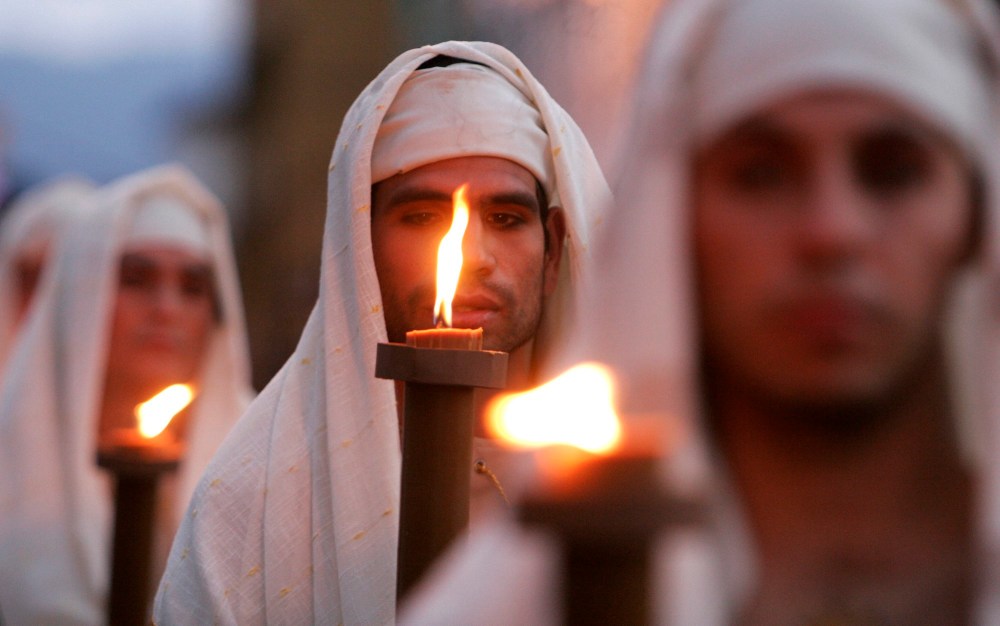
This week remains as the main Christian celebration together with the Christmas season. The Catholic Church organizes fancy and pompous processions and special masses. Many adults and children compete to be selected to represent apostles, Jesus, Marías and Josés or Roman soldiers during the many parades.
These processions happen every day during the week with a different topic each day. The most attended are on the Palm Sunday, when Jesus enters the town riding a donkey, and the “holy funeral” on Friday. People dress up as if attending a funeral and walk slowly behind a mock funeral for Jesus. On “resurrection Sunday,” people are happy to celebrate Jesus’ return.
All these processions have live musicians who usually ride on a truck and play several traditional tunes. The parades are widely attended and people enjoy seeing the different outfits, colorful displays and carriages and listening to religious leaders speeches.
• Food traditions: According to tradition, no meat is supposed to be consumed during Holy Week. It became a tradition to eat seafood during this week. Seafood restaurants and products thrive during this time of the year. People enjoy ceviche, a raw fish dish made with lime juice, cilantro, onion and garlic. It’s also common to be treated to rice with shrimp, fish soup and tuna dishes.
Grandmothers tell their grandkids about the dangers of eating meat: You can wake up next morning with fish scales on your skin or looking like a fish.
Many sweets are cooked specially and only during this week. The most famous in Costa Rica is miel de chiverre. Chiverre is a huge squash that looks like a spaghetti squash but is much bigger. The squash is cooked and drained. Its ribbons or strands are then cooked with sugar cane honey and spices such as cinnamon, clove and nutmeg. It is served as a dessert or put into patties called empanadas de chiverre. The same procedure is done with coconuts to achieve miel de coco.
It is also a tradition to bake any kind of bread, normally sweet varieties.
These foods are offered to the whole family, but especially to visitors, who would subsequently form an opinion about the best miel or the best bread consumed this year.
• Alcohol: According to tradition, no alcohol should be consumed during the week. This has changed over the years for two reasons. People use the holidays to party, and the non-religious population is growing. In the past, local and national laws prevented liquor stores, bars and restaurants from selling alcohol. People managed to work around the laws either by stocking lots of alcohol before the dry law was in place during the week, or by creating illegal alcohol locals in the neighbourhoods were people would get together to have a “holy drink.”
Today, the national government does not enforce a dry law and it leaves the decision on whether on alcohol sales to local governments. Out of 82 municipalities, only 17 decided to ban alcohol this year.
• Vacation time: Religious leaders proclaim that the week is one of contemplation, rest and introspection. According to them, it should be a time for staying at home with your family while studying the Bible.
The problem is that in a tropical country, it is also one of the peak vacation weeks. Some government and private organizations give the whole week to their employees as a holiday, while others give employees Wednesday to Sunday off.
Most public offices are closed for the entire week. Some banks and public hospitals, however, are open from Monday to Wednesday only.
Transportation services are reduced, including train service, which is suspended until the following Monday. Commerce not related to tourism comes to a halt on Holy Thursday and Good Friday.
Entire families take advantage of that and travel to the many beautiful beaches for the whole week or at least for a couple of days. Weather-wise, the holy week is one of the best times to do it since summer is on its peak and the sun will be up with little or no rain.
» Jaime Chinchilla is part of Brandon’s Latin American community and a member of the popular Son Latino Band. His column appears monthly.