
Vine Lines: Big reds for those who like some oomph
Advertisement
Read this article for free:
or
Already have an account? Log in here »
We need your support!
Local journalism needs your support!
As we navigate through unprecedented times, our journalists are working harder than ever to bring you the latest local updates to keep you safe and informed.
Now, more than ever, we need your support.
Starting at $15.99 plus taxes every four weeks you can access your Brandon Sun online and full access to all content as it appears on our website.
Subscribe Nowor call circulation directly at (204) 727-0527.
Your pledge helps to ensure we provide the news that matters most to your community!
To continue reading, please subscribe:
Add Brandon Sun access to your Free Press subscription for only an additional
$1 for the first 4 weeks*
- Enjoy unlimited reading on brandonsun.com
- Read the Brandon Sun E-Edition, our digital replica newspaper
*Your next Free Press subscription payment will increase by $1.00 and you will be charged $20.95 plus GST for four weeks. After four weeks, your payment will increase to $24.95 plus GST every four weeks.
Read unlimited articles for free today:
or
Already have an account? Log in here »
Hey there, time traveller!
This article was published 24/11/2012 (4922 days ago), so information in it may no longer be current.
I love big red wines.
And by big, I mean full-bodied, with intense aromas and flavours. I like my reds strong. I like them aggressive. I want them to attack my taste buds until those little suckers cry out for mercy.
But there’s a contradiction here. (Not about liking big reds. That’s a given.) I like two versions of these wines. The edgy, gutsy, heavily tannic types, which I usually drink more slowly because there’s so much there to taste. However, I also love the round, smooth, still-deep-but-elegant ones which are so easy too easy, in fact — to sip.
My go-to red is usually the lovely J. Lohr Cabernet Sauvignon from California. I don’t like the price — $20.48 a bottle but it’s consistent, which is a bonus, and it’s wonderful to savour on its own. Yet with its deep well of berry flavours, it stands up as a match to many red meats, particularly beef. Incidentally, if you like your red wines chilled (and I do, to old-world cellar temperature about 16 to 18 degrees — as opposed to room temperature, which at my house is 23 degrees), try the J. Lohr after it’s sat in the fridge for about half an hour. It’s still pliable, but cooler, it’s not quite so soft, and I definitely prefer it that way.
Anyway, back to the issue at hand. I’ve recently discovered, and in one case, rediscovered, some reds that are really worth checking out if you’re a fan of big, dry red wines. Trust me that these ones aren’t for the faint of heart, or the delicate of palate.
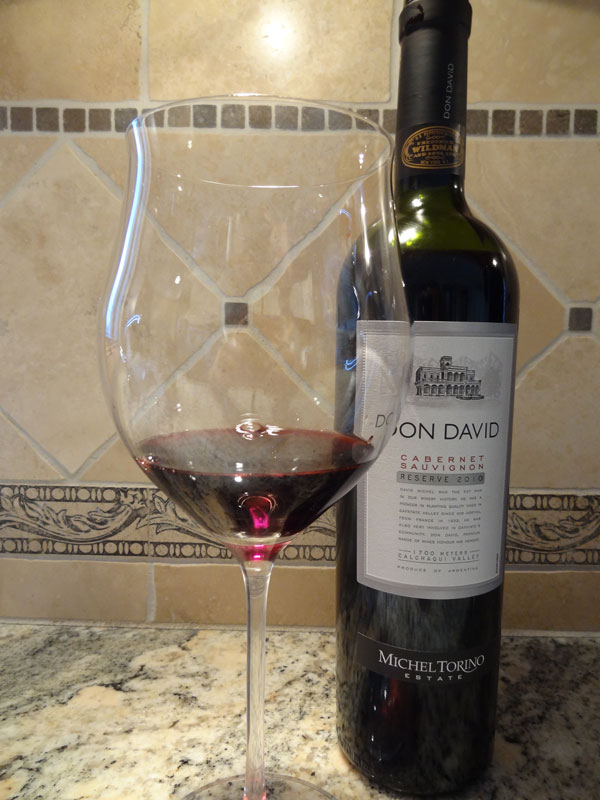
First up, the Don David Cabernet Sauvignon. I was knocked out a few months back when a friend brought over a bottle of Argentinian wine, Michel Torino’s Don David Tannat, a very dry varietal that was chock full of black currant and black cherry aromas and flavours, with some plum and a sniff of oak thrown in for good measure. It was dry and ballsy, and I liked it so much I went out and bought three bottles the next day.
But when I got to the Liquor Mart, I found that the Don David label also adorned a Malbec and a Cabernet. Rarely a Malbec fan, I left that one on the shelf. But after being so enamoured by the Tannat, I had to give the Don David Cab a try. And all three the Tannat, the Malbec and the Cab — sell for $13.26 a bottle.
Anyway, my reaction to the Don David Cab was pretty much the same as it was to the Tannat.
“Excellent,” said I, my face almost puckering at the delectable dryness of it all.
A stereotypical Cab, with the expected black fruit, pinch of spice and hint of oak, this is not really a sipping wine. I find it’s always fun — and obviously, more accurate — to try a wine on its own in order to identify the flavours and the specific characteristics that make it either appealing or not. But with a deep, heavy, edgy beverage like this, once those features are determined, it’s best to move on to enjoying it with food.
And the Don David Cab, like most Cabernet Sauvignons, is a great pairing for beef. Steak, prime rib, short ribs, even hamburgers are all perfect matches for this wine. It also works well with intensely tomato-sauced Italian foods, like a spicy lasagne or meat-lovers pizza.
So it’s certainly worth a try, especially given the price, as long as big dry reds are your thing.
In keeping with that, I once had a close pal describe the revisiting of a long-forgotten or long-unpartaken of wine as “a visit with an old friend.” I’ve loved that metaphor ever since she uttered it, and that was what first sprang to mind when, at a dear friend’s Thanksgiving luncheon, I tried the Wolf Blass Yellow Label Cabernet Sauvignon from Australia for the first time in years. And I mean years — at least eight or 10, I would think.
Anyway, I had always liked this wine, but as sometimes happens, it had slipped from my consciousness when other lovely Cabernets came my way. I honestly don’t know how that happened, given that the Wolf Blass Yellow Label products are always prominently displayed on Liquor Mart shelves, and the collection of all those wines forms what equates to a bank of yellow that could probably be seen from outer space, albeit with a special lens. But I digress.
Since the entrée at this catered Thanksgiving bash was roast beef, our hostess very sensibly provided the Blass Yellow Label Cab as one of the choices to accompany the meat. And although I’d taken a lovely Shiraz, because I thought that’s what many red wine fans in the company preferred, I couldn’t wait to try the Blass Cab again.
I’m not really sure what I was expecting. I’d known this wine well all those years ago, and I didn’t expect it had changed all that much. But perhaps the game-changer was that I had. Changed, that is. And consequently, I think I appreciated the Yellow Label even more.
Again, it’s not really a sipping wine — it has the usual Cabernet Sauvignon characteristics referred to above, but it’s at its best with food. And believe me, while the beef from the Komfort Kitchen was delicious and I enjoyed it a lot, the Blass Yellow Label Cab paired with it was what made this meal extra-memorable. The price of the Blass is $16.99 for a 750 ml bottle, or you can save 99 cents and get 1.5 litres for $32.99.
Anyway, these two Cabs are tasty, great with food and deliver plenty of bang for your buck. Enjoy! I’ll be pouring and chatting about wine from 3 to 5 this afternoon at The Green Spot. What a uniquely beautiful setting in which to enjoy a glass or two! Check The Green Spot’s website to see how you can qualify to join me. Hope to see you there!