
Dog attack prompts calls for increased animal control
Advertisement
Read this article for free:
or
Already have an account? Log in here »
We need your support!
Local journalism needs your support!
As we navigate through unprecedented times, our journalists are working harder than ever to bring you the latest local updates to keep you safe and informed.
Now, more than ever, we need your support.
Starting at $15.99 plus taxes every four weeks you can access your Brandon Sun online and full access to all content as it appears on our website.
Subscribe Nowor call circulation directly at (204) 727-0527.
Your pledge helps to ensure we provide the news that matters most to your community!
To continue reading, please subscribe:
Add Brandon Sun access to your Free Press subscription for only an additional
$1 for the first 4 weeks*
- Enjoy unlimited reading on brandonsun.com
- Read the Brandon Sun E-Edition, our digital replica newspaper
*Your next Free Press subscription payment will increase by $1.00 and you will be charged $20.95 plus GST for four weeks. After four weeks, your payment will increase to $24.95 plus GST every four weeks.
Read unlimited articles for free today:
or
Already have an account? Log in here »
Hey there, time traveller!
This article was published 29/02/2024 (944 days ago), so information in it may no longer be current.
WINNIPEG — The mother of a woman severely bruised and cut after being mauled by a pack of dogs says the attack has made her daughter terrified to sleep at night.
“She slept with me last night and she was crying in her sleep. She’s traumatized,” said the mom, who agreed to speak to the Winnipeg Free Press anonymously.
“She’s still sore, her body is covered in bruises and bites from the shoulders right to her feet.”
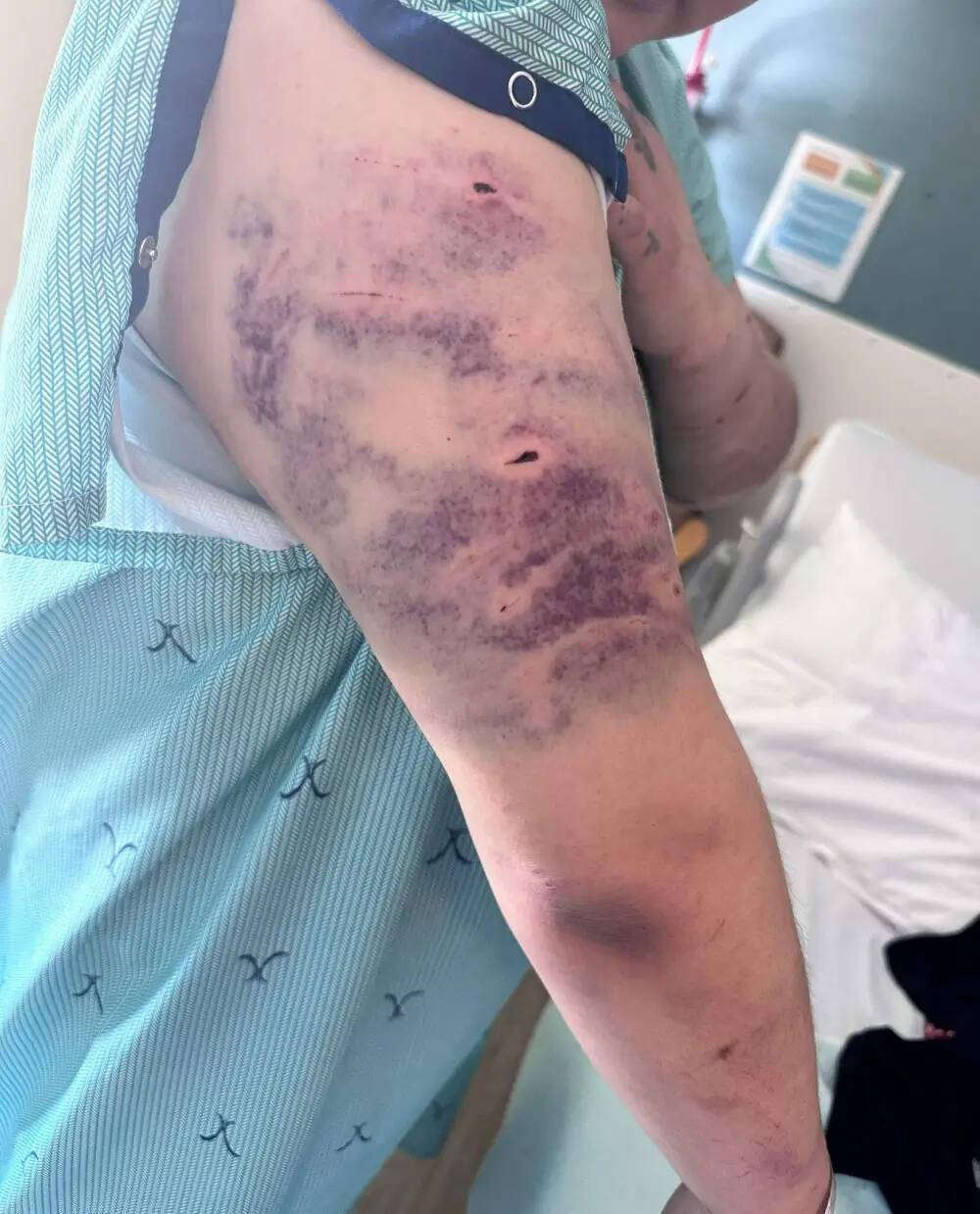
A woman, 22, was mauled by six dogs on Waywayseecappo First Nation. (Submitted)
The victim, 22, was walking to visit a friend on the Waywayseecappo First Nation, located about 150 kilometres northwest of Brandon, early Saturday when she was mauled by six dogs, her mother said.
The attack highlights the need for increased animal control in remote communities; the victim called on pet owners to properly feed, care for and manage their dogs.
“They were barking at her. One dog started the attack by biting her ankle and the other dogs jumped in,” the mother said, describing how the pack dragged her daughter into the ditch as they ripped at her clothing and flesh.
The attack lasted up to 10 minutes, ending only when people heard the woman scream and rushed over to scare the dogs away.
The Manitoba First Nations Police Service confirmed the attack occurred around 4 a.m. The victim was taken to the health centre in Russell.
Her wounds included two punctures that required stitches, her mother said, adding that the dogs were owned by somebody in the community.
A news release issued after the attack said First Nation safety officers and police went to a home in the community where they found three of the dogs. Safety officers seized two of the animals and killed a third dog.
MFNP Insp. Darryl Hunter confirmed Tuesday a fourth dog involved had been identified.
The dogs were turned over by the owner(s) to an animal control officer, who will determine what will become of the animals according to the local bylaws, he said.
The community’s animal control bylaw says dog owners are not allowed to own more than one dog and are held “responsible and liable for any and all damages caused by that dog to any person, or personal or real property.”
If an animal control officer captures a dog and it is not claimed within five days of notification, the officer may sell, place the animal up for adoption or have it euthanized, the bylaw says.
It also states anybody on the First Nation is permitted to kill a dog that is actively chasing or attacking a person.
Waywayseecapo’s MFNP detachment commander has met with community leadership regarding the incident, and they have drafted changes to the local dog bylaw, Hunter said, adding, “Overall, there is not a huge concern regarding strays in the community.”
The police inspector did not elaborate on what changes were made to update the bylaw, deferring requests for comment to the chief and council.
Chief Murray Clearsky was not available for an interview Tuesday, staff at the band office said.
Animal advocates say many Manitoba First Nations have a high number of dogs that are not spayed or neutered.
While some have animal control bylaws and services that are enforced, others do not. As a result, said Winnipeg Animal Services general manager Leland Gordon, Manitoba has so many strays that rescue organizations often have to ship them out of province to other jurisdictions.
The city operates a northern outreach program to rescue healthy, non-aggressive dogs from remote communities.
Last year, it was only able to accept seven such animals, owing to limited capacity in Winnipeg facilities.
The initiative, which was launched around 2018, offers a free three-day course to help community leaders develop animal control bylaws and welfare programs. Since its inception, only one community — Norway House Cree Nation — has participated, Gordon said.
Investigations in the wake of attacks should determine whether the dogs were responsibly owned and cared for, or if they were allowed to run loose in the community in packs.
“You have this ongoing cycle of overpopulation and high volumes of dogs that aren’t being cared for, and then once in a while you see a tragic story where somebody’s been attacked,” he said.
“The solution is that all levels of government, from the local chiefs and council to the provincial and federal government, need to work together to improve the safety of the community.”
The NDP has promised to expand mobile spay and neuter clinics.
Agriculture Minister Ron Kostyshyn reiterated the pledge this month, after Roseau River First Nation allowed a member to cull the dog population.
Jessica Miller, chief executive officer of the Winnipeg Humane Society, said her organization will meet with Kostyshyn next week to discuss its mobile spay and neuter clinic.
The government committed $750,000 toward the program in 2022.
» Winnipeg Free Press