
1st moon crew in 50 years includes woman, Black astronaut
Advertisement
Read this article for free:
or
Already have an account? Log in here »
We need your support!
Local journalism needs your support!
As we navigate through unprecedented times, our journalists are working harder than ever to bring you the latest local updates to keep you safe and informed.
Now, more than ever, we need your support.
Starting at $15.99 plus taxes every four weeks you can access your Brandon Sun online and full access to all content as it appears on our website.
Subscribe Nowor call circulation directly at (204) 727-0527.
Your pledge helps to ensure we provide the news that matters most to your community!
To continue reading, please subscribe:
Add Brandon Sun access to your Free Press subscription for only an additional
$1 for the first 4 weeks*
- Enjoy unlimited reading on brandonsun.com
- Read the Brandon Sun E-Edition, our digital replica newspaper
*Your next Free Press subscription payment will increase by $1.00 and you will be charged $20.95 plus GST for four weeks. After four weeks, your payment will increase to $24.95 plus GST every four weeks.
Read unlimited articles for free today:
or
Already have an account? Log in here »
Hey there, time traveller!
This article was published 03/04/2023 (1269 days ago), so information in it may no longer be current.
NASA on Monday named the four astronauts who will fly around the moon late next year, including the first woman and the first African American assigned to a lunar mission.
The first moon crew in 50 years — three Americans and one Canadian — was introduced during a ceremony in Houston, home to the nation’s astronauts as well as Mission Control.
“This is humanity’s crew,” said NASA Administrator Bill Nelson.
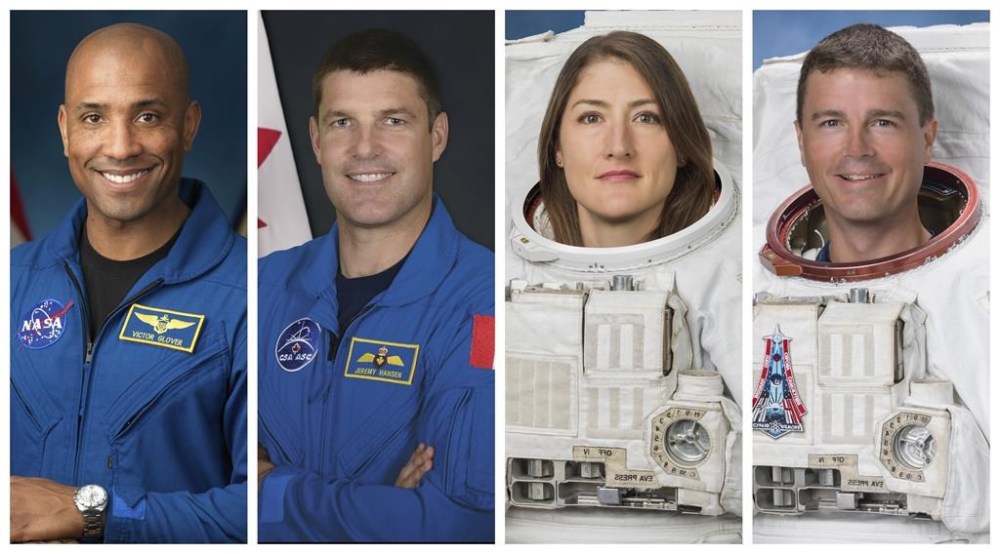
The four astronauts will be the first to fly NASA’s Orion capsule, launching atop a Space Launch System rocket from Kennedy Space Center no earlier than late 2024. They will not land or even go into lunar orbit, but rather fly around the moon and head straight back to Earth, a prelude to a lunar landing by two others a year later.
The mission’s commander, Reid Wiseman, will be joined by Victor Glover, an African American naval aviator; Christina Koch, who holds the world record for the longest spaceflight by a woman; and Canada’s Jeremy Hansen, a former fighter pilot and the crew’s lone space rookie. Wiseman, Glover and Koch have all lived on the International Space Station. All four are in their 40s.
“This is a big day. We have a lot to celebrate and it’s so much more than the four names that have been announced,” Glover said.
This is the first moon crew to include someone from outside the U.S. — and the first crew in NASA’s new moon program named Artemis after the twin sister of mythology’s Apollo. Late last year, an empty Orion capsule flew to the moon and back in a long-awaited dress rehearsal.
“Am I excited? Absolutely,” Koch said to cheers from the crowd of schoolchildren, politicians and others. “But my real question is: ‘Are you excited?’ ” she said to more cheers.
The Canadian Space Agency snagged a seat because of its contributions of big robotic arms on NASA’s space shuttles and the space station. One is also planned for the moon project.
Hansen said he’s grateful that Canada is included in the flight.
“We are going to the moon together. Let’s go!” he said.

During Apollo, NASA sent 24 astronauts to the moon from 1968 through 1972. Twelve of them landed. All were military-trained male test pilots except for Apollo 17’s Harrison Schmitt, a geologist who closed out that moonlanding era alongside the late Gene Cernan.
Provided this next 10-day moonshot goes well, NASA aims to land two astronauts on the moon by 2025 or so.
NASA picked from 41 active astronauts for its first Artemis crew. Canada had four candidates. Almost all of them took part in Monday’s ceremony at Johnson Space Center’s Ellington Field, a pep rally of sorts that ended with Wiseman leading the crowd in a chant.
President Joe Biden spoke with the four astronauts and their families on Sunday. In a tweet Monday, Biden said the mission “will inspire the next generation of explorers, and show every child — in America, in Canada, and across the world — that if they can dream it, they can be it.”
___ The Associated Press Health and Science Department receives support from the Howard Hughes Medical Institute’s Science and Educational Media Group. The AP is solely responsible for all content.