
1982 BRIER — Part 4: Determining a champion
1982 Labatt Brier Retrospective
Advertisement
Read this article for free:
or
Already have an account? Log in here »
We need your support!
Local journalism needs your support!
As we navigate through unprecedented times, our journalists are working harder than ever to bring you the latest local updates to keep you safe and informed.
Now, more than ever, we need your support.
Starting at $15.99 plus taxes every four weeks you can access your Brandon Sun online and full access to all content as it appears on our website.
Subscribe Nowor call circulation directly at (204) 727-0527.
Your pledge helps to ensure we provide the news that matters most to your community!
To continue reading, please subscribe:
Add Brandon Sun access to your Free Press subscription for only an additional
$1 for the first 4 weeks*
- Enjoy unlimited reading on brandonsun.com
- Read the Brandon Sun E-Edition, our digital replica newspaper
*Your next Free Press subscription payment will increase by $1.00 and you will be charged $20.95 plus GST for four weeks. After four weeks, your payment will increase to $24.95 plus GST every four weeks.
Read unlimited articles for free today:
or
Already have an account? Log in here »
Hey there, time traveller!
This article was published 12/08/2022 (1392 days ago), so information in it may no longer be current.
As Newfoundland’s Mark Noseworthy and New Brunswick’s Charlie Sullivan geared up for their tiebreaker matchup at the 1982 Labatt Brier on the evening of Friday, March 12, Mel Logan and his Manitoba teammates weren’t in the Keystone Centre.
Instead, Logan, third Doug Armour, second Lloyd Lang and lead Allan Granger were at the Wheat City Curling Club as they took part in one of the many functions that the Souris rink had been attending throughout the week in Brandon.
“To be honest, I didn’t really care which team won,” Logan said. “As long as we curled decently, I felt like we could beat either one of them.”
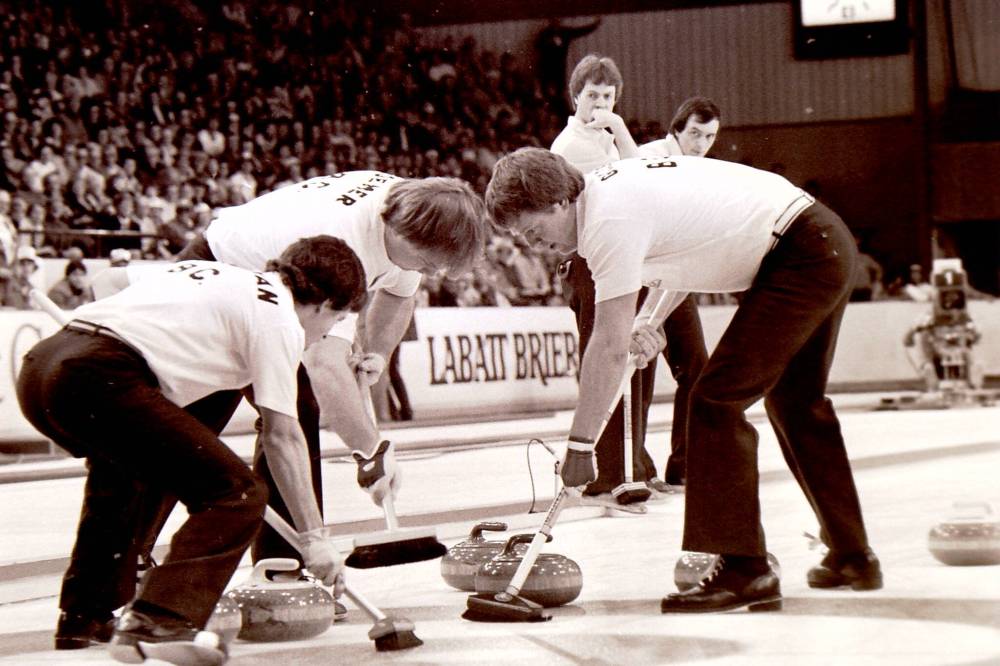
For those who were in the building, they ended up witnessing what may have been the wildest game of the entire tournament.
First Tiebreaker
After Noseworthy picked up a point with the hammer in the first frame, Sullivan responded with a pair in the second and a steal of one in the third.
The Newfoundland squad bounced right back with a three-ender in the fourth to go up 4-3.
Sullivan had a single in the fifth end and stole another point in the sixth to take a 5-4 advantage, only to have Noseworthy get two points in the seventh to move back in front 6-5.
The Friday night slugfest took what seemed to be a pivotal turn in the eighth, as Sullivan missed an open hit attempt, gave up a steal of one and found himself facing a 7-5 deficit.
“I knew it was going to be an uphill battle,” Sullivan said to the Brandon Sun’s Gregg Drinnan. “In fact, I didn’t think we’d win the game.
“All we could do was just keep trying and hope.”
Sullivan got a point in the ninth end to cut the lead down to one but was without the hammer coming home.
He came up big when his team needed him the most as he drew to a partially covered eight-foot to sit shot stone and would get a steal to tie things up at seven when Noseworthy’s final draw came up short.
In the extra frame, Noseworthy drew to the four-foot on his first, with Sullivan making a takeout and sitting shot in the eight-foot again.
While he just needed to make another draw to the four to earn the win, Noseworthy elected to play the hit, which he made.
However, his shooter rolled out of the rings and a Sullivan rock that was just biting the 12-foot proved to be the winning point as New Brunswick stayed alive with a dramatic 8-7 victory.
“I think it was the last time I ever tried that shot at the end of a game, but you learn from your mistakes,” said Noseworthy, who was joined on his St. John’s Curling Club rink by third Randy Perry, second Eugene Trickett and lead John Wheeler. “After that, we became much more of an aggressive drawing type of team, which was because we got to see how the top teams played.
“It was still a really good week for us. When we first got to the Brier, we had to keep our emotions in check because we were there with all the guys we had seen on television. They were like heroes to us. Once we got more confidence and realized that we could play with those guys, I thought we curled really well.”
The lessons that Noseworthy learned in Brandon paid off in his return to the Brier in 1987 in Edmonton.
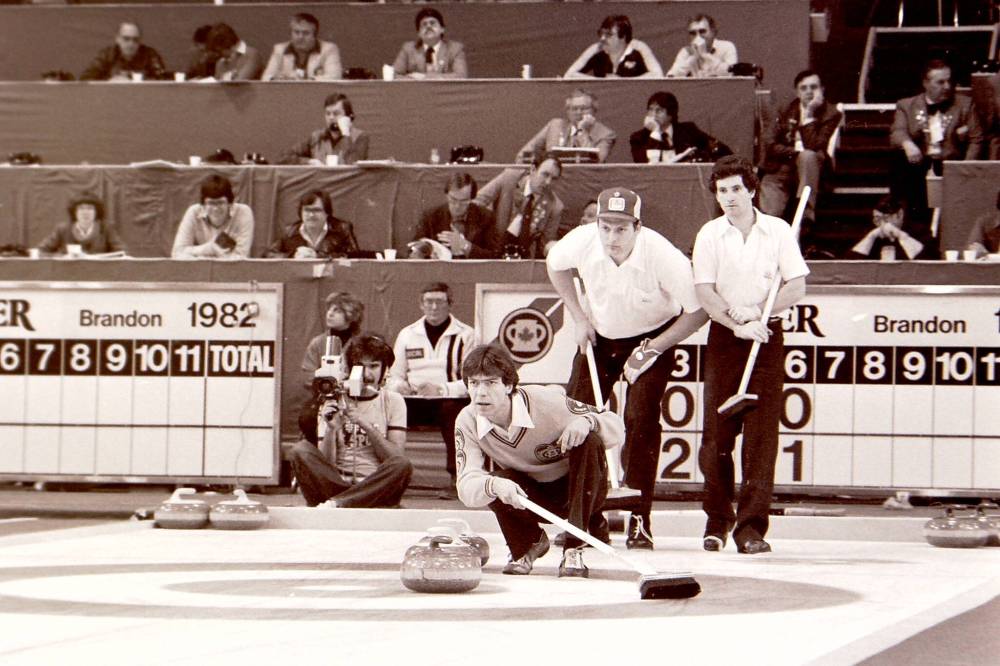
His rink, which again featured Perry and Trickett but now had Rob Thomas at lead, posted an 8-3 record and qualified for the semifinals, where they lost to British Columbia’s Bernie Sparkes.
That result was the best for Newfoundland since Jack MacDuff won their first title in 1976, with the province’s next playoff appearance not coming until 2004 when Brad Gushue finished fourth.
“I tell people now that those who don’t have experience (at the Brier) don’t know have valuable it is, and those that do have experience realize that you can’t win without it,” said Noseworthy, who received the Ross Harstone Award in Brandon as the event’s most sportsmanlike player.
“By the time we got back to the Brier, we had gone out and started playing on the tour a lot more, which was reflected in our play. We wanted to get better and you could only do that by going up against the likes of (Pat) Ryan, (Kerry) Burtnyk and (Al) Hackner.”
Second Tiebreaker
While Noseworthy was left to wonder what could have been, Sullivan was in the best spot of his Brier career.
“Awful lucky,” Sullivan said to the press following his win. “I can’t say much, we’ve got a big game tomorrow.”
The skip from the Capital Winter Club in Fredericton — who played with his brother David at third, Sheldon Palk at second and Robert Cormier at lead — had been to the event in 1966 and 1967, but had posted a combined record of 4-16.
He had gotten off to a 1-3 start after the first two days in Brandon, but soon rattled off five wins in a row to put himself into the playoff mix.
“New Brunswick was rated so lowly a week ago that in one betting pool, there was only one man brave enough to buy tickets on Charlie Sullivan’s squad,” John Chaput wrote in a column that was published in the Saturday, March 13 edition of the Regina Leader-Post.
“The odds on New Brunswick in that pool ended up at roughly 215-1 and the bettor’s 10 bucks will return more than $1,800 (nearly $5,000 in today’s money) if Sullivan wins the Brier.”
Sullivan was inches away from not needing to play in the tiebreakers, as he just missed out on making an angle-raise hit in the 10th end of his final round-robin game against British Columbia’s Brent Giles that would have assured him of third place.
Instead, he kept the hopes and dreams alive for Logan’s rink, who he had to face for a spot in the semifinal.
The Manitoba champions, which featured Doug Armour at third, Lloyd Lang at second, and Allan Granger at lead, took an early lead with a deuce in the first end.
Sullivan got a point in the third and stole another in the sixth to even things up at two in a contest that was the polar opposite of his high-scoring affair with Noseworthy.
Logan moved back in front with a single in the seventh and stole a point in the eighth to regain his two-point lead.
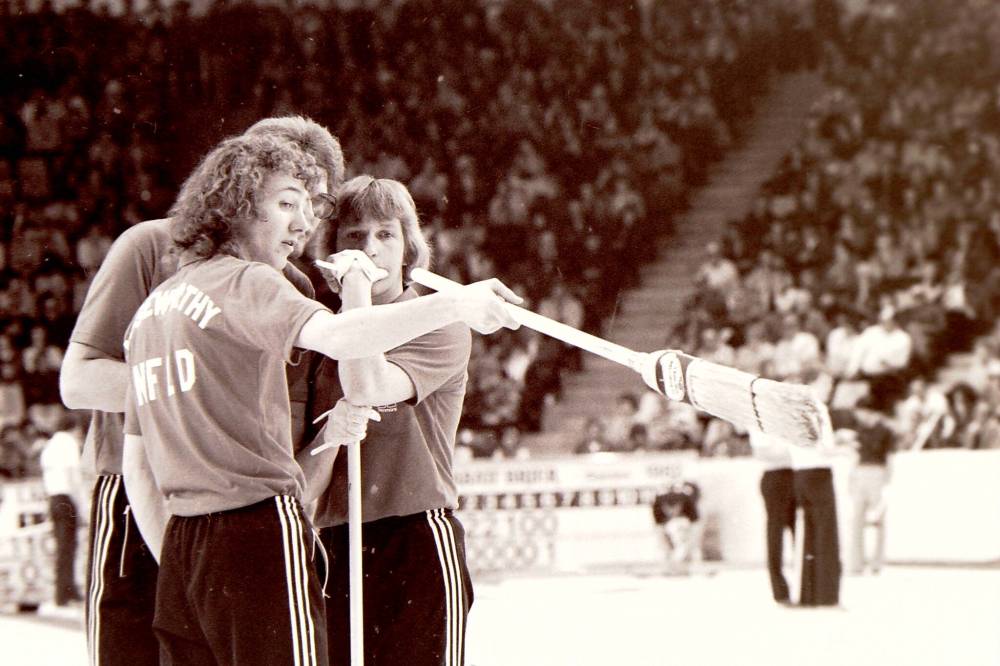
After getting a single point in the ninth, Sullivan’s last rock in the 10th didn’t come close to the rings, which allowed Manitoba to advance to the semifinals with a 4-3 triumph.
“We felt in control for most of the game,” Armour said.
“The steal in eight turned out to be huge, but there never seemed to be a moment where it felt like we were in danger of giving the game away.”
Despite the loss, it was still an impressive result for Sullivan, who gave New Brunswick their best finish at the Brier since Pete Murray’s quartet from Saint John finished in a tie for fourth in 1978.
The Sullivan rink was the only squad that played in Brandon to make it back to the Canadian men’s curling championship the following March in Sudbury, Ont., but they ended up well back of the playoff picture at 4-7.
Seven years later, the next generation of Sullivans nearly brought the province their first Brier title.
David’s son Jim and Charlie’s son, Charlie Jr., led New Brunswick to the championship contest in Sault Ste. Marie, Ont., where they lost to Ontario’s Ed Werenich.
The closest the province has come since was in 2000, when Russ Howard fell to British Columbia’s Greg McAulay in Saskatoon.
Semifinal Saturday
With the fans at the Keystone Centre still buzzing following Logan’s win earlier that morning, they returned to their seats a few hours later to see how they would fare against Northern Ontario’s Al Hackner.
While the support was going to be with the local rink no matter what, surely some patrons had to feel that momentum was in favour of the Souris squad.
After all, Manitoba had nearly knocked off the tournament favourites in the opening draw and the rink from the Fort William Curling Club in Thunder Bay, Ont., had stumbled into the playoffs with three straight losses after rattling off eight wins in a row to start the week.
For Northern Ontario third Rick Lang, there was a bit of apprehension creeping in.
“I remember going into the semifinal thinking, ‘My goodness, what are we doing here?’” Lang said. “There was about a group of 500 people that had come from home to cheer us on and everyone was going up to us saying, ‘What’s wrong with you guys? What happened?’
“Thank God there wasn’t any social media then because we would have been hearing all about it from all over. Even though we had been in that spot before (playing in the playoffs), there was more of a feeling of self-doubt with how things had been going.”
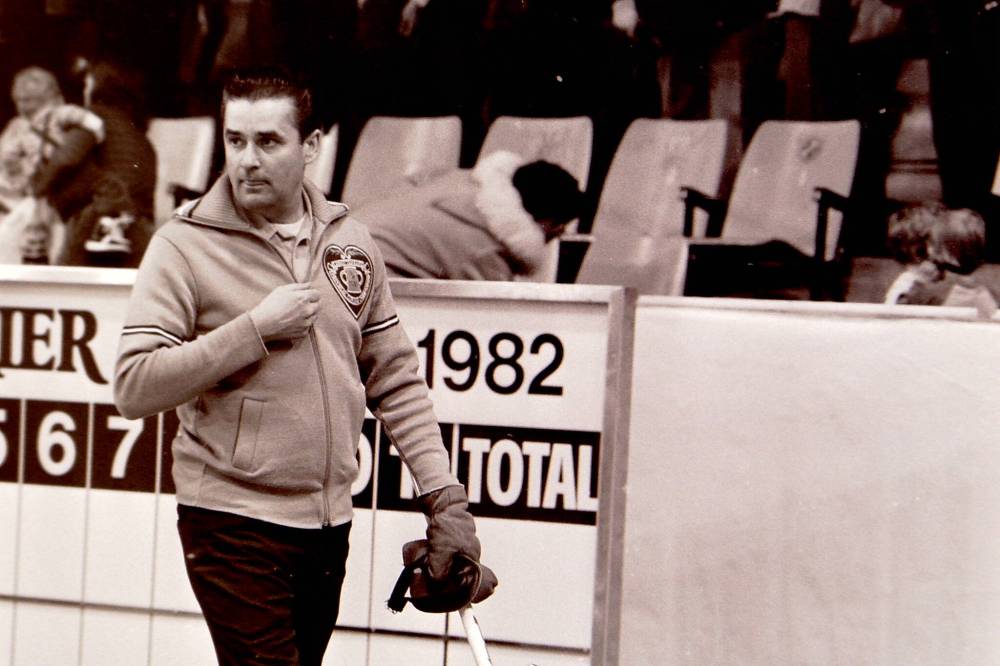
While his third may have been worried ahead of their matchup with Logan, Hackner believed that being the only rink among the top three with any playoff experience was going to play to their advantage.
“You were able to walk into those games knowing how you handled those nerves before,” said Hackner, who was also joined on his team by second Bob Nicol and lead Bruce Kennedy. “In 1980, we were just super happy to be there (in the final) and we played like it, though that was a pretty good team from Saskatchewan with Rick Folk that beat us.
“The next year when we played Kerry Burtnyk, we had basically outplayed him for nine ends before everything went to hell in the 10th (when the Manitoba rink scored three points to take a 5-4 win). It hurt to lose that one, but we knew how good we played in that game and that was something we could take into our semifinal against the Logan rink.”
Hackner quickly assumed control of the contest with a pair of points with the hammer in the first and had a 3-1 lead following the third frame.
In the fourth end, the skip known as “The Iceman” made Logan pay for his slightly heavy draw by making a double takeout to set up a steal of one.
Two more steals followed in the fifth and the sixth to give Northern Ontario a commanding 6-1 advantage.
As he looked back on the contest 40 years later, Logan was quick to admit that it wasn’t one of the rink’s better games, but that it really was a shot here or there that got things out of hand.
“Once the Hackner rink got up by a couple of points, they were really hard to come back on,” he said. “If we had gotten the lead on them, I think we could have controlled the game like they did against us.”
“There were a few key shots that we were on the wrong side of the inch on,” Armour added. “The result ended up being huge because of it.”
Logan gave the fans something to cheer about though as the game wound down, as they scored three points in the ninth end to put the final score at 8-5.
In addition to reaching the podium, Armour was also saluted for his play as he joined Hackner, British Columbia second Al Roemer and Saskatchewan lead Warren Rechenmacher on the tournament’s all-star team.
His performance was so impressive that Winnipeg Free Press sports editor Hal Sigurdson wrote that “many Brier veterans insist the show (Armour) put on ranks among the best in history.”
“It was a real honour to get that award, but it’s a team game and I couldn’t have done it without the guys in front of me who made things easier for me,” Armour said.
“The team played really well that week. We were a real good hitting team, but we made an incredible amount of runbacks during the Brier. That was a major asset for us when we would take advantage of another team’s miss. We’d make them pay.”
Championship Contest
By the time Sunday, March 14 rolled around, it had been almost 48 hours since Giles and his rink from the Vancouver Curling Club had played in their final game of the round-robin.
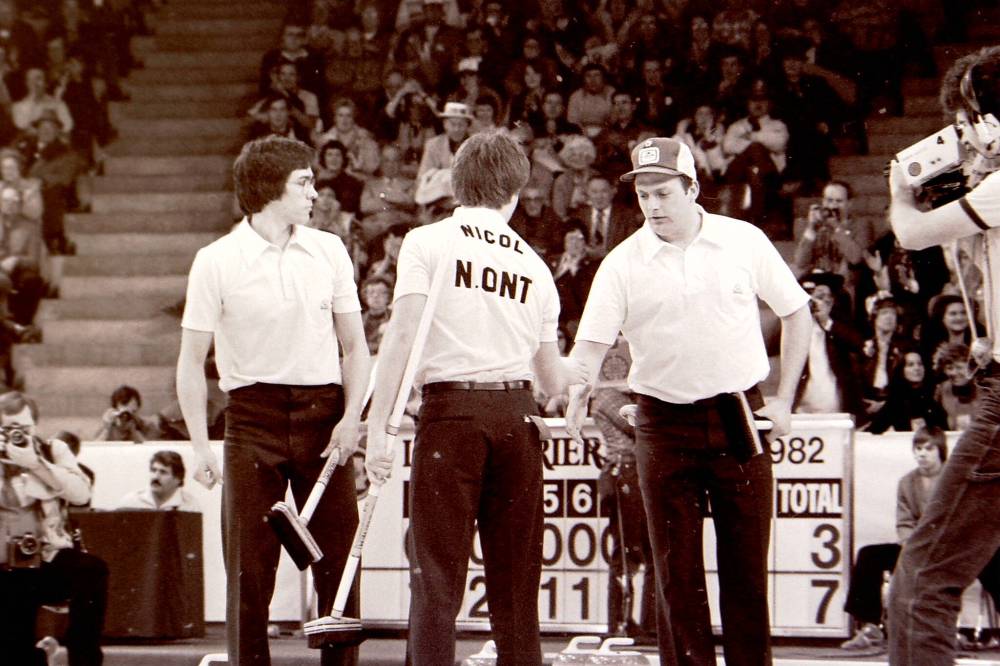
Although he and his brother Brad, who was the lead for the squad, competed in the Brier 10 years earlier, this was a totally different stage as they had a chance to be the first British Columbia squad to win it all since Lyall Dagg in 1964.
“We were able to practise for an hour on Saturday but we had to kill a day-and-a-half before the final,” said Giles, who was also joined on his team by Roemer and third Greg Monkman.
“There were a lot of differences then in how you approached the final compared to now. Unlike today, where the team that wins in the round-robin or in the 1 vs. 2 Page playoff game has the hammer, there was a coin toss before the game. Hackner won that and that made things a little bit difficult early on, especially since there was no free guard zone.”
Hackner was able to build some confidence in the opening frame as he made a draw to the tee-line for a single point while facing a pair of Giles stones.
“That’s a totally different shot back then as there weren’t any practices before the game to warm up,” Hackner said. “Today you spend nine minutes going up and down the sheet and if you miss a draw in the first end … it’s your own fault.
“I remember making that draw and knowing that I had the weight down right away. I felt very good after that.”
The key moment in the final, according to Giles, came in the third end.
With the game tied at one, he missed a pair of takeouts and Hackner made an open draw for two points and a 3-1 advantage.
“That kind of set us back a bit,” Giles said. “A couple of ends later (in the sixth, with the score now at 4-2 for Northern Ontario), we were trying to make a raise takeout that could have allowed us to close the gap or even tie it up.
“Instead, we just missed it by a quarter of an inch and they stole a point (to take a 5-2 lead). That’s the way it goes sometimes.”
Like in their semifinal meeting with Logan, Hackner’s rink never let up when they had the lead as they stole points in the seventh and eighth frames to extend their advantage to 7-2.
“We weren’t the greatest hitters in the world, but with no free guard zone, we managed to build on our leads and made things pretty comfortable in both games,” Lang said.
“One of the things that stands out to me was just how straight the ice was back then. Our team actually got together last year to watch a couple of the games and we all couldn’t believe just how straight it was when you compare it to today’s standards.”
Giles would finally respond with a single in the ninth end but it was all over by that point as Hackner flung the monkey off his back with a 7-3 triumph.
Although his rink was unable to snap British Columbia’s drought at the Brier, which would last until Folk won it all in 1994, Giles and his teammates were quick to put things in perceptive.
“I remember saying to the guys that ‘There are about a million curlers in Canada and 999,996 would love to be in our positions right now,’” Giles said.
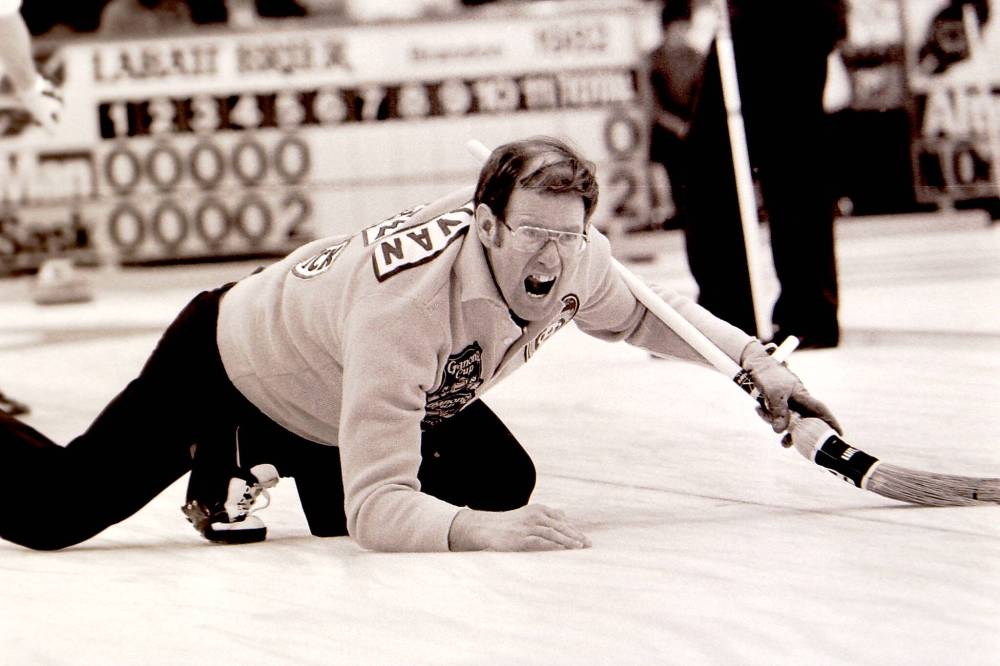
“Al’s team was very good. There were no expectations that we would beat them easily and we knew that we would have to play one of our better games like we did against them in the round-robin for it to be close. They deserved to win.”
On Top of the Mountain
For Hackner, Nicol and Kennedy, the accomplishment that came with winning a Brier title for the first time didn’t sink in right away.
“By the time we shook hands with the Giles rink, had the awards ceremony and done everything else, it was just the four of us back in the locker room,” Hackner said.
“We all looked at each other and said ‘We did it!’ It all hit us at that moment.”
The triumph in Brandon was the second national men’s championship for Lang, though his first came under drastically different circumstances.
In 1975, he was called up to fill in for Tom Tod as the third for Bill Tetley’s rink at the provincial playdowns and ended up sticking with the team all the way through their Brier win in Fredericton, N.B.
“It was the experience of a lifetime for a 21-year-old but it wasn’t with the team that I had played with on a regular basis,” Lang said. “I hardly knew those guys.
“In 1982, it was the culmination of three years of playing with your best friends and achieving a goal that you had all worked so hard at. This one was a lot more fulfilling and satisfying.”
» See Part 5 of the five-part series in Saturday’s edition of the Brandon Sun.
» lpunkari@brandonsun.com
» Twitter: @lpunkari