
BWK SEASON REVIEW: Early questions weren’t all answered
» BRANDON WHEAT KINGS SEASON IN REVIEW
Advertisement
Read this article for free:
or
Already have an account? Log in here »
We need your support!
Local journalism needs your support!
As we navigate through unprecedented times, our journalists are working harder than ever to bring you the latest local updates to keep you safe and informed.
Now, more than ever, we need your support.
Starting at $15.99 plus taxes every four weeks you can access your Brandon Sun online and full access to all content as it appears on our website.
Subscribe Nowor call circulation directly at (204) 727-0527.
Your pledge helps to ensure we provide the news that matters most to your community!
To continue reading, please subscribe:
Add Brandon Sun access to your Free Press subscription for only an additional
$1 for the first 4 weeks*
- Enjoy unlimited reading on brandonsun.com
- Read the Brandon Sun E-Edition, our digital replica newspaper
*Your next Free Press subscription payment will increase by $1.00 and you will be charged $20.95 plus GST for four weeks. After four weeks, your payment will increase to $24.95 plus GST every four weeks.
Read unlimited articles for free today:
or
Already have an account? Log in here »
Hey there, time traveller!
This article was published 12/04/2023 (1129 days ago), so information in it may no longer be current.
Before the 2022-23 Western Hockey League season began, the Brandon Sun posed five key questions that needed to be answered by the Brandon Wheat Kings.
Here’s a look at what was written in September — without the accompanying responses from prominent veterans and staff that ran at the time — and a look at what actually happened this season with general manager and head coach Marty Murray
1. Will the young goaltending staff come through?
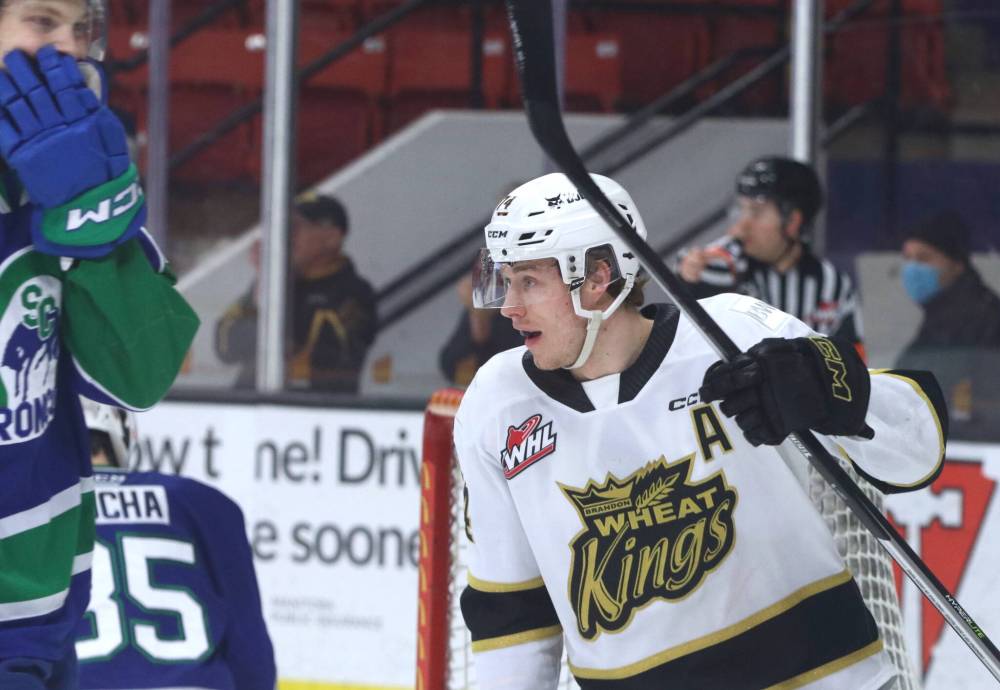
Brett Hyland (74) was a revelation for the Brandon Wheat Kings in a breakout offensive season, and his loss to a lower-body injury considerably dimmed their playoff hopes. (Perry Bergson/The Brandon Sun)
SEPTEMBER: The pressure will certainly be on 17-year-old sophomore Carson Bjarnason and 18-year-old rookie Nick Jones this season.
With the graduation of last season’s overage starter, Ethan Kruger, and the reassignment of 16-year-old rookie Ethan Eskit, the job is falling into the hands of Bjarnason, who has 23 WHL appearances, and Jones, who has two.
The only similar situation came during the 2018 training camp, but that was after the team liked what they saw in 19-year-old rookie Jiri Patera and traded veteran Dylan Myskiw.
Before that, the team went with 17-year-old rookies Liam Liston and Corbin Boes for the 2010-11 season.
After winning the backup job at camp a year ago, Bjarnason was thrust into the starting role when Kruger was injured and had some tough outings backstopping an injury-riddled team. He improved steadily, and actually worked his way onto the under-18 Canadian team that won gold at the Hlinka Gretzky Cup during the summer.
Meanwhile, Jones was terrific after being sent back to Calgary to his U18 team last season and has enjoyed an outstanding camp and pre-season.
THE RESULT:
Bjarnason won the team’s three stars award and was co-MVP with Nate Danielson, which provides a sense of how good he was at times. After nine games he had a gaudy .945 save percentage and had single-handedly won several games.
Meanwhile, Jones was thrust into a new role as backup goalie and struggled to find his footing early on. As the season went on, Brandon’s goalies were their best players some nights and on others allowed costly goals they might have wished they could have back.
“I think as a tandem, it was OK,” Murray said. “I think at times we looked really solid and at times we looked our age a little bit and our experience. I thought there were parts of the season where Carson was really hot and played really well. If you look at it, Carson was playing so much and for Nick, it was hard to get into a rhythm too.
“In a perfect world, you probably want a little more of a 1A, 1B situation with your goaltending but at the time, we felt Carson was on a good roll and gave us the best chance to win on certain nights.”
The pressure the duo felt to perform might have ultimately been their undoing. While Murray certainly wasn’t expecting them to stand on their heads and stop everything that came their way, there may have been an internal pressure that if they weren’t fantastic, the team would lose.
“I know talking down the stretch to the goalies and Tyler Plante, our goalie coach, they thought that maybe they were looked upon to do that a little bit,” Murray said. “I thought we as a team made some strides in the shots and chances for and against category, where it was just make the saves you need to make. That’s all I ask out of our goaltenders. They’re going to make some of those ones they probably shouldn’t, right?
“You don’t want any player to think they have to put the team on their back. Obviously guys get more ice time and more responsibility with certain roles but they’re part of our team. All I want is for them to give us a chance to win every night, and that was maybe an area we were a little inconsistent with throughout the year.
“Hopefully being a year older next year, we’ll play with a little more confidence game in and game out.”
It will be an interesting camp next fall, with the team’s top goaltending prospect Eskit coming in for his 17-year-old season. He appeared in three WHL games this season when Bjarnason was sidelined, posting a 3.42 goals-against average and a .893 save percentage.
The team’s other top goaltending prospect, the unsigned Ryder Green, posted a 2.70 goals-against average with the Cariboo Cougars under-17 AAA team, and will be entering his 16-year-old season.
2. Will the class of 2004 step up in a big way?
SEPTEMBER: It’s hard to overstate how important Brandon’s 18-year-old class will be to any team success they enjoy this season.
Brandon has an incredible nine players in that age group, including rookie goalie Nick Jones, defencemen Owen Harris, Zach Turner and Andrei Malyavin, and forwards Nate Danielson, Tyson Zimmer, Rylen Roersma, Ben Thornton and WHL rookie Matt Henry.
Conversely, they have to settle on three 2002-born 20-year-olds — they currently have four and will have to cut down by Oct. 10 — four 2003-born 19-year-olds, six 2005-born 17-year-olds and three 2006-born 16-year-olds.
Harris and Turner debuted a year ago, as did Malyavin, who played with the Ontario Hockey League’s Sarnia Sting last season and was taken by Brandon in the import draft.
Four of the forwards, Danielson, Zimmer, Roersma and Thornton, were in the top 19 picks of the 2019 draft, and will be expected to be bigger contributors in their third WHL seasons. While every player has to get better every season, the step from 17 to 18 and the added responsibility and expectation makes it a massive year.
Henry, meanwhile, was an absolute gift for the Wheat Kings, who scouted the rugged winger in the Saskatchewan Junior Hockey League and quickly listed him. He has shown ability around the puck, terrific speed, relentless forechecking and a high level of intimidation every time he steps on the ice.
THE RESULT:
Brandon dealt Zimmer to the Lethbridge Hurricanes on Sept. 27, and Harris left the team to join the Manitoba Junior Hockey League’s Swan Valley Stampeders. The team later added forward Nolan Flamand and defenceman Luke Shipley to its class of 2004.
Thornton was hurt much of the season and Turner was a frequent healthy scratch. Malyavin was terrific at times on the back end, and Henry added a bona fide heavyweight for the first time in years.
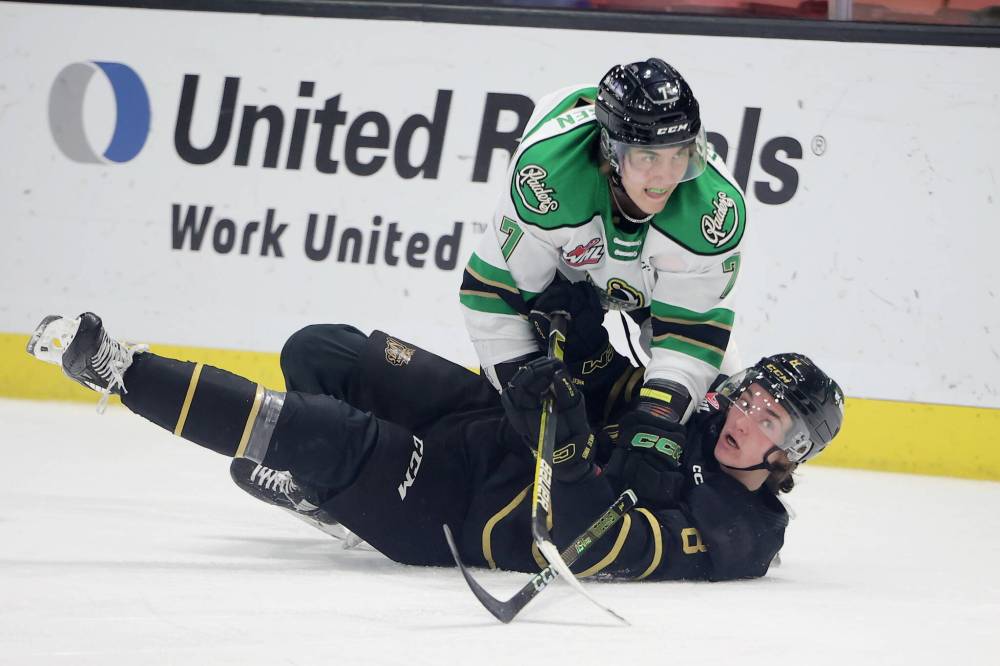
Quinn Mantei (8) was the steadiest defender for the Brandon Wheat Kings as they sought to replace the graduated duo of Chad Nychuk and Vinny Iorio. (Tim Smith/The Brandon Sun)
“There’s another level to get to, for sure,” Murray said. “Probably as an ’04 group, they underachieved. Some guys come in mid-season, some guys had injuries and stuff like that and that takes a toll too.
“I’m always one of those guys who looks at scoring and where guys come from in the league as far as production. (Chase) Wheatcroft (of the Prince George Cougars) goes from nearly 40 points to 100-plus. That’s extreme but you want to see those progressions year in and year out.
“I’m a firm believer that guys should improve every year. For me, improving numbers every year, some guys did and some guys didn’t but probably not as much as we had hoped.”
The only breakout success in the group was the co-captain Danielson, who led the team with 78 points in 68 games and will be a first-round NHL draft pick in June. Roersma continued to flash elite scoring ability, but unfortunately, it continues to be streaky.
Murray said that’s an age group that has to be good for a team to win.
“That’s a pretty big year,” Murray said. “Especially number-wise, it’s probably the biggest group you have. If you look at our group, it’s not half the team but it’s probably 35 or 40 per cent of the team out of the five age groups we can have. It’s big chunk of players and it’s a big time in their career. That large group of players, if they’re playing at the top of their game, that translates into team success.”
The problems started with Brandon’s draft in 2019, which saw them make 10 picks in the first 106 selections but grab just one player who is impactful every night.
The team had three first rounders, Danielson, Roersma and Zimmer. The others were Turner (second round), third-rounder Jesiah Bennett, who was released by Brandon and later the Prince Albert Raiders and landed in the Manitoba Junior Hockey League, Harris (third round), fourth-rounder Liam Watkins, who chose to go the NCAA route, and fifth-rounders Jones plus Kaiden Ellertson and Cyle Clayton, who both played in the Alberta Junior Hockey League.
3. Who will replace the departed top defensive pairing of Vincent Iorio and Chad Nychuk?
SEPTEMBER: Brandon is relatively inexperienced on the back end, and they desperately need their veterans to step up and grow into front-line roles.
Overager Mason Ward is a likely candidate, while 19-year-old Logen Hammett, 17-year-old Quinn Mantei and the 18-year-old Malyavin will also be counted on. While it would potentially be a bit unfair to him, 16-year-old rookie Charlie Elick could quickly play himself into the discussion as well.
The team will also be hoping for bigger contributions from Owen Harris and Zach Turner, a pair of Westman products who will look for more in their second seasons. The eighth defenceman is rookie Eastyn Mannix, who at 17, is making his full-time debut with the club.
THE RESULT:
The pressure to replace Iorio and Nychuk proved to be a little too much.
Murray said at Christmas nobody completely stepped into their skates, with no ones or twos — as the top two defencemen on a team are referred to — emerging from the group. Instead, Brandon had a lot of threes, fours and fives.
“In the first half of the year we had Mason Ward and Quinn Mantei playing together as a top pair, and I think they were fine,” Murray said. “We traded Mason and brought in (Kayden) Sadhra-Kang and I think at that time, Quinn took a real big step. It seemed like him and Sadhra-Kang had some chemistry together and I thought they did a pretty good job of playing against a team’s top line.
“The fact that they’re both double digits in plus-minus and maybe not big point producers tells me that they did a pretty good job defensively.
“Moving into next year, we obviously have some 20-year-old decisions but we think we have some decent pieces on the back end to work with. We can obviously get better but it’s encouraging with a guy like Mantei leading the charge coming back.”
Mantei and Elick both have the ability to become ones or twos, and it could start next season. It may have to, since Brandon will likely be losing one of their older defenders.
Brandon can return five overagers next season, although Belarusian forward Zakhar Polshakov may not be in their plans as a “two-spotter” who takes up both an overage and import slot. Forwards Brett Hyland and Dawson Pasternak will almost certainly be counted on for offence, leaving Sadhra-Kang and Hammett battling for the final overage spot.
“We’re always going to be looking to see how we can get better but again, you have a group that can return a lot,” Murray said. “We have two potential 20-year-olds there, so that’s going to be something we have to sort out. I think there is potential there. You have to hope that guys take some strides like we expect them to every year. At the same time, we’re always looking to upgrade our team and we’ll be listening to anything that might come our way.”
The team will have a pair of signed 16-year-old defencemen competing for a spot, Gradey Hope and Emerson Clark, plus a number of other promising prospects.
4. Will any of the eight members of Brandon’s significant rookie class make a big impression?
SEPTEMBER: Brandon’s rookies include 16-year-olds Elick, Roger McQueen and Caleb Hadland, plus 17-year-olds Teydon Trembecky, Evan Groening and Eastyn Mannix and the two 18-year-olds, Jones and Henry.
Malyavin is new to the Wheat Kings but has Canadian Hockey League experience.
The lanky McQueen scored four goals in the pre-season, and has quickly displayed why Brandon took him fourth overall in the 2021 draft. That was one pick behind Elick, who will almost certainly play major minutes on Brandon’s blue-line.

Dawson Pasternak (46) and Quinn Mantei (8) celebrate a Brandon Wheat Kings goal with their teammates. While there were some big moments for the club in the 2022-23 campaign, it will ultimately go down as a lost season for a club that didn’t make the Western Hockey League playoffs. (Tim Smith/The Brandon Sun)
Jones is ready to step into the net, and Groening and Trembecky played Junior A last season and have a sense of what’s coming.
In fact, all but Hadland and Henry made their WHL debuts with the Wheat Kings last season.
Brandon has done a good job developing young players in recent seasons, something apparent to anyone who watched the careers of recent Wheat Kings such as Logan Thompson, Chad Nychuk and even Ridly Greig from beginning to end, but it’s a never-ending cycle.
Something to watch for with the rookies is the difference in their games before and after Christmas. Brandon’s last game is on Dec. 17 and they don’t play again until Dec. 28: For some reason, that break reliably marks a turning point for many youngsters.
THE RESULT:
Trembecky was traded in November, and Hadland broke his leg but was fearless and appears to be a born leader. Elick was outstanding at times, while McQueen showed tantalizing glimpses of the player he can be.
Groening had seven goals in a fourth-line role, while Mannix was a frequent healthy scratch on the blue-line.
“In different ways, we maybe hoped we would have a more impactful rookie class,” Murray said. “I think there were some growing pains for sure. Those guys have to be our group that go home and make sure they reflect on the season — we had some good exit meetings with everybody — and they put in a good summer of work.
“A lot of those guys are young players and strength is one of their biggest deficiencies so it’s going to be crucial to them to put in a real good summer and come back and be key contributors because the torch gets past quicker than you think.
“Those guys have to make sure they’re ready to take the torch when it’s passed their way.”
While youngsters aren’t often key contributors, the flashes of brilliance rookies display every now and then can be interpreted as a potential sign of the player they’ll become at 19 or 20. Murray saw enough of those moments that he’s optimistic about the group moving forward.
“Some of these guys who were rookies aren’t necessarily flashy players,” Murray said. “Groening, Mannix are not flashy players. With our 16-year-olds, McQueen you did see at times what he could be when he grows into his body a little bit more and understands he has to play with a little more pace. You can certainly see the upside there.
“It’s the same with Elick. He looks like a 19-year-old out there and then there are times in the game where he looks his age, and that’s natural. He’s another guy who we expect to be a key anchor on our back end for a number of years here.”
Murray knows first-hand what he’s talking about. While he ended up with 20 goals and 36 assists as a 16-year-old member of the Wheat Kings during the 1991-92 season, it wasn’t all sunshine and lollipops.
“I had four goals at Christmas and was coming home in tears a lot of nights and wondering what I got myself into,” Murray said. “You have to trust the process. It’s not easy as a 16-year-old to come into this league and have immediate success. It tests your character a little bit and your willingness to persevere at times but the strong survive and the strong get through it and they end up being very good players.
“We feel like our ’06s, there are some names that could be game changers. There are some good things they certainly did and then some things that we can improve on, like everybody.”
And ultimately, that will be achieved by learning what it takes to thrive in major junior, which is an entirely new experience for the teenagers.
“It’s just a matter of the details every day,” Murray said. “I think our young players just have to be ready to practice is a big thing and execution in practice is a big thing. That’s what makes the games easier, if you practise at a high pace and you execute at a high pace, that slows the game down when the puck drops on a Friday or Saturday night.
“A lot of times, 16-year-old years are learning experiences and we have to understand what we did well and continue to grow on that and at the same time understand what we need to do better to make sure we’re continuing to develop.”
5. Where will the offensive spark come from with Ridly Greig’s departure?
SEPTEMBER: While he missed nearly half the games last season, Greig was a threat every time he stepped on the ice.
He averaged 1.62 points per game in 39 outings last season, which was 0.47 points per game more than the next player, team scoring leader Ritchie.
Obviously he’ll be missed, but there are a few candidates to fill his shoes, and a couple ways of approaching that job.
The overager Ritchie is in his fourth year in the league, and has elite ability to read the play. He also has a quick shot — he led the team with 33 goals last season — and the ability to feed his teammates, illustrated by his 43 assists.
A pair of the team’s 19-year-old forwards Jake Chiasson and Hyland, are both candidates for massive jumps in production. Hyland had 29 points in 61 games last season, but flashed the considerable skill that made him a U18 AAA scoring champion in Alberta.
Chiasson, an Edmonton draft pick, was injured at Oilers camp and only played 20 WHL games last year, earning 18 points as he quickly rediscovered his touch after missing two-thirds of the season.
Both were very good in camp.
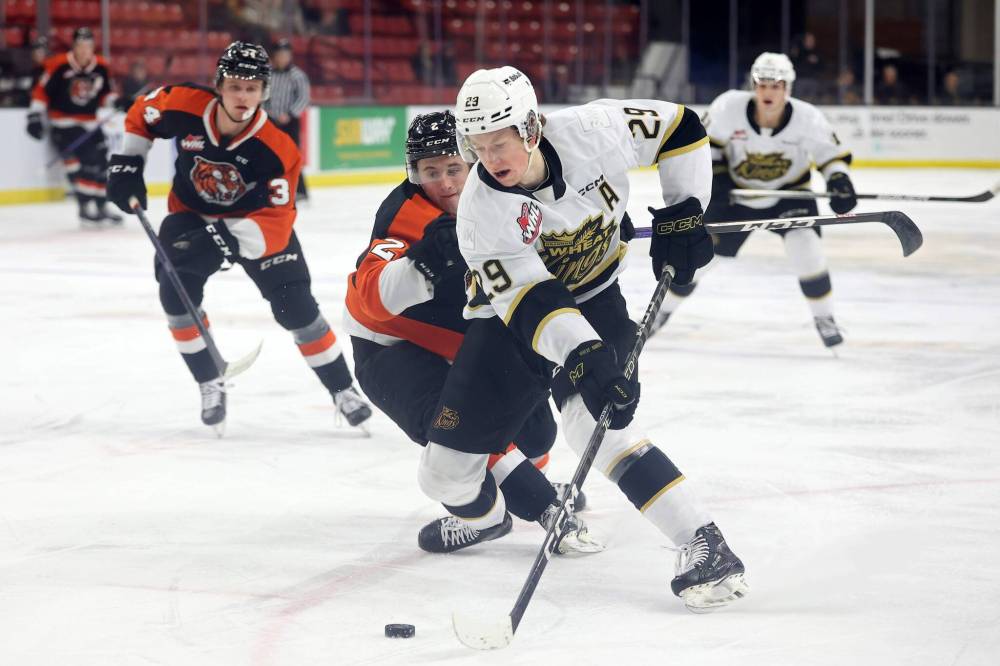
Brandon Wheat Kings forward Nate Danielson (29) was outstanding in his third WHL season, leading the team in scoring and playing all 68 games. (Tim Smith/The Brandon Sun)
The 18-year-old Danielson piled up five points in two pre-season games, and if he has better luck with injuries this season, could lead the team in scoring and be selected in the first round of the 2023 draft.
Roersma was the team’s hottest goal scorer at times last season, and with more consistency, could see his 2021-22 total of 19 goals improve to 30 or more.
A dark-horse candidate for a break-out season is the 18-year-old Thornton, who has impressed at camp and in the pre-season.
THE RESULT:
There were more negatives than positives on the scoring front.
Chiasson didn’t have a great start to the season offensively and was dealt to the Saskatoon Blades at the trade deadline. The streaky Roersma matched his 19-goal output from a year earlier, and still seems poised for a breakout.
Thornton lost much of the season to injury, and Ritchie posted six fewer goals and points than a year earlier.
The bright spots were Danielson, who led the team in scoring, and Hyland, who jumped to 26 goals and 47 points in just 42 games from 13 goals and 29 points a year earlier.
“I think probably if you look at the big picture of our hockey team, you probably look at maybe the lack of top-end scoring throughout and secondary scoring,” Murray said. “You’re playing against Winnipeg and they have six players higher than our top scorer, and that’s hard to combat. Granted they’re a powerhouse this year — I’m thrilled we got to play them 10 times — but just the depth.
“We need guys to take that next step, from 17 to 18, from 18 to 19, that’s where the drop-off was for me. Our high-end scoring, we didn’t have enough of that and we battled a lot this winter for secondary scoring.”
Only four players eclipsed 40 points — Danielson, Ritchie, Calder Anderson and Hyland — and only nine had 10 goals or more. Of that nine, three of them were acquired in trades and also had goals elsewhere.
Another concern was Brandon had plenty of guys who liked to dish the puck off, but a precious few who could bury it.
“I think that natural goal scorers are a big thing,” Murray said. “Even look at our top, top scorers, Danny is a real good all-around passer-shooter. I’m hoping he gets to the forties or fifties next year.
“I wouldn’t say Brett Hyland is a natural goal scorer but he did a heck of a job for us this year. He creates most of his chances by going to the net and getting to the dirty areas.
“Nolan is another guy who is probably a pass-first guy and you appreciate that. You look at the teams around our division in particular, and everybody has probably three or four elite scorers. We lacked that a little bit.
“How do we get there? That’s hopefully something that another year older will help with our guys but at the same time, we’re always looking to get better.”
At least there were encouraging signs as the season went on. Ritchie said the team’s statistics were trending in the right direction by the end of the season.
“I think we made some nice strides in puck possession, O-zone time, chances for, chances against all those analytics, and it’s definitely going the right way,” Murray said. “I think bearing down and putting the puck in the back of the net is something that we can get better but it’s still a little bit of a concern.”
Some of the blame has to fall on the power play, which scored 59 goals in 279 opportunities for a 21.1 per cent success rate. There were games when Brandon moved the puck around the outside and had incredible zone time without creating any real scoring chances.
“I thought the first part of the year was a little vanilla and then we got better and then I thought we tailed off a little at the end,” Murray said of his power play. “This league is all about special teams. For whatever reason, when our power play got hot, our PK would cool off and then vice versa.
“To have success and win hockey games, you need to have both special team units firing on the same cylinders.”
» pbergson@brandonsun.com
» Twitter: @PerryBergson