
Shaw savours NHL milestone with Jets
Advertisement
Read this article for free:
or
Already have an account? Log in here »
We need your support!
Local journalism needs your support!
As we navigate through unprecedented times, our journalists are working harder than ever to bring you the latest local updates to keep you safe and informed.
Now, more than ever, we need your support.
Starting at $15.99 plus taxes every four weeks you can access your Brandon Sun online and full access to all content as it appears on our website.
Subscribe Nowor call circulation directly at (204) 727-0527.
Your pledge helps to ensure we provide the news that matters most to your community!
To continue reading, please subscribe:
Add Brandon Sun access to your Free Press subscription for only an additional
$1 for the first 4 weeks*
*Your next subscription payment will increase by $1.00 and you will be charged $20.00 plus GST for four weeks. After four weeks, your payment will increase to $24.00 plus GST every four weeks.
Read unlimited articles for free today:
or
Already have an account? Log in here »
Hey there, time traveller!
This article was published 20/05/2023 (1054 days ago), so information in it may no longer be current.
Brad Shaw took a different path to the National Hockey League’s Winnipeg Jets than the players, but that didn’t make his 1,000th game any less meaningful.
The 40-year-old Cardale product has served as the team’s assistant athletic therapist since the Jets returned to Winnipeg in the fall of 2011. For a fan of the team growing up, it’s been an incredible ride.
“It’s obviously something to be proud of for sure,” Shaw said. “Going to school, pro sports was where I wanted to be. I went to university and always thought there would be a path for me someway, somehow.
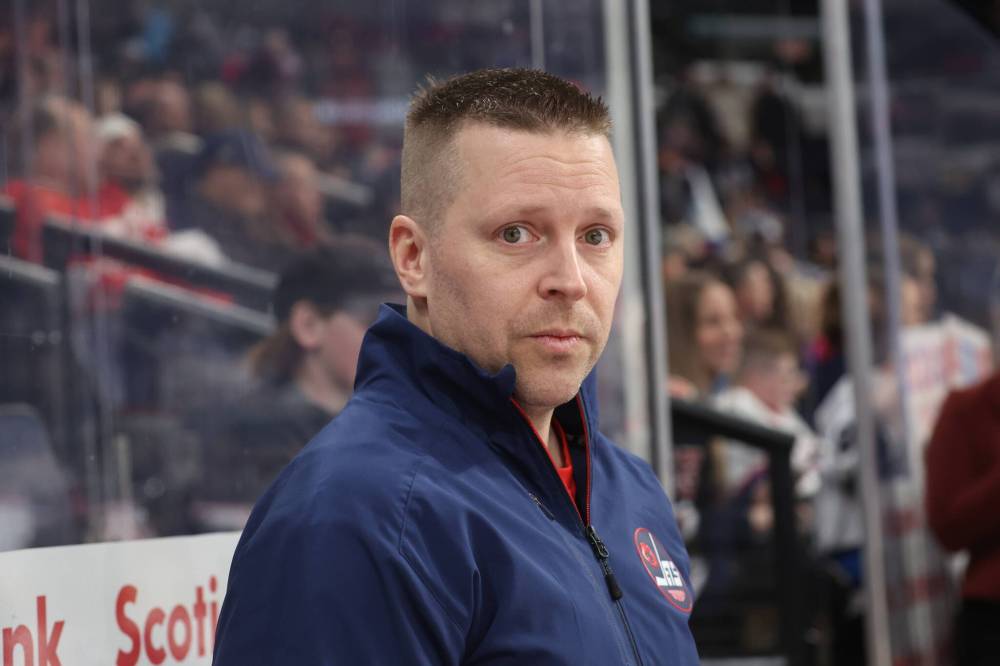
Cardale product Brad Shaw worked his 1,000th game with the National Hockey League’s Winnipeg Jets in March, a remarkable milestone for the team’s assistant athletic therapist. (Courtesy of Winnipeg Jets)
“If you grow up on a farm, you keep your nose down and get the job done and you work. And if you work hard enough, you’ll be rewarded.
“And it’s not just to be able to work in pro sports, but to be able to work in my home province with the team I grew up watching is something that I’m extremely proud of.”
Shaw grew up on a grain farm near Cardale, which is located 70 kilometres northwest of Brandon, and 36 kilometres straight west of Minnedosa. He played hockey in the winter and baseball in the summer, and while his father Harvey was definitely involved, sports had to go on the back burner when there was work to be done in the fields.
“Dad always coached me or tried to coach me so practices kind of revolved around the farming schedule,” Shaw said. “It’s funny looking back on it how it all kind of worked. Hockey season was definitely a better season in terms of coaching-wise goes for volunteers in the community. Baseball was definitely a battle with coaches but they always seemed to make it work.”
Shaw went to high school in nearby Rivers, and after graduation, entered the University of Manitoba with an interest in the medical field.
While he was the youngest of three and his mother Janice was no longer nursing — “she stayed at home and was the rock of the family” — she played a role in his decision. So did simple geography.
“Growing up in a small town in southwestern Manitoba, you didn’t have a doctor at your fingertips and you didn’t have an athletic therapist or physiotherapist at your fingertips,” said Shaw, whose siblings include brother Jeff of Brandon and sister Susan, who lives in Cochrane, Alta. “Whenever somebody got hurt, it was always kind of ‘Well, what do we do?’
“Some people would say put heat on it and the next person would say put ice on it. It was the draw that there had to be something you could do that is the right way of doing it.”
He graduated from the U of M in 2004 with a degree in kinesiology, with a major in athletic therapy.
The first break in his professional career came in part because he knew other students in the small university program, which admits just 20 people a year. A friend of his had taken a job with the Winnipeg Goldeyes baseball team fresh out of school, and Shaw asked if he could intern with him.
He got to know Goldeyes general manager Andrew Collier and the team’s former longtime manager Hal Lanier, and Shaw was hired after his friend left.
The next step in his career took him to Cranbrook, B.C., after he was hired by the Western Hockey League’s Kootenay Ice. He spent four seasons with the club between 2006 and 2010.
“I loved it because you are dealing with young men who are away from home for the first time,” Shaw said. “Obviously they’re looking up to you as well as the coaching staff, and helping guide them and turn them into not just professional athletes but good people.”
As a result, he had a completely different relationship with them than the pro athletes he works with now.
“You’re almost a, I don’t want to use the father figure, but they can lean on you if they’re having problems with school or homesick,” Shaw said. “You’re a figure that they feel comfortable coming to and talking to, and I think that was the big thing with the Western League that you don’t get with pro hockey, you get that connection.
“At that point, they’re literally kids trying to find their way in the world and you don’t get that anywhere else.”
He noted junior players are sponges who are soaking up tips and advice from everyone they come in contact with, which is seldom the case at the next level.
He got his own promotion to professional hockey in the 2010-11 season when the athletic therapist left the Grand Rapids Griffins of the American Hockey League, and Shaw was recommended to Grand Rapids by former Brandon Wheat Kings athletic therapist Craig Heisinger, who was then working with the AHL’s Manitoba Moose after the Jets left for Arizona in 1996.
Shaw landed the job on a Monday, flew down on Friday, found a place to live on Saturday and by the next Monday was heading to Traverse City for the Detroit Red Wings rookie camp.
Even with former WHL players among the AHL players he worked with, there was an immediate difference in how he related to them.
“It’s definitely a different mindset of hockey when you get to the pro level,” Shaw said. “In the Western League, the losses really hurt. The kids take it personally, whereas when you get to pro hockey, you can’t dwell on losses anymore. You have to move forward past them, and every game is another opportunity.”
After a season in the AHL, something happened in the NHL that proved to have a profound impact on Shaw’s life. As a youngster, he had grown up a huge fan of the Jets, and in the summer of 2011, the news broke the Atlanta Thrashers were moving to the Manitoba capital to become the second incarnation of the Jets.
The sports world is a small one, and Shaw had kept in contact with the guys he knew with the Moose who he had gone to school with years earlier. When Grand Rapids and Manitoba met in the AHL, the friends always got together to catch up.
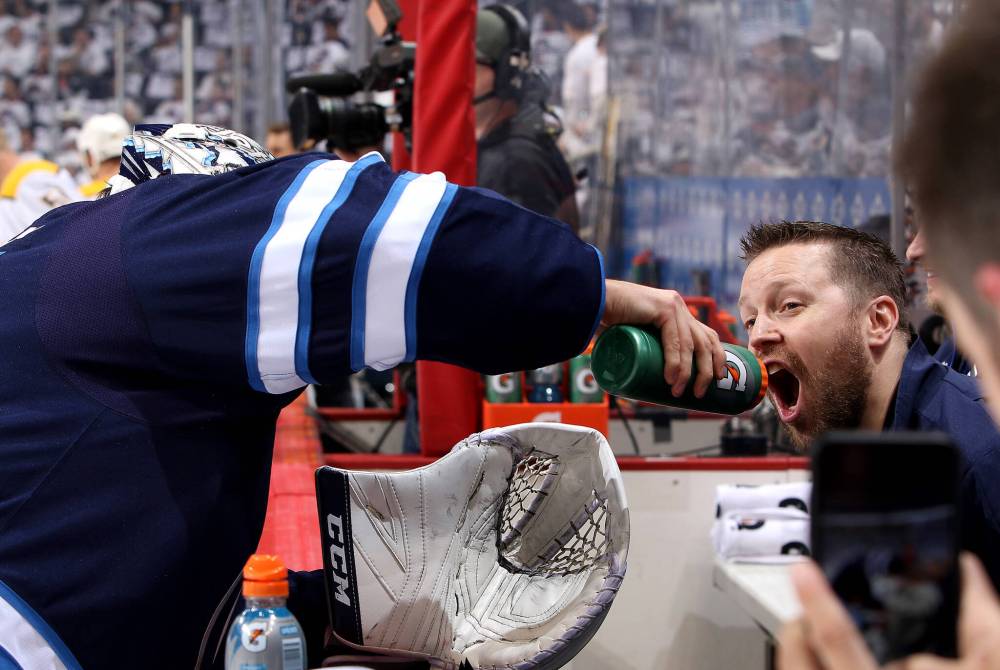
Goaltender Connor Hellebuyck of the Winnipeg Jets helps assistant athletic therapist Brad Shaw stay hydrated during pre-game warmup of their National Hockey League playoff game against the Nashville Predators in 2018 . (Photo by Jonathan Kozub/NHL)
“I got a phone call out of the blue that True North was purchasing the Thrashers and they were moving back to Winnipeg,” Shaw said. “With that came an expanded staff, because the NHL staff is bigger than the American League staff, so they were looking to round out their staff and wondered if I would like to move home and be part of the Jets coming back to Manitoba.
“That was a very easy yes for me, having grown up with the Jets and watching them leave. The thought of being part of them coming back was something I couldn’t say no to.”
That’s because Shaw’s ties were deep with the original club. He called the team his “winter pastime” growing up, and said trips into Winnipeg once or twice a winter to see games as a youngster remain meaningful to him.
“I remember watching Wayne Gretzky live and going to the old arena and sitting up in the nosebleed seats,” Shaw said. “Those are special memories as a kid. To have that coming back to the province and being available for my kids to go and do it and other peoples’ kids to go and do it is something a lot of people look by in this province and take for granted.
“Having seen them leave, there’s a gap there where a lot of kids didn’t get to go to those games. That’s something every kid in Canada should get to do, to go experience a live NHL hockey game.”
While Shaw brought a lot of experience when he came on board as the Jets re-entered the NHL for the 2011-12 season, there was a transition.
It’s fundamentally the same job, but almost everything changes. There are more resources, both in terms of money and staff, and the stakes are incrementally higher.
“When you’re dealing with multimillion-dollar athletes, when you do the math, if they’re going to miss one game, you’re talking about tens of thousands of dollars of lost wage that the player is still making but he can’t perform that night,” Shaw said. “Anything we can do to further our education, to further our skills might get one of these players back one game sooner, it’s worth doing.”
As a result, the therapists take new courses every summer. Although it may be an investment of thousands of dollars for the club, if it helps a player get back a game early, it’s already paid for itself.
They also take the cutting-edge courses that players are interested in so that they can offer treatment in-house rather than going elsewhere.
The Jets can call on 11 medical professionals, including doctors, dentists, chiropractors, psychologists and even an optometrist, but the day-to-day tasks of dealing with the players’ medical and equipment needs are handled by a much smaller team of six.
“We have a very special staff between the medical side and the equipment side,” Shaw said. “We spend more time together than we do with our families in the winter time. We always joke about it but we literally are paid brothers who get to hang out with each other all winter. With that comes the squabbles and the good times and the bad times.
“We’ve been with each other through everything and honestly, we all have the knowledge behind us that we know what each other is capable of doing and what each one is responsible for doing.”
On the medical side, he is joined by head athletic therapist Rob Milette and massage therapist Al Pritchard, with equipment staff Jason McMaster, Mark Grehan and Robert Cook also on hand.
“We’re a very, very close knit group,” Shaw said. “Everybody has each other’s back, and that’s almost what you need in any pro sports situation. There is something that’s going to go wrong, it’s just a matter of who is going to be able to pick up the slack that day.”
They certainly have their work cut out for them.
Hockey players have a well-earned reputation of trying to push through injuries, and occasionally they need to be saved from themselves. Shaw said not all injuries are created or treated equally, although players are now realizing there are times when resting is the much smarter approach.
“We always say their body is their business,” Shaw said. “If your body is broken, your business can’t go on. They definitely understand there is a line they can push to, but sometimes we have to remind them where that line is.
“Probably more so from our side of things, it’s on concussions. Guys know when they have a knee injury or a broken bone. When you’re dealing with concussions, a lot of the time in the heat of the moment, they don’t understand they have a concussion, and not be combative with us, but they can stand up and say ‘I’m going back out there.’
“That’s where our job is ‘No, you’re not.’”
Shaw said he is willing to let a guy who has an injured knee play because surgeons can fix that if a problem results. A brain is different.
After the therapists lay down the law, the players will almost always thank them the next day when they are removed from the adrenalin of the moment.
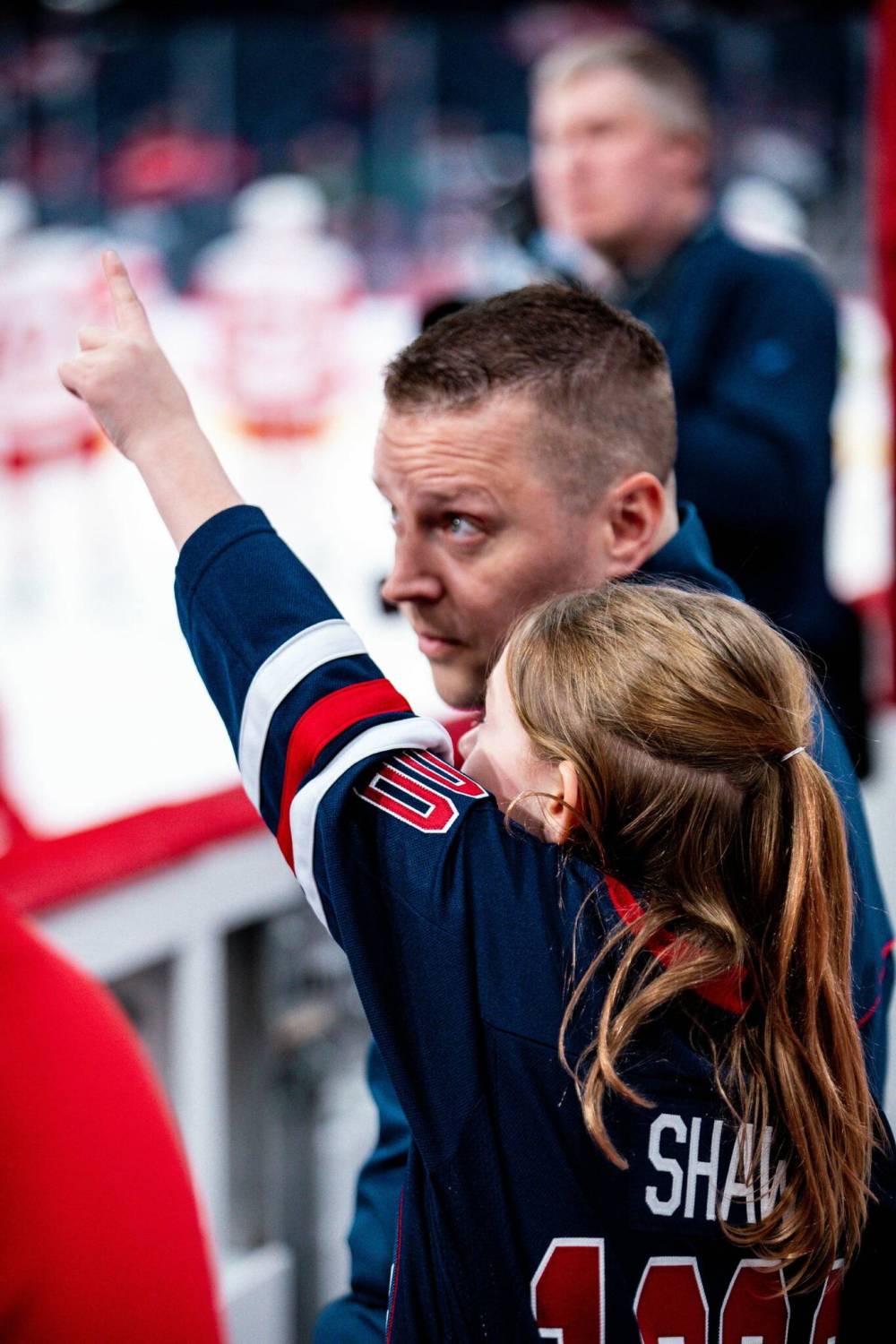
Brad Shaw of Cardale sits on the Winnipeg Jets bench with his daughter Reese. (Courtesy of Winnipeg Jets)
“There are points when they get it, and there are points when the emotion of the game gets the best of them,” Shaw said.
Shaw is working in the best hockey league in the world, and has a vantage point that gives him an unparalleled view of the action. Still, he is essentially a paramedic on the bench so he’s always watching for injuries and doesn’t have much of an opportunity to concentrate on the play itself.
Even so, there are moments that can’t be missed.
“At the end of the day, you’re watching the best players in the world do what they do,” Shaw said. “There will be times during a game where it’s not that you get caught up in the play but you notice something very small that a lot of fans in the building might not see, like a perfect cross-ice pass that happens to go through a pair of skates and under a stick that was purposely made.
“From ice level, you kind of sit back and go ‘Wow, that’s incredible!’ … You’re always kind of on but there are moments in the game that definitely jump out at you and make you realize what you’re watching.”
Apparently it’s not the only thing that jumps out at him. During the team’s playoff series against the St. Louis Blues in 2019, he took a puck in the cheek off a deflected icing attempt.
“I think if you stand on the bench long enough, you’re going to take one at some point,” Shaw said. “You’ll get the odd one off the glass in the back or whatever but that one, no one was expecting it. We were all just watching as if the puck was going down the ice and it came perfectly between two players on the bench and caught me right in the cheekbone.”
He was taken straight to the hospital with a broken cheekbone, and had to get a CT scan to determine if he would be able to fly home.
It’s not the only hazard of the job. While Shaw is quick to point out travel is done on chartered planes and teams aren’t waiting for their flights, it can be impactful.
“The actual travel isn’t as hard as you would think it’s going to be,” Shaw said. “For me, it’s the consistency of the travel and the time zone changes. By the time you get into the meat and potatoes of the season, in late November, December, January, your body is just numb to time zones.
“As hard as it is to get on a regular routine, you just can’t because your body clock is broken.”
Last season, there were multiple times in a six-day span when the team was in the Western time zone, came back to Central, went to Mountain and then headed east.
“It’s tough on the body, and especially your sleep cycles,” Shaw said. “You get worn out really quick, and when you have the opportunity to catch up on sleep, you have to make the best of it or else you go down a fatigue hole that you have a really hard time coming out of.”
That makes the milestone Shaw reached last season even more remarkable. The Detroit Red Wings visited Canada Life Centre on March 31 for Shaw’s 1,000th game behind the Jets bench, and between 25 and 35 of his friends and family were in attendance to share the moment with him.
While his two children, 11-year-old Riley and nine-year-old Reese, get to come to games and visit the dressing room, he noted the other side of it is he misses a lot of big moments in their lives and his wife Cori has to pick up the slack.
“It’s definitely a milestone that I was looking forward to, and not just for myself, but for the people around me,” Shaw said. “It’s as much a pat on the back for my family as it is for me because they’re the ones who put up with me being home probably 20 to 30 per cent of the time all winter.
“I call myself the delinquent dad in the winter time.”
» pbergson@brandonsun.com
» Twitter: @PerryBergson