
Colin McGill finds passion for coaching goalies
Advertisement
Read this article for free:
or
Already have an account? Log in here »
We need your support!
Local journalism needs your support!
As we navigate through unprecedented times, our journalists are working harder than ever to bring you the latest local updates to keep you safe and informed.
Now, more than ever, we need your support.
Starting at $15.99 plus taxes every four weeks you can access your Brandon Sun online and full access to all content as it appears on our website.
Subscribe Nowor call circulation directly at (204) 727-0527.
Your pledge helps to ensure we provide the news that matters most to your community!
To continue reading, please subscribe:
Add Brandon Sun access to your Free Press subscription for only an additional
$1 for the first 4 weeks*
- Enjoy unlimited reading on brandonsun.com
- Read the Brandon Sun E-Edition, our digital replica newspaper
*Your next Free Press subscription payment will increase by $1.00 and you will be charged $20.95 plus GST for four weeks. After four weeks, your payment will increase to $24.95 plus GST every four weeks.
Read unlimited articles for free today:
or
Already have an account? Log in here »
Hey there, time traveller!
This article was published 09/03/2024 (822 days ago), so information in it may no longer be current.
You’ll hunt long and hard to find a more interesting path to Brandon’s hockey scene than the one taken by Colin McGill.
The goaltending coach, who assists Tyler Plante with the Western Hockey League’s Brandon Wheat Kings and serves as the director of goalie development at the Western Canada Hockey Academy, grew up in Scotland and became one of the best young goalies in the country.
He later moved to Canada and eventually Brandon last August, where he has quickly embraced his busy career.
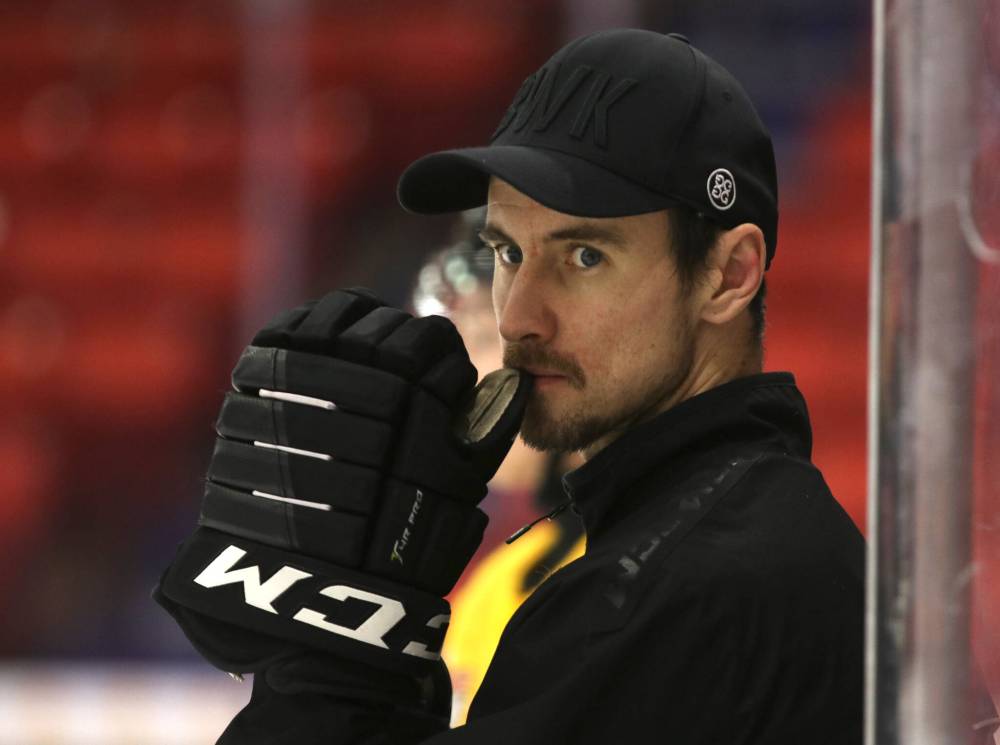
Colin McGill grew up in Scotland, becoming one of the top young goalies in the country before moving to Canada to refine his game. (Perry Bergson/The Brandon Sun)
“I love it here,” McGill said earlier this week at J&G Homes Arena. “I get to work with a lot of goalies, and obviously the WCHA is a pretty cool place, right down to in the last year the people who trained here. I skated with Jiri Patera of (the National Hockey League’s) Vegas (Golden Knights) and Kristen Campbell of Toronto of the PWHL.
“You’re talking two goaltenders right there, for an example, who play at the highest level in the world for their position and their gender.”
The Wheat Kings were in action against the Lethbridge Hurricanes on Friday evening in a game which ended after deadline.
McGill grew up in Ayr, a coastal community 60 kilometres southwest of Glasgow, which is best known as the home of Robbie Burns.
The city is actually a hockey hotbed, with the Ayr Scottish Eagles playing in the Ice Hockey Superleague for seven seasons from 1996 to 2003 as McGill grew up. Among the many players who suited up there are Brandon products Jeff Hoad and Mark Woolf, and former Brandon Wheat Kings defenceman Kevin Pozzo.
McGill’s father Tom was a soccer goalie and coach, but a devoted hockey fan.
“He couldn’t skate, but watched hockey,” McGill said. “He still continues to scout. He knows the game like the back of his hand. He’s a very smart guy in the game, but he never played it.”
When Colin was around 10 or 11, he decided to try it and immediately gravitated to the net. He started by attending sessions for new players but didn’t make quite the immediate impression he was seeking.
“The first time I ever stepped on the ice, I wore goalie gear,” said McGill, who had dabbled in different sports, but never found one that stuck. “… As soon I stepped on the ice, I went right back and fell flat out. I lost my gloves.”
He played at a small rink without plexiglass and with boards which were on an angle, but the youngster had discovered his passion. At the time, hockey in Scotland was far less organized than in Canada. They played in a Scottish league and would go to tournaments to play English and Welsh clubs, and even headed to an event in France one year.
There were national teams in every age group in minor hockey, and in his first couple of years in the sport, he made the grade, playing for Scotland all but one year until he was U17.
There was no such thing as a goalie coach, with McGill noting “You learned by having pucks fired at you and adapted.”
With his career heating up, he decided to come to Canada to become better and attended the Okanagan Hockey Academy’s summer camp in Penticton, B.C. McGill was struck by the quality of coaching and the attention to detail so he stayed to play with the U18 team when he was in Grade 12.
His family, which also included mother Susan and younger brother Calum, loved the Summerland area as his father took what was essentially an unpaid sabbatical from his job.
“I had a ton of improvement that year,” McGill said. “I’m not going to lie, I’m humble enough to say it was a shock. I was spending seasons where I was one of the best goalies in Scotland — I’m not meaning that arrogantly, it was clear to see, and if not, I was one of the top two or three — and then you come to Canada and it’s like ‘Wow, everybody is good.’ I had to adapt a little.”
He won the top goalie award by the end of the year under the guidance of head coach Robert Dirk, a former National Hockey League defenceman. McGill thought there were times Dirk was being unfair to him as the coach pushed him to get better, but as McGill got older, he began to understand what he was taught.
“I wouldn’t be where I was and I wouldn’t have had the life I had without the lessons he taught me, even when I was 17 years old,” McGill said. “Sometimes it took to 26 or 27 and it was, ‘Ahh, that’s what he meant,’ but it was pretty amazing and a really big influence in my life.”
He was offered a chance to play with Minot State University during the 2009-10 season but instead chose to join the Northern Pacific Hockey League’s Rogue Valley Wranglers. It proved to be a rough year because the team was so bad — they went 8-40-0-0 — so he headed home during the season and committed to Minot State the next season.
That summer, his car was hit by a drunk driver and he badly injured his back, which set him back. He went to Minot the next season but received a pro offer from back home and played most of the season with the Kilmarnock Storm of the Scottish National League instead.
“Being young and dumb you could say, I decided to give that up, which was three more years of development, to go and play pro hockey,” McGill said. “I went over there to play hockey and I think in my opinion, I wasn’t mature enough to play. I battled and did as good as I could, but I had constant injuries, groin issues during my whole career.”
After three seasons of struggling with his health, he retired after the 2012-13 season and returned to Canada.
He had been coaching at hockey schools since age 14 and did some private lessons, but was more focused on his career in the car business in Kamloops.
McGill worked his way up to being a dealer principal, and with a more flexible schedule, he began coaching with the Kootenay International Junior Hockey League’s Chase Heat. After a year as a goalie coach, he became an associate coach.
“I really started to fall in love with the game away from goaltending,” McGill said. “It’s not that I didn’t love goaltending because it was always part of it and something I had, but to be a bench coach and run a bench and be that involved emotionally … I find it hard not to be hands-on so that was a great experience.”
He said it helped him understand what head coaches look at in goalies, adding the ability to coach both the defenceman and netminders as one unit was also something that worked well.
At the same time, he was growing disenchanted with the automotive industry and felt like it was time to make a change.
“I’m a very big values person,” McGill said. “There were a couple of things in the car business that didn’t align with my values.”
Around this time, one of his players who had landed a spot in Arizona sent him a text acknowledging him for his help, and as McGill looked at the message and his paycheque that day, he made a decision.
“The car business was a pretty lucrative business, but I couldn’t find any justification in the monetary side compared to the words of that kid saying ‘Hey, I can’t believe I have this opportunity, thank you for getting me there. This is going to be amazing.’
“That kid is thriving down there. You’re going to live one life, and I would rather see kids move on and change their life and impact it. The reward is way better than anything money can give you.”
He sold his shares in the dealership in early 2023, and soon Tyler Plante approached him about joining the Wheat Kings and Western Canada Hockey Academy.
They gave him an offer, and McGill met the Wheat Kings staff at the National Hockey League draft in Nashville last June to get a sense of the people in the organization.
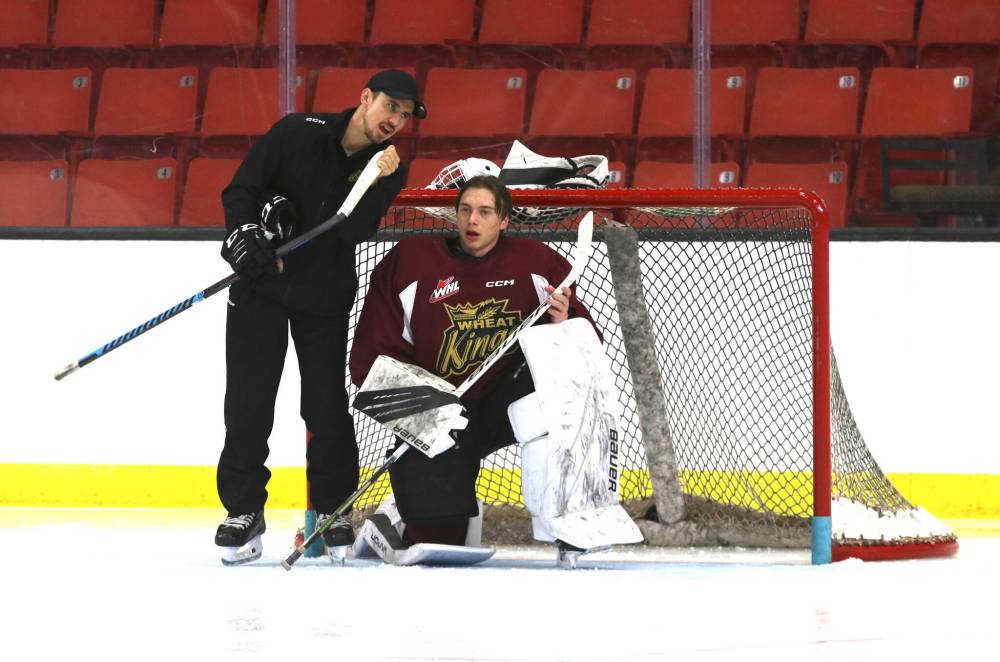
Colin McGill, shown with Brandon Wheat Kings goalie Ethan Eskit during a practice earlier this season, also serves as the director of goalie development at the Western Canada Hockey Academy. (Perry Bergson/The Brandon Sun)
“It was such a welcoming environment,” McGill said. “… In some things, you have to follow your heart and I decided to call back and we negotiated a contract and I decided to make my way out here.”
He and his father drove out from British Columbia and arrived on Aug. 4 just in time to make his tee-off with Plante at the U18 AAA Wheat Kings golf tournament.
On Aug. 7 he joined Plante for a skate with Wheat Kings goalie Carson Bjarnason and U18 AAA goalie Burke Hood and started his new job a day later.
“Tyler and I have a lot in common in the way we think the game the same way and coach very similar,” said McGill, noting Plante also played professionally in the United Kingdom. “Our eyes might see different things, but we approach them the same way.”
On a long day at WCHA, which also includes goaltender coaches Jared Paulsen and Dan Averill, he might be at the rink for more than 14 hours, while a shorter day might be three or four.
He also did a grassroots program for Hockey Brandon to introduce the position to young goalies and uses some of the top young goalies he coaches to help with the smallest netminders.
In addition, he’s on the ice at some Wheat Kings practices working with Bjarnason and Ethan Eskit. McGill notes younger, less accomplished goalies have more holes in their game, and sometimes it’s harder to gain their respect.
The difference between Bjarnason and Eskit is how they approach the game.
“When you get up to these guys, they are so professional,’” McGill said. “They’re very humble and very willing to get your opinion. They want criticism because they always want to get better.”
He has a large stable of clients through the WCHA, and also works with the Wheat Kings goalies, U18 goalies from Brandon, the Southwest Cougars and Yellowhead Chiefs, and with the female U18 Chiefs, plus a number of U15 netminders.
He is working with more than 50 goalies at various times.
As assistant goaltending coach for the Wheat Kings, he works with Bjarnason and Ethan Eskit and also pre-scouts puck stoppers from other organizations around the WHL.
McGill notes every job has its ups and downs, and working in hockey is no different.
“Sometimes you’re having a bad day and it’s easy just to look down at your skates and stickhandle a puck for a second and go ‘Oh my God, I get paid for this,’” McGill said. “It’s a pretty privileged experience. The hard part about it is I love it so much, sometimes when you emotionally invest in something, you care a lot and that can make the highs more intense and the lows more intense.”
McGill’s wife Ali and four-year-old son Westin stayed in Kamloops for the first year because he knew he would be busy as he became established. This gave him a chance to get a better sense of the city, so the house hunt might begin in the summer.
“I love Brandon,’” McGill said. “I love the community, it’s definitely a great place and I’m excited to continue.”
» pbergson@brandonsun.com
» Twitter: @PerryBergson
Colin McGill’s big theory of goaltending is built around a couple of themes. Here is his unedited insight into what makes a goalie effective.
“We focus on the wrong things. When you watch the speed of a puck hitting a pad for example and leaving that pad, it takes about .25 seconds to stop a puck. It’s that quick. If it’s .25 seconds to stop a puck and you’re going to get 40 shots in a game — that would be a heavy workload for a goalie — that means they’re actually stopping pucks for 10 seconds of a 60-minute hockey game.
“We have 59 minutes and 50 seconds left. To me, especially when we get to high levels, they know how to stop the puck, they know how to save it and do these things, the big thing is how do we get there? How do we move?
“Are we moving in a calm manner? Are we chasing the play or are we ahead of the play? Do we know our locations on the ice? Are we precise about it? Are we moving not only the fastest way, but the most efficient way?
“The movement from a goaltender is what tires that goaltender out. We talk about 40 shots in a game, there’s the movement to get to that .25-second save and that takes a lot of energy. For me, if you can be a goaltender who is very calm, you’re number one, going to conserve energy because less pucks will go through you, which is the worst goal a goalie can let in. You’re going to find less holes, you’re going to find efficient movement conserves energy and you’re also going to get to the location quicker.
“The other thing for me is a goaltender’s performance does not directly reflect the result of a game. I’ve watched a goaltender have a shutout and play horrible. It was all perimeter shots but their rebounds were bad, the team looked after them and cleaned it up. I’ve seen goalies let in seven goals and play amazing. The seven goals were Grade A scoring opportunities they had no chance on and they went in.
“As a goalie, you can let in three quick goals and it’s very easy for that frustration to come in and show it, and it’s only going to get worse from there. Being able to have a calm demeanour as you play calms down your team and they’re going to play in front of you better.”
» Bergson