
Forbes earns major sports nutrition honour
Advertisement
Read this article for free:
or
Already have an account? Log in here »
We need your support!
Local journalism needs your support!
As we navigate through unprecedented times, our journalists are working harder than ever to bring you the latest local updates to keep you safe and informed.
Now, more than ever, we need your support.
Starting at $15.99 plus taxes every four weeks you can access your Brandon Sun online and full access to all content as it appears on our website.
Subscribe Nowor call circulation directly at (204) 727-0527.
Your pledge helps to ensure we provide the news that matters most to your community!
To continue reading, please subscribe:
Add Brandon Sun access to your Free Press subscription for only an additional
$1 for the first 4 weeks*
- Enjoy unlimited reading on brandonsun.com
- Read the Brandon Sun E-Edition, our digital replica newspaper
*Your next Free Press subscription payment will increase by $1.00 and you will be charged $20.95 plus GST for four weeks. After four weeks, your payment will increase to $24.95 plus GST every four weeks.
Read unlimited articles for free today:
or
Already have an account? Log in here »
Hey there, time traveller!
This article was published 29/06/2024 (841 days ago), so information in it may no longer be current.
One day, Scott Forbes hauls 10 kilograms of creatine into his Brandon University office to prepare to test his theories on the supplement. The next, he’s flying around the world sharing his groundbreaking findings.
The BU professor spent last week in Florida presenting at the International Society of Sports Nutrition’s annual conference. To his complete surprise, he was named a fellow of the ISSN, one of just 40 worldwide.
“It came as a shock. Super grateful and honoured,” Forbes said.
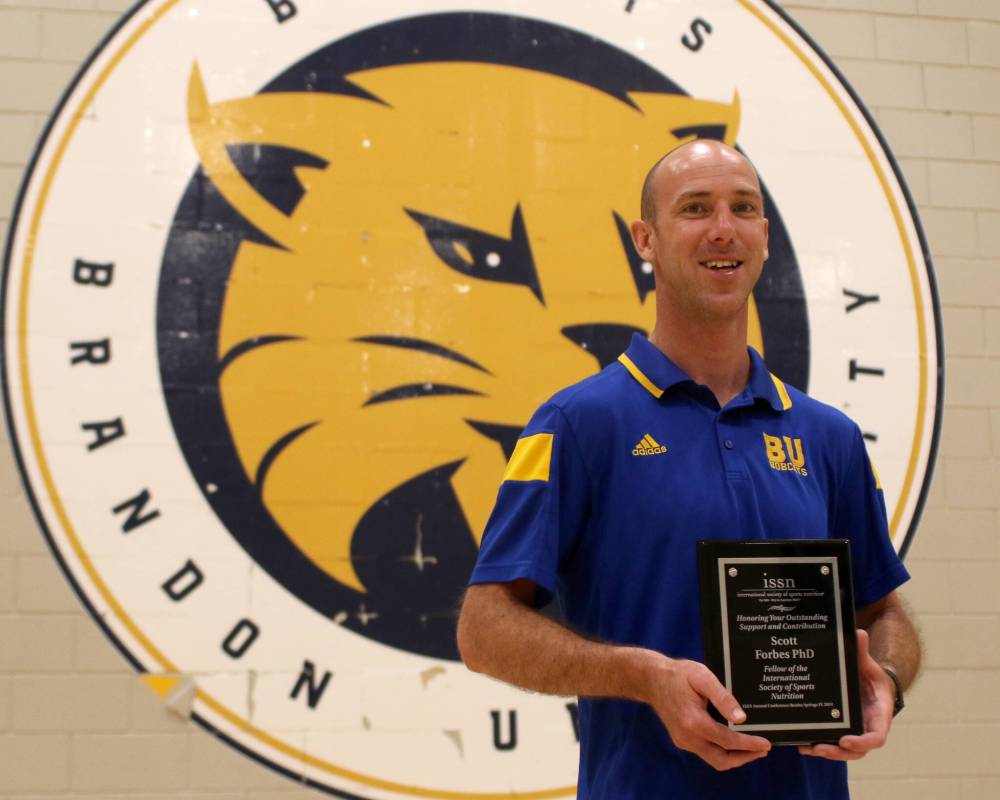
Brandon University professor Scott Forbes was awarded a fellowship with the International Society of Sports Nutrition earlier this month. Only 40 people in the world have the designation. (Thomas Friesen/The Brandon Sun)
“It shows what you can do at a smaller institution. To me, it means my research is having an impact and my peers are recognizing it and people around the world are recognizing that research.
“Oftentimes you’re stuck at your computer doing all the work and you don’t know who’s being impacted by your research but to me, this solidifies I made it to that level and am making an impact around the world.”
Forbes is the department chair of BU’s faculty of physical education. More commonly, he’s known as “Dr. Creatine.”
Most of the content on his Instagram page — followed by more than 14,000 people — is centred around the supplement and his ever-growing list of benefits he’s found in hundreds of studies dating back to his days at the University of Regina.
Forbes completed his undergraduate degree in kinesiology there in 2004, then followed up with a master’s degree. While studying Para Nordic cross-country skiing, another student and instructor invited him to study creatine and its effect on bench-press performance.
They found those who took their recommended dose of creatine could complete a couple more reps than those who took placebos.
Forbes had to learn more.
He completed his PhD at the University of Alberta in 2012 and a post-doctoral fellowship at the University of Calgary in 2014 before joining the BU faculty.
Over the years, he has continually learned more benefits of regular creatine supplementation while also quashing dozens of myths about it.
For example, some people fear creatine consumption along with resistance training will make their muscles “too bulky.”
However, Forbes’ studies — ranging from six to 32 weeks — found a difference of just one millimetre in muscle thickness compared to placebo.
While that is deemed statistically significant, the larger impact is in strength, where a five to 10 per cent increase is the norm.
“We’ve shown it’s not only a benefit to building bigger and stronger muscles for younger individuals. It’s also important for an aging or older population,” Forbes said.
“You can carry more groceries, just do more things if you’re stronger and you can also live longer, healthier lives with more muscular strength.”
“Now we also know it can impact bone tissues, so it can make your bones stronger and emerging research is showing it might improve your brain as well. It’s a really cool supplement that seems to cross several tissues in the body.”
For every study finding significant evidence to support creatine use, a few show no significant benefit. One was focused on high-intensity interval training in female college athletes. While everyone improved from start to finish, the creatine users had no measurable difference compared to the control group.
While Forbes has spent more than a decade of research and published more than 50 papers on creatine, he has to ensure studies are without bias.
He does that by preparing equal packages of creatine and a sugar and maltodextrin mix, which looks identical. Someone independent from the study randomizes the packages and assigns them to participants in groups “A” and “B.” Forbes doesn’t know which one the creatine group is until the statistical analysis is complete.
The recommended dosage of creatine is five grams per day. According to Forbes, it’s “very safe” when taken appropriately.
Forbes is currently working on a review of the effects of creatine on body composition, and one answering 16 misconceptions about the supplement with a team of researchers.
He could leave his research there and encourage everyone to head to their local supplement store and grab a tub if they want increased muscular strength.
But his curiosity is leading him in more directions now than it did at the start.
For one, people with Alzheimer’s have been found to have lower-than-average amounts of creatine in their brains, leading Forbes to study whether supplementation can reduce the impact of the disease on memory.
He also found evidence showing rugby players improve in passing accuracy with creatine when sleep-deprived. He posits creatine improves brain function when recovery through sleep is lacking, which leads to a thought for a future study on firefighters.
“I think creatine would be really cool to study in that population,” Forbes said. “They’re sleep deprived, they need that physical performance, so increased muscle strength, they might have hypoxia as well — a low amount of oxygen.”
Forbes has done much of the work alongside Darren Candow of the U of R, who also received the ISSN fellowship honour last week.
Forbes said the shift to Zoom meetings during the COVID-19 pandemic made collaboration much easier and significantly aided in his research, which he juggles with teaching BU courses from anatomy and exercise physiology to sport nutrition and fitness theory and practice.
He never imagined he’d have to juggle his regular work with speaking engagements and questions about supplements from around the world.
Then again, it just comes with the territory for Dr. Creatine.
» tfriesen@brandonsun.com
» Instagram: @thomasfriesen5