
Chyzyk builds on what he’s learned
Advertisement
Read this article for free:
or
Already have an account? Log in here »
We need your support!
Local journalism needs your support!
As we navigate through unprecedented times, our journalists are working harder than ever to bring you the latest local updates to keep you safe and informed.
Now, more than ever, we need your support.
Starting at $15.99 plus taxes every four weeks you can access your Brandon Sun online and full access to all content as it appears on our website.
Subscribe Nowor call circulation directly at (204) 727-0527.
Your pledge helps to ensure we provide the news that matters most to your community!
To continue reading, please subscribe:
Add Brandon Sun access to your Free Press subscription for only an additional
$1 for the first 4 weeks*
- Enjoy unlimited reading on brandonsun.com
- Read the Brandon Sun E-Edition, our digital replica newspaper
*Your next Free Press subscription payment will increase by $1.00 and you will be charged $20.95 plus GST for four weeks. After four weeks, your payment will increase to $24.95 plus GST every four weeks.
Read unlimited articles for free today:
or
Already have an account? Log in here »
Hey there, time traveller!
This article was published 12/12/2024 (623 days ago), so information in it may no longer be current.
Bryn Chyzyk is a product of all the people he’s met along the way.
The 32-year-old longtime player now serves as general manager of the USHL’s Waterloo Blackhawks and suggests his greatest strengths were developed by listening to and watching others.
“It starts with my parents (Dave and Michelle) back in Virden and some of the things they instilled in me as a person and every coach I had through my hockey career, I’d like to think I picked up some of the positives that I thought they exemplified along the way,” Chyzyk said. “That goes right from the Southwest Cougars to the Dauphin Kings and ultimately the University of North Dakota. When I think of myself, I think my personality is my greatest attribute and my handling with people, which I do a lot in this job, just being honest and firm and respectful while also being a good person to talk to.
“I think that’s how I’ve been shaped through my upbringing and I’m proud of where I’m at today.”
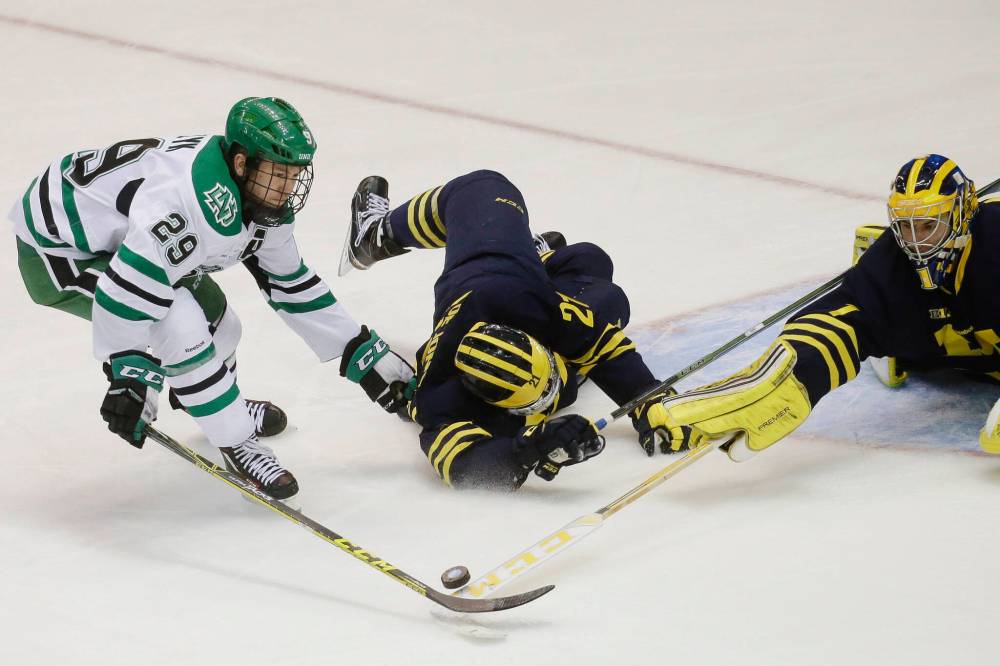
Chyzyk played with the under-18 AAA Southwest Cougars in 2009-10, the Manitoba Junior Hockey League’s Dauphin Kings in 2010-11 and the USHL’s Fargo Force in 2011-12 before spending four seasons at the University of North Dakota, winning a national championship in 2016.
He became Waterloo’s director of scouting during the 2020-21 season, and was unusually young at 29 when he was named GM in advance of the 2021-22 season.
“It definitely came faster than I expected it to,” Chyzyk said. “I started working for the organization a year before as director of scouting and was working hard, and there was a shakeup with the GM and the coach the next year and the ownership group was impressed with the work I had done in one year and I was fortunate enough to get that job.
“It was always my long-term plan to get into a position, but it happened a little sooner than I was planning, which I can’t complain about.”
As a scout, he worked with the other scouts on his team but as a GM — similar to any business owner or operator — suddenly every problem in the organization ends up on his desk eventually.
“That’s probably the biggest adjustment starting out,” Chyzyk said. “As a kid I dreamed of being a GM. I know I was a hockey player at one point, but my true dream was to be an NHL GM over being a player, which is maybe why I didn’t make it. Playing around, it’s all trades and drafts and you think that’s the whole job, but once assuming the role, you realize everything falls onto your plate as far as budgets and development plans and agents and the different people who are involved in running a hockey team. Trading and drafting are just a small portion of it.”
He was apparently a quick learner, because after his second season the 30-year-old hockey executive was named the league’s general manager of the year. The Blackhawks had gone 40-21-1 that season, finishing second in the Western Conference.
While they lost in the first round of the playoffs, it was a 21-point improvement over his first season, and a 36-point increase over two years earlier before he took over the team.
“It’s a league award voted on by your peers, and just entering the league one year prior, I was trying to earn everybody’s respect and it was cool to see I had done that among my peers as a young individual in a field dominated by guys who had been there a long time,” Chyzyk said. “It was a nice feather in my cap to know my peers were respecting the job I was doing.”
Waterloo, Iowa is a community of 67,000 located 350 kilometres southeast of Minneapolis. The team was founded in 1962 as a semi-pro senior squad, and became a junior club in the 1979-80 season.
“The league is kind of centred in Iowa, where we’re at,” Chyzyk said. “As far as youth hockey, it’s fairly light, but the fans are really passionate about our team and have been following it for a lot of years. The crowd gets rowdy. They’re maybe not as hockey knowledgable as the fans up in Manitoba but they love a good drink special and they love a good hockey game. We feed off that and it’s a really fun atmosphere.”
Managing in the USHL isn’t easy because of the roster turnover. While a Western Hockey League GM can reasonably expect to have a player from 16 to 19 unless they’re good enough to play in the National Hockey League, a USHL player might leave for college any time after they graduate from high school.
For instance, this season Chyzyk had just seven full-time players returning.
“It’s incredibly difficult,” Chyzyk said. “The reality is in the USHL that when you develop a good player, he’s gone. We try and keep our players on two-year windows but that’s not always the case. “The roster turnovers so extreme that the importance of scouting and always finding the next level of talent is crucial. It’s very difficult to do long builds and long projection plans. In Waterloo, we pride ourselves in rebuilding every single year and going at a championship, which is difficult to do.”
Chyzyk said the major junior and USHL models are different for that reason. You can play a 16-year-old in junior because you’ll likely have him for a while. He thinks there will be a positive impact on his league due to the NCAA’s recent changes that allowed in major junior players.
“With the extra players going to college, we probably will be able to return more players now,” Chyzyk said. “I think it will give us more returnees in our league, just because it’s going to be more difficult to enter Division 1 hockey. I think in regards to the CHL, they’re not always going to be able keep those guys that long anymore, so they get a little closer to how our league is structured. “Not all the way, but a little bit closer and I think we will get a little bit longer term path with our players.”
Ultimately, there are still 1,400 jobs spread out among the 60 teams in the Canadian Hockey League and about 400 with the 16 USHL squads, which includes the U.S. Development Team. They’re funnelling players into 64 Division 1 programs, so there aren’t more jobs being created, they’re just essentially being redistributed.
“There aren’t more spots being created or less spots, but you may see a shuffle,” Chyzyk said. “If you look at the U.S. product, we have 15 teams for the entire country. How much growth there has been in American hockey is pretty crazy. I feel like our depth among those 15 teams is very strong and there are players who aren’t able to play in the USHL who want to go to college who are Tier 1 junior players in my opinion. I do feel there are more players that are at our level than we have spots for, which I think will be a big piece of the shuffle with some of those guys looking up north.”
“Where does it shift those players? I don’t know.”
At the league level, there were conversations when the rumours began the NCAA changes were inevitable, but nobody was certain when and how it would come down the pipe. That led Chyzyk to focus inward and prioritize building relationships with players and prospects.
He added the USHL clubs have pre-existing relationship with the NCAA teams, which gives them a leg up.

Chyzyk said that just like with major junior players, it’s a topic of conversation with elite American players as they puzzle out what to do next.
“It’s changed my job completely,” Chyzyk said. “Previously in our draft process, it was looking for the odd red flag of a guy wanting to go play Canadian major junior, and now we have to recruit everyone. Players have options. I do think it’s changed the whole landscape and there will be a lot more recruiting in my job than there used to be.
“If you wanted to play college hockey before, you knew you were coming to our league and now that’s not the case, so there will definitely be a lot more recruiting.”
Chyzyk chuckles when asked if it’s easier or harder for younger players now that there aren’t two well-defined paths anymore in which kids either take the college route or play major junior.
“It’s hard question to answer because right now we’re just in the predicting and projection standpoint of this rule change,” Chyzyk said. “The more players who can play college hockey, the better. I was fortunate with myself as a player that I was a late bloomer and it happened organically. I didn’t necessarily choose that route, it chose me. But some of these players who are like that, not having to make a decision at 16 and still get the opportunity to play college hockey is a good thing for hockey.
“Whether that makes it harder or easier, I don’t know. It definitely makes my job harder.”
» pbergson@brandonsun.com
» Twitter: @PerryBergson