
Paddock tapped for Manitoba Sports Hall of Fame
Advertisement
Read this article for free:
or
Already have an account? Log in here »
We need your support!
Local journalism needs your support!
As we navigate through unprecedented times, our journalists are working harder than ever to bring you the latest local updates to keep you safe and informed.
Now, more than ever, we need your support.
Starting at $15.99 plus taxes every four weeks you can access your Brandon Sun online and full access to all content as it appears on our website.
Subscribe Nowor call circulation directly at (204) 727-0527.
Your pledge helps to ensure we provide the news that matters most to your community!
To continue reading, please subscribe:
Add Brandon Sun access to your Free Press subscription for only an additional
$1 for the first 4 weeks*
- Enjoy unlimited reading on brandonsun.com
- Read the Brandon Sun E-Edition, our digital replica newspaper
*Your next Free Press subscription payment will increase by $1.00 and you will be charged $20.95 plus GST for four weeks. After four weeks, your payment will increase to $24.95 plus GST every four weeks.
Read unlimited articles for free today:
or
Already have an account? Log in here »
Hey there, time traveller!
This article was published 16/07/2025 (323 days ago), so information in it may no longer be current.
The end line of the volleyball court at Oak River Elementary is two bricks up the wall.
Far from the ideal training round, it’s still the starting point for one of the most remarkable volleyball careers in Manitoba’s history.
Russ Paddock took his game from the tiny Westman community to the sport’s biggest stage, the 1992 Olympics in Barcelona, Spain. Entering 2025, he had nine medals from national championships as a player, coach and athletic director.
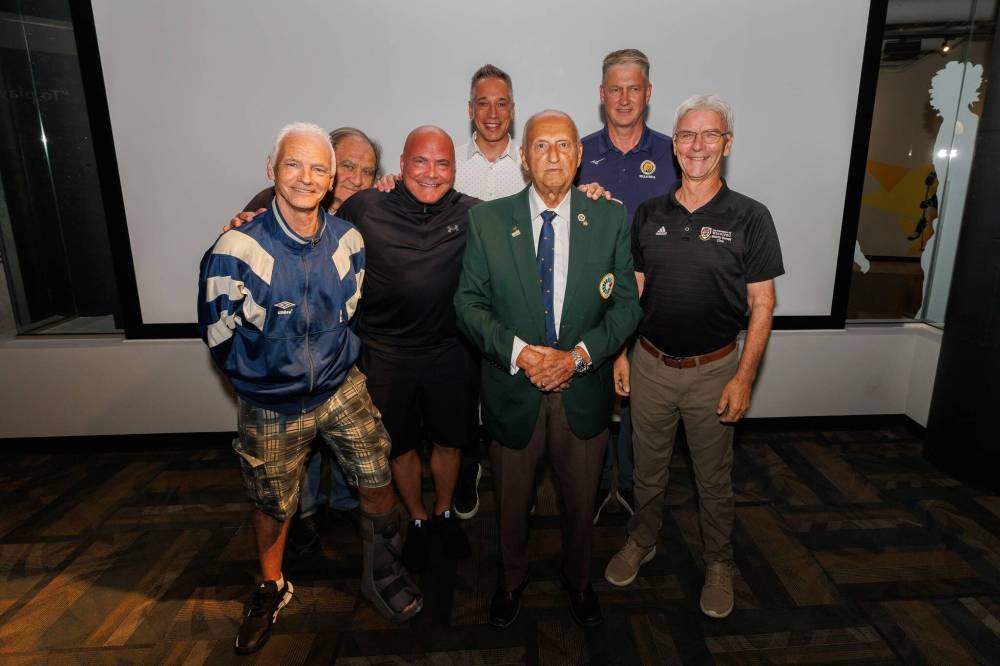
Some of the inductees of the class of 2025 for the Manitoba Sports Hall of Fame during a press conference at the Manitoba Sports Hall of Fame on Wednesday. (From left) John Baillie, Michael Nardiello, Troy Westwood, Rob Albo, Colonel Gary Solar, Russ Paddock and Glen Bergeron. (Winnipeg Free Press)
On March 23, however, the program Paddock took from the basement of Canada West to a national contender reached the pinnacle with its first-ever U Sports title.
The Brandon University athletic director was announced as part of the Manitoba Sports Hall of Fame class of 2025 on Wednesday, and will enter the Hall in November as an athlete/builder.
“I was quite surprised and honoured to be recognized or included with some of the amazing athletes, builders and sport contributors that have come from Manitoba,” Paddock said, adding he’s especially humbled to join a few of the province’s volleyball greats.
“Certainly Garth Pischke’s in there, but I’d never consider myself in the athlete category like he would be.”
HUMBLE ROOTS
Paddock grew up in a baseball and hockey family — in a baseball and hockey town.
While Oak River isn’t known as a hotbed for athletes, Paddock said the emphasis the school system placed on sport participation made for a great start to his athletic career.
He attended high school in Rivers, about 18 minutes away, before graduating in 1984 as an “A” provincial volleyball all-star.
While the six-foot-eight middle blocker seems made for volleyball, he feels his involvement in the game may not have been the same if artificial ice was more prevalent.
His local rinks were mostly natural ice, so hockey couldn’t start until the end of November, freeing him and his older brothers up for volleyball season.
“It was something that I always did but even when I finished high school, I never imagined playing university volleyball,” said Paddock, who received an invite to an ID camp for the 1985 Canada Summer Games team.
“I probably wouldn’t have gone, except that I convinced some teammates to go with me.”
He was invited to a few more camps, where he met Phil Hudson, the current University of Winnipeg women’s coach and someone with a strong case for a place on Manitoba’s Mount Rushmore of volleyball coaches.
BISONS CAREER
Paddock credits Hudson with truly shifting his focus to volleyball as he encouraged him to try out for the powerhouse University of Manitoba Bisons.
He was already planning to attend the school but vied for a spot on Pischke’s defending national championship team.
Believe it or not, Paddock didn’t make the roster.
“Their bench was probably the third-best team in the country,” Paddock said of the team, which included a big-name newcomer in 1984 Olympian John Barrett.
Pischke let him practise with the team until December, when he had his last Canada Games tryout. Paddock made the team and practised three times a week before travelling to Saint John, N.B.
At the Games, Manitoba fell in the final to Saskatchewan, something that’d soon become a recurring theme in Paddock’s volleyball journey.
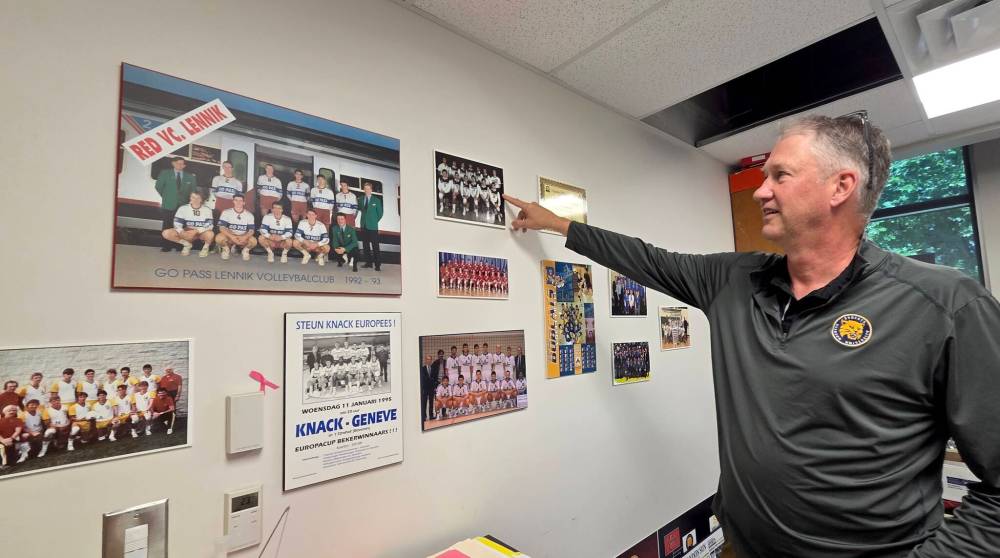
Russ Paddock looks at the wall in his office, full of team pictures from his playing and coaching days. (Thomas Friesen/The Brandon Sun)
He returned to the U of M and made the team in 1985, playing a bit that year and starting the following three.
The Bisons lost the 1986 national final to the Winnipeg Wesmen, beat the Calgary Dinos for bronze the following year, fell to the Saskatchewan Huskies in 1988, and then dropped yet another final to the Dinos in 1989.
TEAM CANADA
His collegiate career ended at a good time, though. That year, Volleyball Canada decided it wanted its national team at a full-time training centre for three years to prepare for the 1992 Olympics, rather than scattering to professional teams around the world for the majority of the year.
He was selected and spent 11 months a year training, along with a few tours. Canada played a nine-match tour against a club team from Kyiv, Ukraine in December 1990, as well as some exhibition matches against the United States in tennis stadiums.
Paddock’s timing proved even better when the FIVB Volleyball World League began in 1990. Canada earned a spot the following year, so the team got plenty of quality international competition to prepare for the Olympics.
There were two sides to Paddock’s Games experience.
Off the court: “Once in a lifetime.”
“Any sport group or team, you remember the process that got you there, and for us it was three years,” Paddock said. “It was a special event I’d never been to before and nothing was like it since.”
On the court: “We could have finished better.”
Canada dropped tight five-set matches to Spain, the U.S., and Japan, along with a 3-1 loss to world No. 1 Italy and a lone 3-0 victory over France to miss the playoffs.
It fell 3-1 to South Korea in the ninth-place match.
Paddock’s career wasn’t done there. He moved to Belgium in 1992 and played his first pro season with Ken Greves, father of UBC stars Logan and Mason.
Paddock spent the following season in Berlin, Germany, then returned to Belgium for two more years to play for the same coach as his pro debut.
TRANSITION TIME
In 1996, after the birth of his and wife Stephanie Karpan’s first child, Milana, he knew it was time to move on.
He returned to U of M to finish his education and coach under Pischke for a season, then taught for eight years at Winnipeg’s Vincent Massey Collegiate.
Then, as the Bobcats completed their two-year probationary period in what’s now the Manitoba Colleges Athletic Conference, a Brandon man named Grant Wilson encouraged Paddock to apply for the men’s volleyball head coaching job.
They had worked together on the 2001 Canada Games staff and teamed up again when Paddock was offered the position.
It wasn’t necessarily an easy decision to move, though.
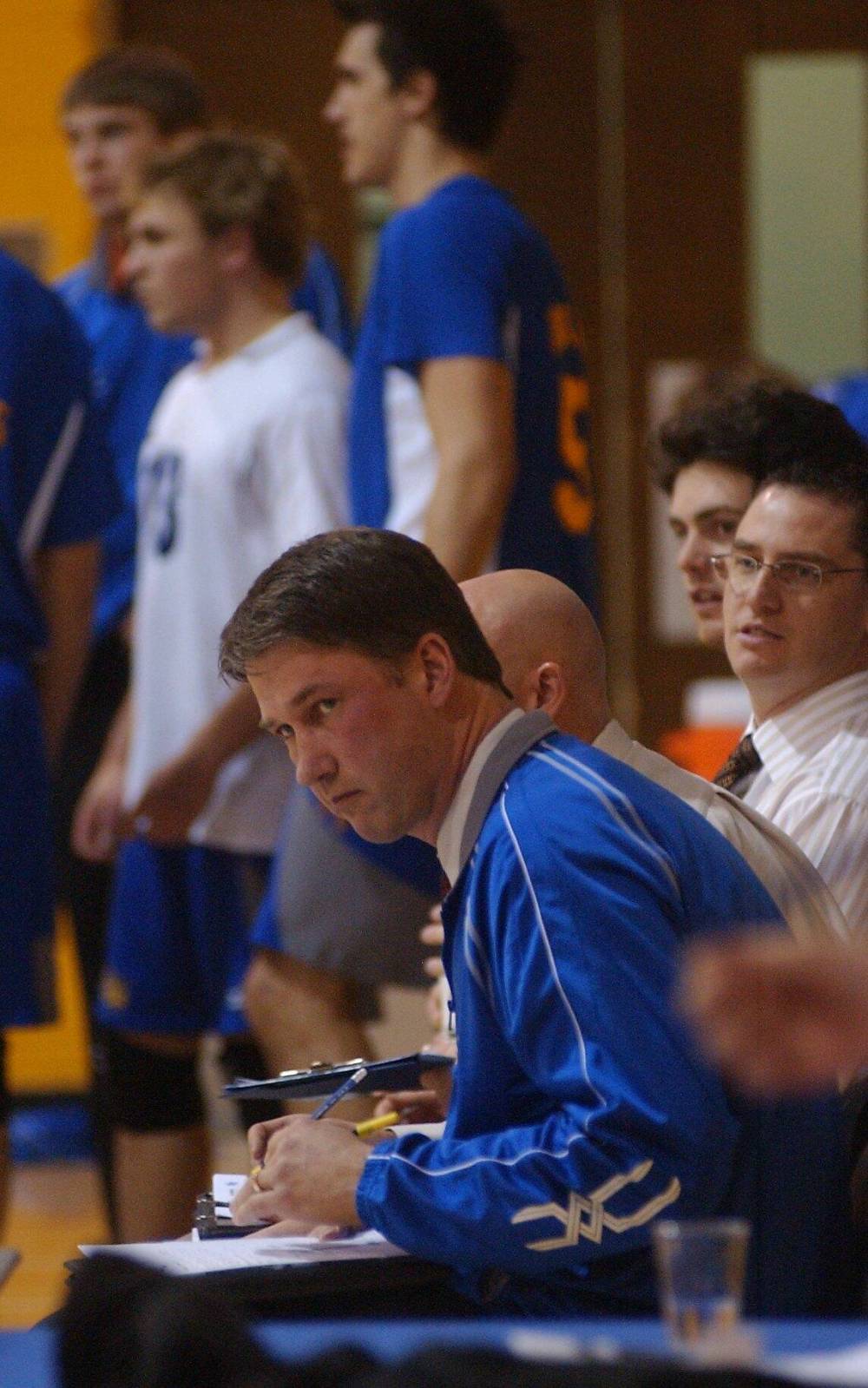
Russ Paddock coaches a match in 2007. (Brandon Sun files)
“It was tough because the program wasn’t very stable here at the time and the facilities weren’t great compared to what we have now,” Paddock said.
“It was going to be tough recruiting to a small school with limited resources and facilities but I thought that’s what I wanted to do.”
When he arrived at BU, president Lou Visentin was realistic about the situation he was entering.
“There’s a good chance you might never win as a small school, but it’s worth pursuing,” Paddock recalls his message.
“We certainly pursued that, tried to make the program appealing to attempt to recruit top players.”
TWO-FOLD APPROACH
The Bobcats weren’t going to start as a powerhouse — no one does.
But Paddock and Wilson established the Brandon Volleyball Club to develop some players, fans and support in the community and encourage the top local athletes to stay home after high school.
The second key was landing talent from around the world.
It started with Cam Blewett, the Australian libero who caught Paddock’s attention in a way utterly foreign to most of today’s recruits.
“He sent a VHS tape, I believe, to every university coach in Canada,” Paddock said.
The libero position was less than a decade old, and in many respects, an afterthought in terms of the ways teams could utilize it.
Paddock said he would typically just give one of his left sides the alternate jersey, and seek a big offensive weapon to use one of his coveted import spots.
But he played the tape and noticed someone else — a hitter named Paul Sanderson.
The future U Sports player of the year had played one NAIA season with fellow Aussie Luke Reynolds in Kansas, for a program that folded after their rookie season.
All three Aussies arrived at BU in 2007 and didn’t take long to set the tiny program on a fast track to success.
“They helped to really raise our level in those few years and for many years afterwards, Luke really assisted with recruiting efforts,” Paddock said.
“They really raised us from the bottom of the league to the middle of the league. We’ve never been below the middle of the league since.”
The Bobcats made their first trip to nationals in 2009, capturing a bronze medal with a four-set win over the McMaster Marauders.
Two years later, they played their first national final, dropping a 3-0 decision to the host Trinity Western Spartans.
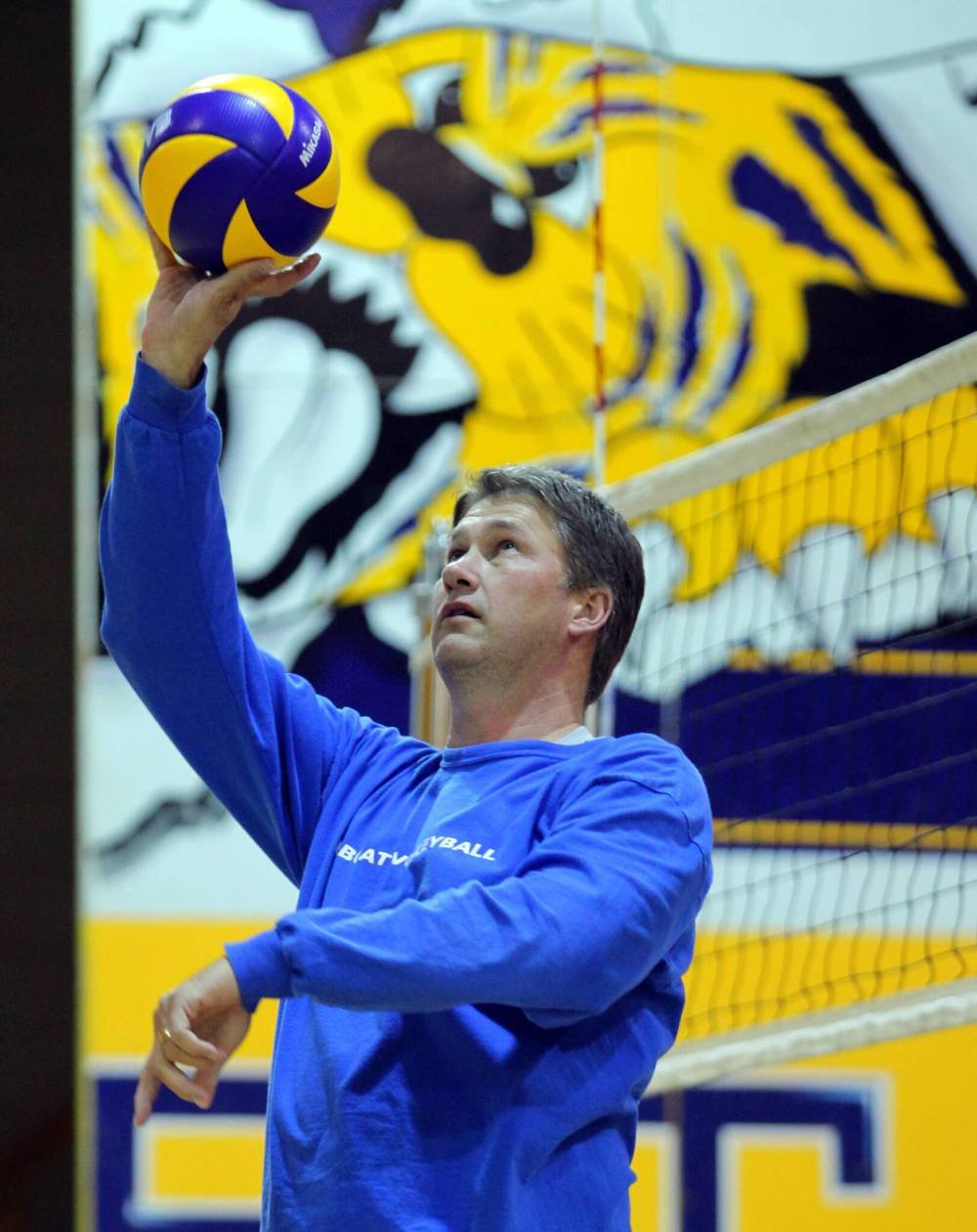
Russ Paddock coached the BU men’s volleyball team to national bronze and silver medals. (Brandon Sun files)
In 2012, Paddock was promoted to athletic director and Wilson moved up to the head coach’s chair.
That season, BU won Canada West for the first time, went back to nationals and returned with another bronze medal.
It took six years to get back, after the No. 1-ranked Bobcats won the Canada West title at home in 2019 before falling to the Spartans a week later in the national gold-medal match, again in straight sets.
The Bobcats had already been named the host for nationals in 2021, but that event was cancelled due to COVID-19.
When they finally got to play in the tournament at home in March, Paddock had to wonder if it would be his last great shot to heal the scar tissue he developed from nine close calls on the national stage.
When the Bobcats swept the Wesmen, came back to beat the Huskies 3-2, and ultimately dropped the defending champion Alberta Golden Bears 3-1, a usually uber-stoic man let the tears flow.
“It was a long time coming,” Paddock said. “You can say 20 years in the making for here but certainly I had some other silver medals at national championships, even back to Canada Games. I didn’t need another one of those.
“It was pretty special to do that.”
Since the program’s inception, only three schools have won more national medals, and only two have reached the Canada West final more often.
Paddock will soon be a Manitoba Sports Hall of Famer, joining Winnipeg Blue Bombers kicker Troy Westwood, softball player Ashley Lanz, athletic therapist Glen Bergeron, Gary Solar and the 1987 Lucania Football Club (soccer) in the class of 2025.
Incredibly, John and Alvina Paddock had three boys, all of whom found their way to Halls of Fame. John landed in the American Hockey League Hall of Fame in 2010 and the Manitoba Hockey Hall of Fame in 2015, and Gord was inducted in the Manitoba Baseball Hall of Fame in 2017.
Russ’s volleyball journey started organically and continued the same way. He simply saw opportunities present themselves and made the most of them. It would have been a success without the gold medal hanging in the corner of his office, but he also doesn’t plan to rest now that he has achieved a lifelong dream.
“I don’t feel that I’ve missed anything,” he said. “I’d certainly like to win another championship, absolutely.
“We’ll keep working towards that and I’ll keep supporting all of our other (Bobcat) teams to give themselves that opportunity as well.”
» tfriesen@brandonsun.com
» Instagram: @thomasfriesen5