
McMahon retiring from remarkable career in sport
Advertisement
Read this article for free:
or
Already have an account? Log in here »
We need your support!
Local journalism needs your support!
As we navigate through unprecedented times, our journalists are working harder than ever to bring you the latest local updates to keep you safe and informed.
Now, more than ever, we need your support.
Starting at $15.99 plus taxes every four weeks you can access your Brandon Sun online and full access to all content as it appears on our website.
Subscribe Nowor call circulation directly at (204) 727-0527.
Your pledge helps to ensure we provide the news that matters most to your community!
To continue reading, please subscribe:
Add Brandon Sun access to your Free Press subscription for only an additional
$1 for the first 4 weeks*
*Your next subscription payment will increase by $1.00 and you will be charged $20.00 plus GST for four weeks. After four weeks, your payment will increase to $24.00 plus GST every four weeks.
Read unlimited articles for free today:
or
Already have an account? Log in here »
Janet McMahon helped build Sport Manitoba from the ground up, without forgetting where she came from for a second.
The approach she took to her first job at Westman Sport, to the inception of Sport Manitoba in 1996, to today as the organization’s president and CEO, is straightforward.
“What stands out for me the most is Janet’s passion for sport — her passion for sport from the perspective of, ‘The athlete comes first,’” said Jeff Hnatiuk, the province’s deputy minister of sport, culture, heritage and tourism.
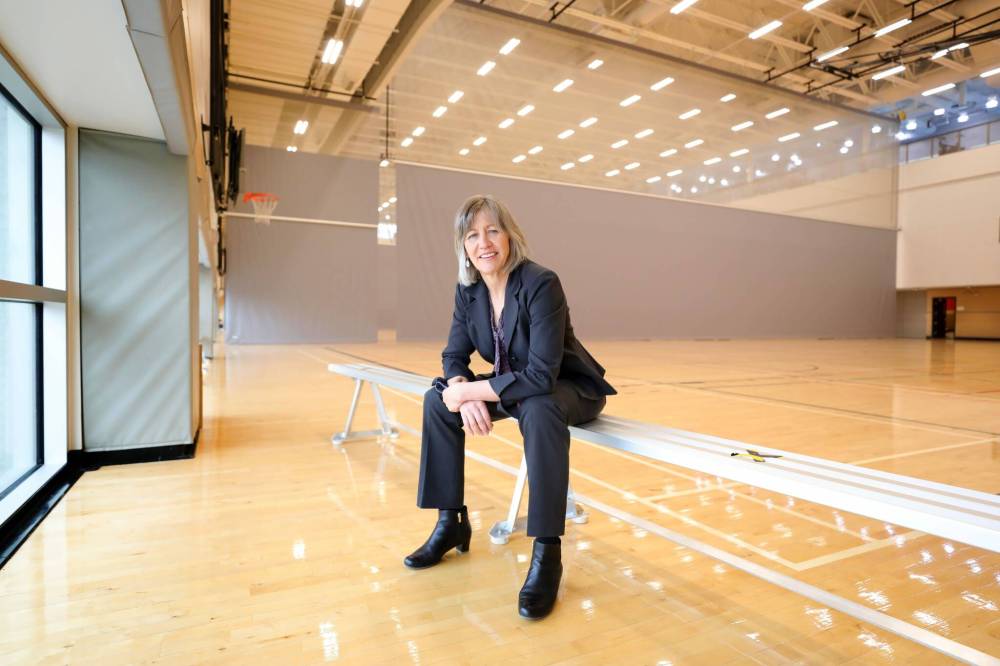
Sport Manitoba president and CEO Janet McMahon is retiring on Friday. The Brandonite has worked for the organization since the start of its 30-year existence. (Winnipeg Free Press files)
“In Janet’s mind, it was always what’s best for the athlete.”
The Brandonite is retiring on Friday after 40-plus years dedicated to the growth and development of sports in Manitoba.
“It’s a really strange position to be in,” McMahon said.
“On the one hand, I’m leaving in a good place for me and I was able to do it on my own terms. From another perspective, you never think it’s going to happen. The idea of not coming here anymore, it’s quite bizarre.”
EARLY LEADERSHIP EXAMPLES
McMahon grew up as a multi-sport athlete like many, but quickly realized the ways organizations ran could be improved when she played Vincent Massey Vikings basketball. Coaches Mike Hill and Stew Farnell laid the blueprint in their fight for equity for the girls’ team.
“Their whole empowerment of high school girls and what they were doing back then was quite forward thinking,” McMahon said.
“We didn’t have a lot of equal programming back in those days. They fought hard so we got the same uniforms, trips, tournaments, all the things the guys’ teams did.”
Following a standout high school career, Winnipeg Wesmen coach Tom Kendall recruited McMahon, and she played four years, winning three Great Plains Athletic Conference titles and two national bronze medals.
After that, she ended up as a games co-ordinator for Westman Sport, which sparked her interest in the path she ultimately followed for the rest of her career.
Hnatiuk and McMahon connected when he was the recreation director in Melita.
When he was appointed president and CEO of Sport Manitoba upon its inception — a merging of the Province of Manitoba Sport Spot Directorate and the Manitoba Sports Federation — he knew he needed McMahon on board.
DIRECT-HER OF SPORT
McMahon proved her value to the organization from the start.
She played a pivotal role in revamping and simplifying Sport Manitoba’s funding model.
Hnatiuk said her creative, outside-the-box thinking was instrumental in resolving major issues or challenges. What stood out most was that if she brought up an issue, she always came prepared with a solution.
Six years after joining Sport Manitoba, following a secondment to help orchestrate the 1999 Pan Am Games in Winnipeg, McMahon was promoted to director of sport.
Soon after, she started Sport Manitoba’s LeadHERship conference. The program was focused on empowering women in coaching, management and administrative roles.
McMahon found other ways to do so through forward thinking. When Hnatiuk was appointed as president and CEO of the 2017 Canada Games, one of his first moves was to bring her over with him on a secondment from Sport Manitoba.
While the Games historically have created major physical legacy projects, such as the Canada Games Sport For Life Centre in Winnipeg, McMahon saw a way to do more.
“Developing women leaders in sport was really important to Janet,” Hnatiuk said. “We wanted to leave a legacy of people.
“We wanted to bring young staff on, give them an experience, give them an opportunity and hope they stay in the community and are valuable contributors in sport or whatever job they may go to.
“We did that, and a lot of it is attributed to Janet and the team she brought along.”
Her team included Kelly Babb, now the senior games specialist for Sport Manitoba. She plays a key role in delivering the Manitoba Games every two years, while keeping Team Manitoba organized behind the scenes to thrive on the national stage.
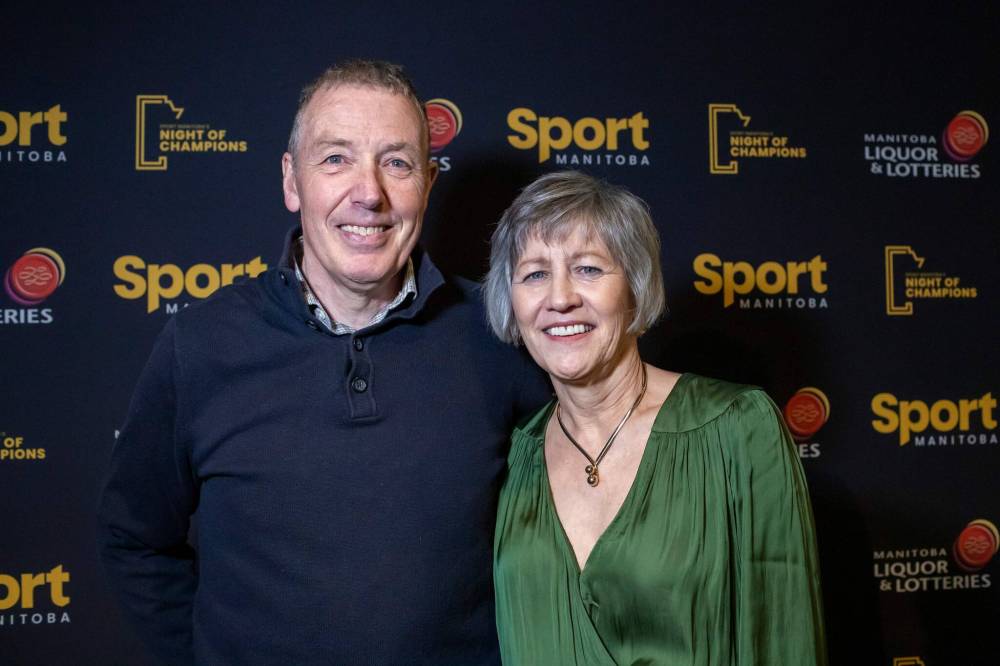
Janet McMahon, right, is pictured with her husband, Laurie Penton, at Sport Manitoba’s Night of Champions in 2024. (Winnipeg Free Press files)
Another is Jolène Dupuis, who spent six years with Cycling Canada after the 2017 Games, and is currently the events and programs manager of Sport Yukon.
Along with empowering the leaders McMahon directly trained, she wants to see the number of women coaching female teams continue to increase.
“One of the fundamental challenges we still have is male coaches for female teams. Without us being able to get more of them to stay in longer and give back, it’ll be difficult to be equal,” McMahon said.
“Some of them have made great strides; you see the soccer numbers and even the hockey numbers being closer.”
LEADING BY EXAMPLE
As McMahon’s role grew, she always knew the importance of volunteers to make sports function.
Her work life was busy enough, yet she refused to promote volunteerism without being involved herself.
McMahon has served as convenor for the Corydon Community Centre basketball program, organizing Winnipeg Minor Basketball Association teams and coaching when necessary.
“She’s done the things the people on the ground level of sport delivery have done and are doing,” said John Blacher, who stepped into McMahon’s director of sport role when she was promoted.
“People that interact with her at that level probably don’t know she’s the president and CEO of Sport Manitoba.”
For the past five years at the top of Sport Manitoba, McMahon hasn’t changed the qualities that helped her get where she is.
Sport Manitoba director of finance Laurel Read, who has known McMahon for 40-plus years, feels she completely excelled in the role.
Some days, the job includes connecting with high-level government officials and leaders of national sport bodies. Others, it’s guiding a staff member through challenging times.
“Everyone on our team feels seen, it doesn’t matter who you are. Whether you are a director or whether you are the cleaners cleaning the building, she’s got time for everyone,” Read said.
“What you see is exactly what you get. She’s extraordinary. There’s no performance, no pretence. She is extremely warm, grounded, whether it’s standing in front of a board or sitting with one of our staff that’s struggling with personal issues or work issues.
“Everything she does, she does with gratitude, grace and professionalism.”
LIFELONG LEARNER
When McMahon started in her current role, she said her focus was internal, on how Sport Manitoba could improve. She realized quickly that the most important job was to improve the provincial sport organizations.
That didn’t necessarily mean telling everyone what to do, but listening to what they need.
“People always talk about defining leadership. Well, leadership is often about listening and really understanding and hearing what people are telling you,” McMahon said.
“I have learned to ask more questions so I can see all the facets of a situation, a debate or a program, versus me jumping to some kind of a conclusion and finding a solution.”
While she may have the ultimate say in a decision, she knows walking into a room with her mind made up is a mistake.
A conversation around a boardroom with six differing opinions may move more slowly than it would if the leader simply put their foot down.
But as an athlete, a coach, and someone with a view of the bigger picture, McMahon encourages people not to shy away from that tension.
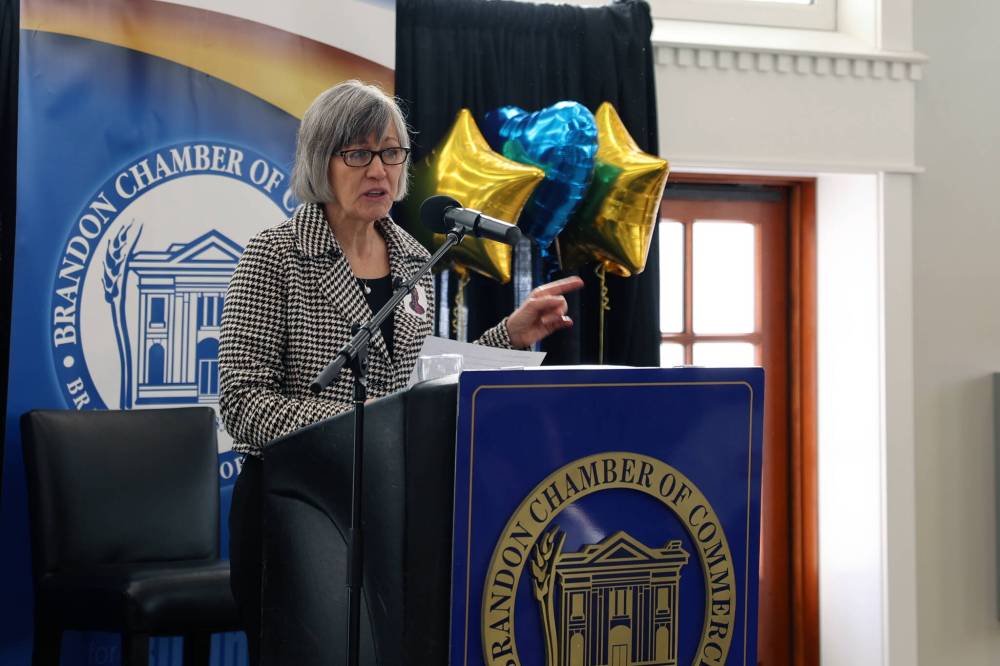
Sport Manitoba president and CEO Janet McMahon delivers the keynote address at the Brandon Chamber of Commerce’s Superwoman Conference in 2022. (Brandon Sun files)
“We talk about sport being a positive experience. Well, sometimes you learn more from the tension and friction, the sandpaper, than you do from the positive experience. We always say we can learn more from losing than winning,” she said.
“We have this idealistic view of what sport is. Sometimes people learn more from those negative experiences … things they’d do differently the next time.”
Listening to people amidst challenging, sensitive conversations around the treatment of athletes was incredibly important late in her career.
In recent years, McMahon helped take Safe Sport from a concept — a few recommendations for coaches to create a safer environment — to law.
The Province of Manitoba passed the Protecting Youth in Sports Act on April 1, mandating all provincial sport organizations follow policies, including coach screening, the rule of two, independent third-party review of maltreatment complaints and more.
It’s a perfect example of her ability to listen to individuals with their boots on the ground, provide solutions to major issues and work with high-level officials to facilitate a change with the athlete experience at the forefront.
“Her contributions have been so far-reaching and have impacted so many over the 40-plus years,” Hnatiuk said. “Sport in Manitoba is in a much better place because of Janet and what she’s done.”
POWERING THROUGH
In 2022, McMahon was diagnosed with amyotrophic lateral sclerosis (ALS), a neurodegenerative disease that kills nerve cells and impairs voluntary muscle control.
She suspects she had it longer, but had started testing during the COVID-19 pandemic, which delayed the diagnostic process.
It was certainly tough to come to terms with, as ALS comes with an expected life expectancy of three to five years. But McMahon was determined to deliver on all the tasks she committed to, even right up to this week, as she’s tying up loose ends on projects she doesn’t want to leave unfinished.
“This is a disease that you don’t know what the progression will be. Technically, I’ve probably beaten some odds,” McMahon said.
“I didn’t want it to define me, but in some ways, the job helped me focus outwardly, not focus on being ill. I’ve loved what I’ve been doing, and it helped me focus my attention on the things I thought mattered more than a disease.”
“I’m amazed and it’s a constant reminder of how she has handled this ALS diagnosis, how we all need to be grateful. She uses the word all the time,” Read added.
“It’s a good reminder to all of us. Our staff have looked at life differently based on how she has reacted and taught us.”
McMahon empowered thousands of people united by the common goals of creating lasting memories and positive experiences in sport, and countless more indirectly through her work.
Moving forward, McMahon is excited to spend more time at her cabin, and with her family, which includes husband Laurie Penton and sons Connor and Erik.
“There were so many experiences and so many people that when you reflect back, it’s just been a privilege to work here,” McMahon said.
“From all the challenges to all the celebrations, it’s really the relationships that mean the most.”
» tfriesen@brandonsun.com