
Treatment for brain injuries continues to evolve
Advertisement
Read this article for free:
or
Already have an account? Log in here »
We need your support!
Local journalism needs your support!
As we navigate through unprecedented times, our journalists are working harder than ever to bring you the latest local updates to keep you safe and informed.
Now, more than ever, we need your support.
Starting at $15.99 plus taxes every four weeks you can access your Brandon Sun online and full access to all content as it appears on our website.
Subscribe Nowor call circulation directly at (204) 727-0527.
Your pledge helps to ensure we provide the news that matters most to your community!
To continue reading, please subscribe:
Add Brandon Sun access to your Free Press subscription for only an additional
$1 for the first 4 weeks*
- Enjoy unlimited reading on brandonsun.com
- Read the Brandon Sun E-Edition, our digital replica newspaper
*Your next Free Press subscription payment will increase by $1.00 and you will be charged $20.95 plus GST for four weeks. After four weeks, your payment will increase to $24.95 plus GST every four weeks.
Read unlimited articles for free today:
or
Already have an account? Log in here »
Decades ago, a hockey player might be knocked unconscious on the ice, wake up in the dressing room and return to play in the third period.
Happily, those days are long gone as concussions are better understood and taken far more seriously.
Former Brandon Wheat Kings athletic therapist Zach Hartwick, who resigned from the club after the Western Hockey League season to move his family closer to home, was asked what happens when a player suffers a suspected head injury.
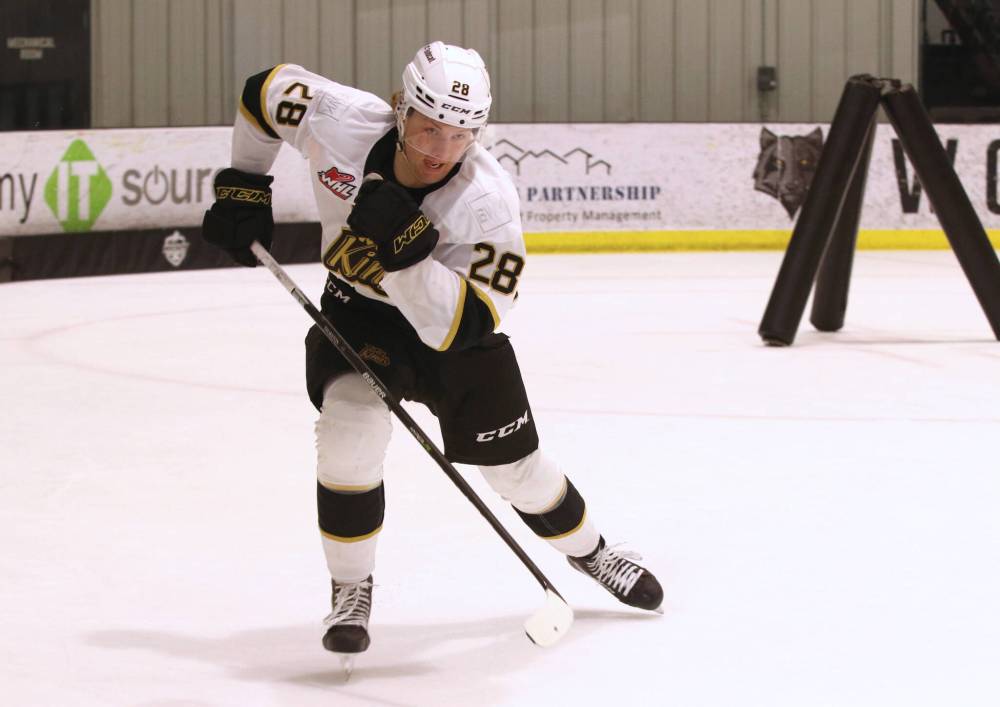
Former Brandon Wheat Kings forward Ben Thornton races to the finish during the fastest skater competition at the team’s skills competition at J&G Homes Arena in 2023. His career ended prematurely as his concussion problems became more and more serious. (Perry Bergson/The Brandon Sun)
Nov. 7, 2023
His full explanation of the Canadian Hockey League’s concussion treatment pathway follows.
“Most of the time I see the hit or whatever happens and you can tell a little bit how they get up or how they get to the bench or if they come right to the bench,” Hartwick said. “Then it’s go talk to them and ask them how they’re feeling and what they’re feeling. A lot of the telltale signs to start with are headache, dizziness, nausea.
“Right when that happens, they have to come off the bench to the room and then we do quizzes and questions for memory recall about the game and stuff.
“Sometimes, increased nausea or light sensitivity or sound sensitivity can come up as well. Those are telltale signs, but other times too, if they get hit in the head, they’re taken to the room to be in a quiet area. If none of the symptoms are there and all the questions are good, they can go back. The league has a good procedure and protocols to catch initial concussions.
“From then on, they go home. Back in the day, the thing was that you wanted to keep them awake so they would have people waking them every however many hours. Now, it’s all about rest. Sleep is good for them to let the brain settle down.
“After we think ‘Yes, they have a concussion possibly,’ we usually get the doctor to come down and do a quick neuroscan on them to make sure everything is good with that. Then we do what’s called a SCAT-6 on them now. The test is cognitive, memory, balance, stuff like that, just to find out where they’re at.
“After that, it’s rest and monitor symptoms for the next day, come in and ask how they’re doing, how they slept. Most of the time, the next day they feel relatively better in terms of nausea and dizziness. The headache will stick around for a couple of days or so.
“Then they’re in the concussion protocol. Usually within 48 hours we have them do what’s called an impact test, which is a CHL-wide test that we do with the neurologist doctor who oversees all the tests. We do a baseline for those with guys every two years, and if they’ve had a concussion, they don’t get a year off, they do it every year.
“After that, there’s some steps to take once symptoms are gone or close to gone. You can start doing some physical activity, like light biking or walking and see if that makes symptoms worse. If symptoms are gone and they stay gone after the physical activity, you increase it day by day for a couple of days until they’re at 80 per cent max heart rate.
“After that, they’re allowed to skate again with no contact, just by themselves doing some sport-specific stuff on the ice. If that’s all good, they do a non-contact practice with the team. Before they can do any contact, they have to see our doctor as well and do the impact test again if the doctor deems it necessary.
“They do a contact practice, and if everything goes well, then they can return to play.”
DIFFERENT IMPACTS
In theory, two players could take exactly the same hit and both suffer concussions, but their symptoms and paths to recovery could be completely different.
The standard approach is usually seven to 10 days for recovery, but if a player suffers multiple concussions in a year, they still got through the same steps, but they take more time to make sure everything is good.
“There’s more check-ins with the doctor just to make sure we’re on the right track,” Hartwick said. “We take a little bit of extra time to make sure everything is where it’s supposed to be before they move on to the next step.”
Back when head coach and general manager Marty Murray played, prevailing wisdom was a long way from where it is now. Murray never had a diagnosed concussion of his own, but thinks he likely had a couple during his long playing career.
“When I played, especially early on in my career, you got your bell rung and came to the bench and the trainer put his arm around your shoulder and asked ‘Are you OK?’” Murray said. “The player usually responded unless it was really bad that they were fine and you just carried on with your business.
“If you had really bad headaches or were throwing ups or things like that, those are pretty severe symptoms and it was taken care of certainly, but there were a lot of times it was ‘Oh, I’ve just got a bit of a headache or I feel off a little bit.’
“Back in those days it wasn’t monitored as close and taken as seriously as we know it should be now.”
With the science of concussions always evolving as scientists learn more, treatment can be a bit of a moving target. The puts the onus on athletic therapists like Hartwick to stay up to date on best practices.
“It’s a big thing to keep up with what’s going on and continuing education is a big thing, just to know how things have changed and make sure you’re on top of what’s the new norm now,” Hartwick said.
It’s impossible to understate how devastating an injury can be for a teenager who defines themselves as a hockey player when they have the game taken away. That means Hartwick almost became a counsellor, a sounding board for the youngsters and a familiar presence as they work their way through their injury.
“That’s definitely a big part of it, especially for the kids who are halfway across the country and they don’t have that family support in town,” Hartwick said. “A lot of their billets are really good with that but it’s not mom and dad, which they’ve known for their whole career.
“Especially with concussion, with any injury really, when they’re away from the team and can’t participate in everything, it’s not just checking in to see how they’re doing injury-wise but mentally as well to see where they’re at and make sure everything is good.”
» pbergson@brandonsun.com