
From here, they’ll be fighting for Koné
Midfielder’s injury gives Canada a greater purpose to succeed
Advertisement
Read this article for free:
or
Already have an account? Log in here »
We need your support!
Local journalism needs your support!
As we navigate through unprecedented times, our journalists are working harder than ever to bring you the latest local updates to keep you safe and informed.
Now, more than ever, we need your support.
Starting at $15.99 plus taxes every four weeks you can access your Brandon Sun online and full access to all content as it appears on our website.
Subscribe Nowor call circulation directly at (204) 727-0527.
Your pledge helps to ensure we provide the news that matters most to your community!
To continue reading, please subscribe:
Add Brandon Sun access to your Free Press subscription for only an additional
$1 for the first 4 weeks*
- Enjoy unlimited reading on brandonsun.com
- Read the Brandon Sun E-Edition, our digital replica newspaper
*Your next Free Press subscription payment will increase by $1.00 and you will be charged $20.95 plus GST for four weeks. After four weeks, your payment will increase to $24.95 plus GST every four weeks.
Read unlimited articles for free today:
or
Already have an account? Log in here »
Some important questions needed answering in Canada’s second game of the 2026 World Cup. Well, consider them answered. And how.
Perhaps the most practical query involved striker Jonathan David, whose disappointing club season at Juventus seemed to seep into the national team’s Group B opener against Bosnia-Herzegovina.
After his early substitution in Toronto, would he start in Vancouver?
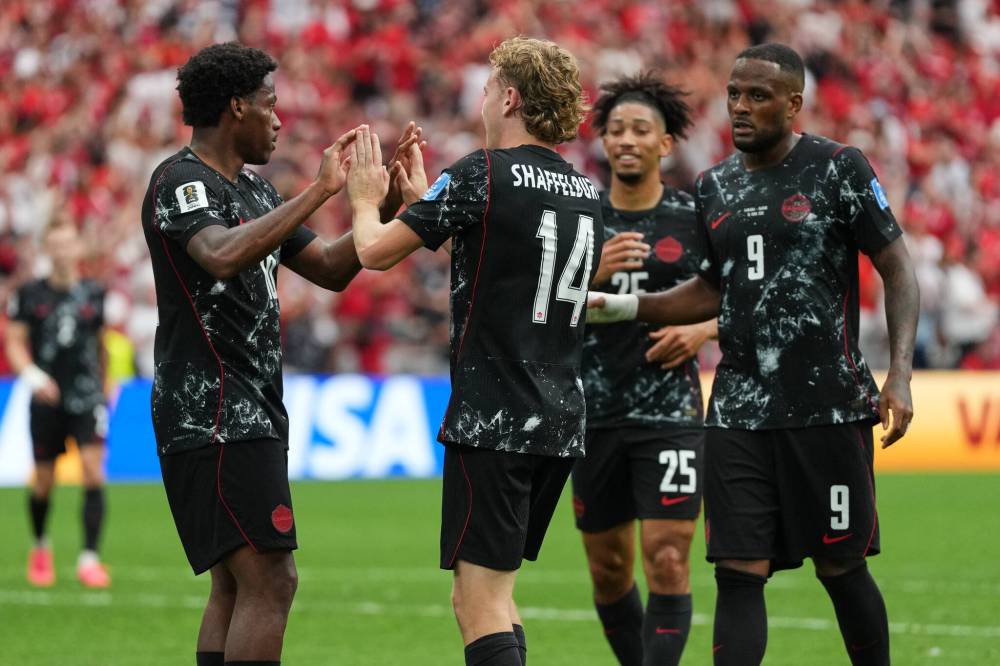
Abbie Parr / THE ASSOCIATED PRESS
Jonathan David’s (left) teammates celebrate his hat trick in Vancouver on Thursday. Canada’s 6-0 route of Qatar made history as no CONCACAF team has scored more than four goals in a single game at the World Cup.
The answer: yes.
OK, but it’s a two-part question. If he lined up opposite Qatar, would he rediscover the form that’s made him the program’s all-time leading scorer?
Let’s answer a question with another question. Does a hat trick work as a suitable response?
David entered Thursday’s match like he’d been shot out of a cannon. In the early exchanges he thundered a shot that goalkeeper Mahmud Abunada did well to save. Another blast was again parried by Abunada in the 16th minute, but this time teammate Cyle Larin was on hand to bang in the opener.
Then — just shy of the half-hour mark — the 26-year-old launched a tremendous volley that doubled Canada’s lead, and he added a second just before the restart. In second-half stoppage time he got his third of the evening and pulled level with Lionel Messi for the tournament goalscoring lead.
If there were any questions about Larin’s ability to replicate his performance from the Bosnia-Herzegovina match, they were put to bed as well. He and David have now combined for five goals from two outings.
Fine, but what about the midfield positions? Would Stephen Eustáquio and Ismäel Koné do enough against Qatar for manager Jesse Marsch to keep faith in the tandem? After all, you won’t go far in tournament football if you can’t control the centre of the park, at least for occasional spells.
For 51 minutes, they were excellent. Canada was up 3-0 and the composed passing and well-timed defensive contributions had seemed to cement the partnership going forward. But the 51st minute is also when the game changed.
Deafening since well before kickoff, the Vancouver crowd went suddenly silent when Koné was felled by a reckless Assim Madibo challenge. It was so quiet, so quickly, that Alistair Johnston was plainly audible as he told the referee that the midfielder’s leg had been broken.
Both sets of players were understandably distraught, and the energy might have escaped the match completely had Nathan Saliba — a friend of Koné’s from their time at CF Montreal — not scored from a free-kick shortly after coming on to replace his teammate.
When he was carried off on a stretcher, sitting upright and waving to the fans while taking oxygen, Koné had completed 90 per cent of his passes, touched the ball more than 60 times and added an impressive five recoveries.
Marsch will now have to think about his midfield starters versus Switzerland, but that’s a question for another day.
Inadvertently, the Koné injury also answered another key question surrounding the national team.
With players needing to step up — and with their future at this World Cup very much in doubt — could the Canadian men somehow galvanize behind a cause? Looking deeper than formations, tactics and personnel, could they find something more emotive to propel them where talent might not?
The post-match huddle answered that. Koné’s injury will remain a difficult part of Canada’s World Cup story. There’s no getting around it. But it has also given the team a greater purpose. From here, they’ll be fighting for Koné.
At the final whistle, by which time the players had produced a further three goals and reignited the crowd, a crucial, decades-stretching question had been answered as well.
Could Canada’s men finally win a first World Cup match?
The answer: yes. And to the tune of 6-0. No CONCACAF team has won so emphatically in the competition’s history, and Canada will go into the Switzerland match needing only a draw to top the group.
Should that happen, it will host a knockout game in Vancouver and face an opponent that finished third — presently Ecuador, the Netherlands, Belgium, Senegal or Jordan. It’s all determined by a complicated formula that will only be solved late next week.
Again, a question for another time.
For now, Canada has addressed every inquiry put to it in the affirmative. It can be proud of that. The country is proud of that. Koné is part of it. And everyone will be hoping for positive answers to the questions he’ll face in the coming days.
winnipegfreepress.com/jerradpeters