
McKague races to top with Brachetto
Advertisement
Read this article for free:
or
Already have an account? Log in here »
We need your support!
Local journalism needs your support!
As we navigate through unprecedented times, our journalists are working harder than ever to bring you the latest local updates to keep you safe and informed.
Now, more than ever, we need your support.
Starting at $15.99 plus taxes every four weeks you can access your Brandon Sun online and full access to all content as it appears on our website.
Subscribe Nowor call circulation directly at (204) 727-0527.
Your pledge helps to ensure we provide the news that matters most to your community!
To continue reading, please subscribe:
Add Brandon Sun access to your Free Press subscription for only an additional
$1 for the first 4 weeks*
- Enjoy unlimited reading on brandonsun.com
- Read the Brandon Sun E-Edition, our digital replica newspaper
*Your next Free Press subscription payment will increase by $1.00 and you will be charged $20.95 plus GST for four weeks. After four weeks, your payment will increase to $24.95 plus GST every four weeks.
Read unlimited articles for free today:
or
Already have an account? Log in here »
Ross McKague has enjoyed a lot of success racing thoroughbred horses over the years, but Brachetto might just be at another level.
A groom once drove that point home with McKague, who has trained horses with his wife Brenda for more than 50 years.
“We were going to the stall and it was ‘How’s my horse?’” McKague said. “‘He’s good. He’s perfect.’ I said ‘What do you mean perfect?’ He said ‘Just look at him. He’s perfect.’”
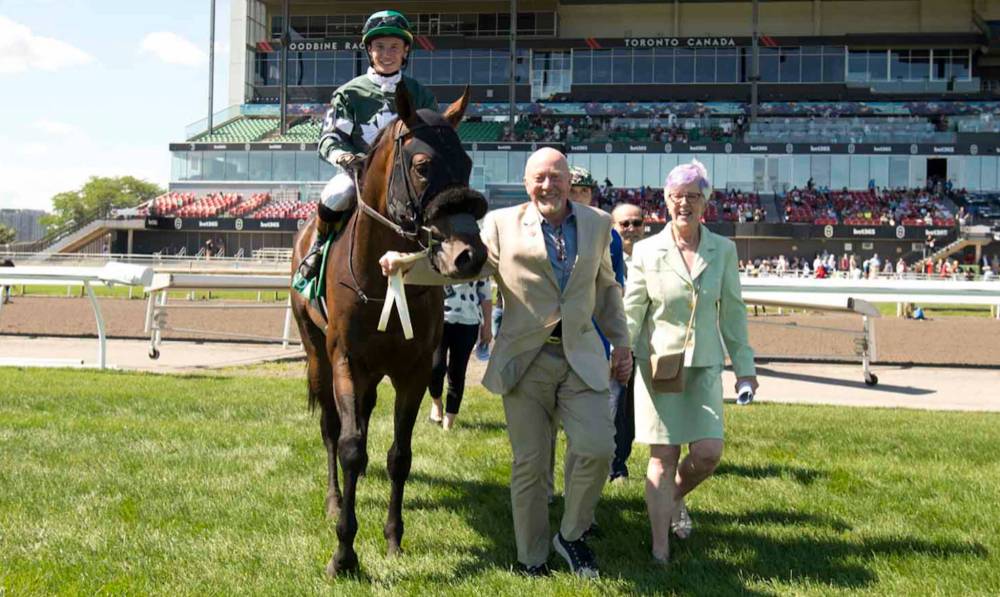
Ross McKague and his wife Brenda walk their horse Brachetto (5), with jockey Ryan Munger on board, into the walking ring in late June. Despite a bad back, the 79-year-old McKague is certainly enjoying the moment. (Michael Burns/Woodbine Photo)
The three-year-old horse, which was born and raised in Brandon, will be a favourite heading into the first leg of Canada’s Triple Crown next month after coming from behind to win a prestigious race in Toronto in June.
Brachetto will be the first-ever Manitoba born-and-raised horse to race at the King’s Plate, which was formerly known as the Queen’s Plate.
McKague, who names his horses after wines, has had a lot of winners over the years, but at 79, this unexpected success has brought some new adventures. Exhibit A is a photo taken at the Marine Stakes.
“It’s huge, especially at my age,” McKague said. “I have a picture of walking into the ring and that whole thing, the grass paddock saddling, they only do that for Stakes races and they go into that inner circle for big Stakes races. I’ve never been in there. They had to show me where it was.
“In the picture of us leading the horse into the walking ring … you need to know the context. I have a really bad back and I was getting really jammed up sitting there and moving around. Look at the stride on me there. I don’t think there was a lot of pain right then.”
Until a year ago, every colt he owned since 1976 was born in his barn just off Patricia Avenue. They had cameras set up and the former veterinarian and Brenda would go out when the mares were ready to foal.
Earlier this year, McKague was presented with the Canadian Thoroughbred Horse Society’s award for breeding for 50 years, becoming just the third person to receive it.
“Most of them are dead or quit,” McKague said with a laugh.
THE COLT
Brachetto certainly isn’t an overachiever. In fact, he’s just living up to the family legacy.
His mother is McKague’s mare, the now 21-year-old Colorino, who was had 10 colts and is back in foal again. McKague purchased her as a weanling from a major farm in Kentucky for $30,000.
Most people resell horses like Colorino, but McKague raised her and then sent her to Toronto to race for her two-, three- and four-year-old campaigns.
“She turned into a super race horse,” McKague said. “She was one of the better older mares and won $212,000 down there running against really good horses. Then we retired her, and instead of selling her, we shipped her to Kentucky and started breeding her.”
He’s made a point of finding high-end stallions for her.
Brachetto’s sire is Vekoma, who stands at stud at Spendthrift Farm in Kentucky. A session with Vekoma now costs US$100,000, but McKague booked him in 2023 at just $15,000.
Brachetto was Colorino’s ninth foal, which can be an issue. Mares are generally less able to develop foals properly as the animal repeats the process over and over, but in this case she birthed a winner in April 2023.
“She fired this foal up and he was up and going,” McKague said. “He never looked back. He was 100 per cent from day one and just went onward and upward. He did everything right. Sometimes you’re happy when something goes wrong and they turn out OK, but in this case, there’s never been anything go wrong right up until today.”
“He had a really good personality,” McKague added. “He was almost bomb-proof in terms of handling him. He was super good.”
The colt grew up on McKague’s property just off Patricia Avenue near 18th Street. As soon as Brachetto became a yearling, McKague began to hear from agents who thought he should sell the youngster.
In the racing world, every horse’s birthday is Jan. 1, regardless of when they’re born. When Brachetto turned two on Jan. 1, 2025 — after spending every minute of his life in Brandon — McKague took him into Winnipeg to “start,” a term that used to be called “breaking.”
McKague was still driving home when he heard from trainer Florent Rivard.
“He sent me a short video while we were in the truck of him with a saddle sitting on him,” McKague said. “He never had a bridle or saddle on him in his life before. We were around MacGregor when we got it. His comment was ‘I shouldn’t even have gotten paid for this one.’
“And then he says ‘I didn’t say that.’”
McKague laughs at the memory of his young horse’s promising start.
Brachetto began to train in earnest in Toronto at Woodbine soon after, and the reports kept saying the young horse simply never did anything wrong.
At age two, horses are still developing physically as they learn to race: If you push them too hard, they can develop sore shins and joints. They brought Brachetto along slowly and at the end of the year, trainer Julia Carey suggested sending him home, even though the young horse was close to being ready to race.
His owner had other plans.
“I’d really wanted to get him started so I don’t have to go all winter wondering if he’s any good,” McKague said. “Then you start in the spring and spend the whole time trying to figure out if he’s any good or not.”
As a result, Brachetto lined up in his first race on Nov. 13, 2025. He broke from the gate well, but got bumped by the horses on both sides of him and fell back to last against a speedy group.
“All of a sudden he’s just galloping and gaining on these horses and he comes around the turn,” McKague said. He got cut off twice, went down to the rail, swung back outside and then got beat by a nose at the finish line.
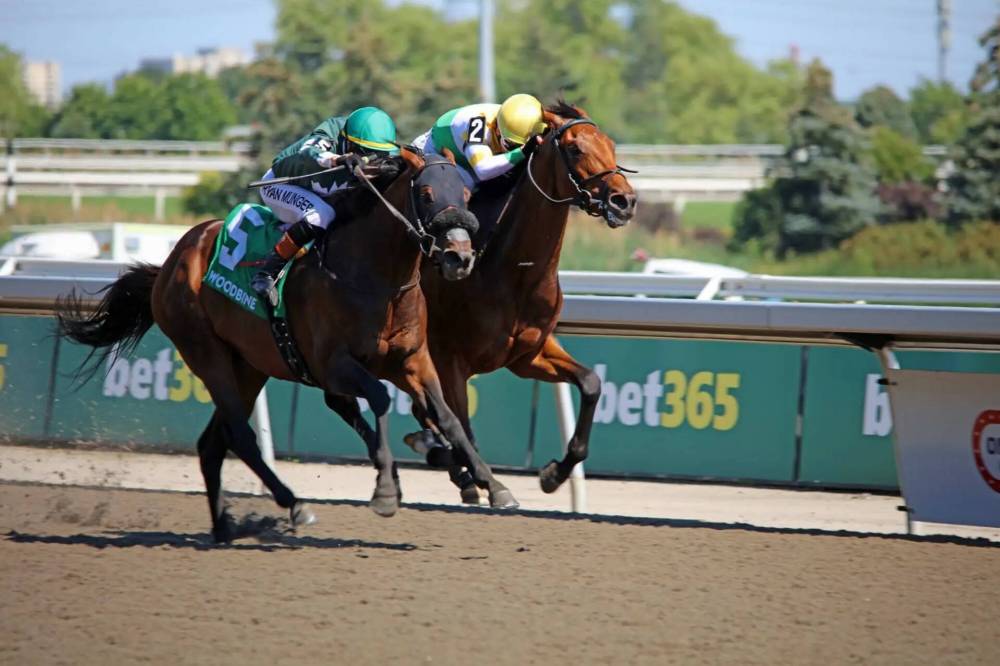
Brachetto (5), with jockey Ryan Munger on board, runs past Magical Factor (2) near the finish of the Grade 3 Marine Stakes at Woodbine in June. (Michael Burns/Woodbine Photo)
Despite multiple hardships in his first race, he nearly won, and the offers began flooding in from syndicates who buy promising horses instead of raising colts.
Serious money was on the table, and even different ownership stakes, but he turned them all down.
“I said ‘Here’s the deal,’” McKague said. “‘I’ve been doing this for a long time and I’ve had some horses that were really good horses, but I’ve never had one this good. I’m 79 years old and I don’t think I’m ever going to have another one. The odds statistically aren’t in my favour and I don’t need the money.’”
The horse then finished third in another race on Dec. 14, with both being contested at six furlongs or 3/4 of a mile.
McKague gave the happy news to Carey that she could continue to work Brachetto at Woodbine, where the horse lives. She suggested they winter him in Florida for more training, lots of time in the paddock and a two-month holiday.
McKague, who’s perpetually ready with a great one-liner, said his horse enjoyed the trip.
“He looked happy down there,” McKague said. “Happier than I was up here.”
When the horse returned to Toronto, he was ready to race, and promptly won his first outing on May 10.
In his next outing, on June 7, he ran in a field of sprinters in the Queenston Stakes, which is a short race.
“He isn’t a sprinter,” McKague said. “He looks like he wants to go far. He was just closing but got third. People were saying ‘Well, you can’t go in the Queen’s Plate, those horses would just beat you.’”
Instead they went into a Plate trial, the $150,000 (Grade III) Marine Stakes on June 27. While some big events in Canada are limited to Canadian horses only, this was an international open being run at the longer distance of 1 1/16-mile.
McKague wasn’t planning to enter — the horse wasn’t among the 30 that were nominated — but they had room for Brachetto.
He entered as an 18-1 underdog in the six-horse field, but there was a quiet confidence inside the Brachetto camp, with South African jockey Ryan Munger assuring McKague they would win.
THE RACE
The six horses lined up near the rail, with the field including the favourite Casson (wearing 1), plus Magical Factor (2), Fire and Wine (3), Yoshii (4), Brachetto (5) and Yukon Striker (6).
Off the start, the four quickest horses — the front-end sprinters or speed — jumped into the lead with Brachetto near the back. McKague was OK with that, hoping the four horses would burn each other out.
“In my head, the only way we can win, and Julia said the same thing, is if the speed takes off and we can track behind them close enough,” McKague said. “You can’t be too far back on the speed. When the speed backs up, we can run by them and could win, and for sure we can get second or third.
“In the worst-case scenario, if the speed doesn’t back up, we’re screwed.”
At the first turn, Casson and Fire and Wine, with both of their jockeys dressed in red, surged to the lead, with Brachetto and Yukon Striker trailing the pack. Yukon Striker inched ahead at the 39-second mark, and the Brandon horse found himself behind a pack of three horses that were trailing the two leaders.
At the half mile — the 55-second mark — Brachetto was alone at the back but the pack had closed on the leaders. Fire and Wine began to fall back, with Casson pushing up.
At the 75-second mark, Brachetto was still in sixth but about to make his move. Five seconds later, he had passed Fire and Wine, Yoshii and Yukon Striker, and was behind Casson along the rail in third.
Munger correctly assessed he had no room to get through and took Brachetto a few feet into the middle, between the two leaders.
At the 92-second mark, Magical Factor broke ahead, Casson fell back and Munger took Brachetto wide.
At the 99-second mark, he pulled into second and moments later, track announcer Robert Geller called out “Brachetto is sprouting wings on the outside!”
With 70 yards left, he was still a half-horse length behind but coming up fast. Then in the final yards, Brachetto surged into the lead by a head and earned the victory in one minute 44.94 seconds.
“We were standing in the box jumping up and down and screaming, and I go ‘He’s going to be third!’” McKague said. “Then I go ‘He’s going to be second! Oh, he won!’”
The jockey Munger later told him he had recognized Magical Factor was the horse to follow, and was confident if he could keep Brachetto close to him with room to run, he could win.
“When he goes faster, he just drops lower and reaches out further,” McKague said. “He was smokin’.”
For the record, the finish was Brachetto, Magical Factor, Casson, Yukon Striker, Yoshii and Fire and Wine.
While McKague was up in the bar — “You have a lot of friends after you win a race like that,” he deadpanned — he received a text from Brachetto’s groom.
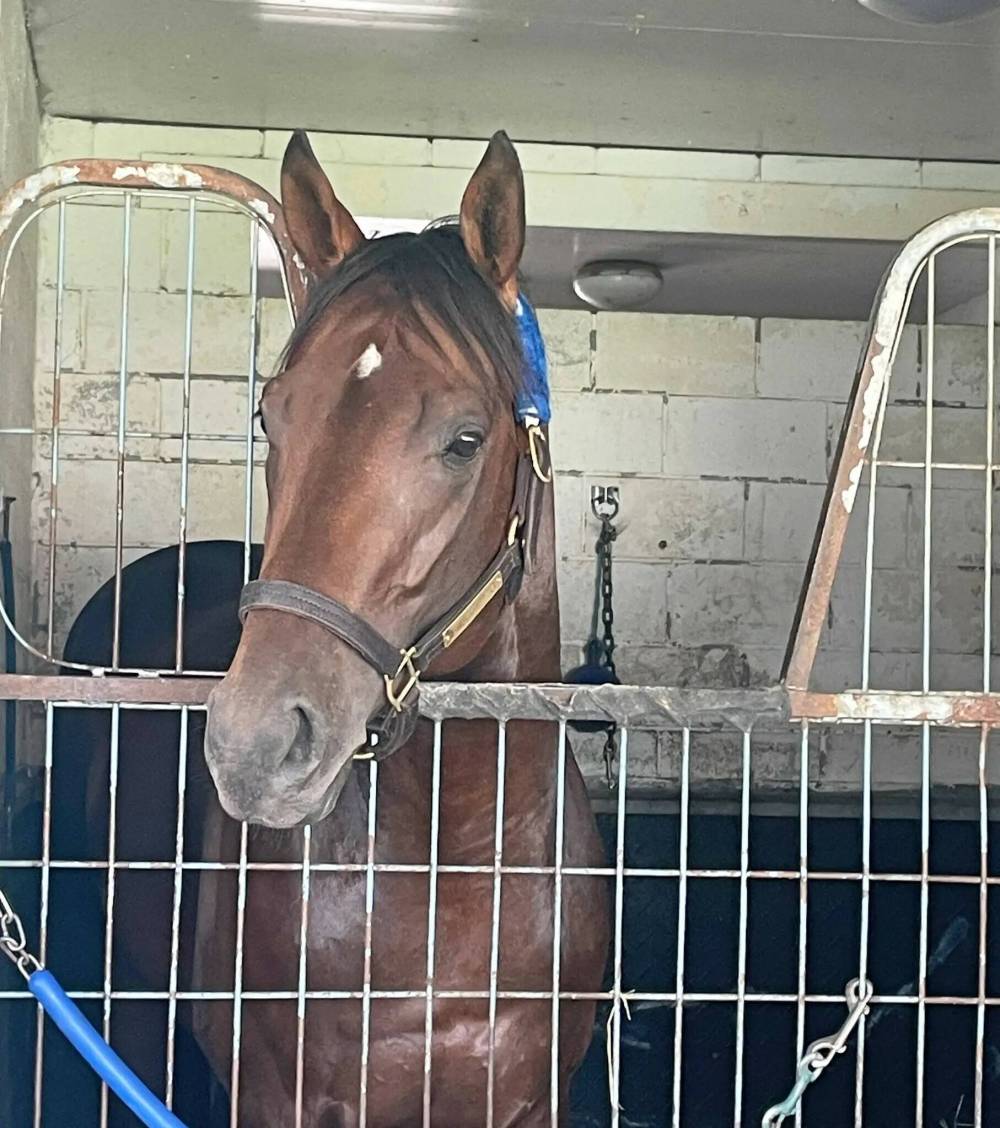
Brachetto is shown in his stall. He is a relaxed horse who likes to get his sleep. (Submitted)
“He was standing there in his stall ripping hay out of his hay net wondering where dinner was, like he never raced,” McKague said. “For him, it wasn’t a tough race.”
THE FUTURE
The King’s Plate is run at a distance of 1 1/4 miles or two kilometres at Woodbine, with the first leg of the Canadian Triple Crown set for Aug. 15. It will be the longest race of Brachetto’s life, with McKague saying there are always questions in the longer races about whether horses have the endurance.
“Nobody knows because you almost never get to run that far anymore,” McKague said. “But somebody can get there.”
There is a Plate trial on July 19 that is run at 1 1/8 miles, which is the middle ground between the Marine Stakes and the King’s Plate, but McKague considered the three-week gap to be too short by modern standards and won’t be attending.
But that doesn’t mean the horse is not raring to go.
“We’ve had two weeks of light training,” McKague said. “(Carey) had to get him back out there because he was ripping the barn down he was feeling so good.”
Another part of Brachetto’s unique disposition is after he goes for his morning gallop, he cools down, eats his food and then lies down and sleeps.
That was even the case on the day of the biggest race of his life so far, the Marine Stakes.
“We had to wake him up,” McKague said. “We had to get him up. He was lying down sleeping.”
When he did get up and was walking around, he was trying to eat grass. McKague said the horses that get cranked up on race day are the ones you have to worry about: Their muscles tighten up and they use up energy when they get stressed out.
The animals that have adapted to their sedentary lifestyle until it’s time to get to work will do OK.
“It’s not that unusual but it often makes the difference between a good horse and a really good horse,” he said. Brachetto’s showing at the King’s Plate will depend in part on who shows up for the million-dollar race. That means there could be tremendous horses out there he’s never heard of that could be in the field, and that can certainly affect the outcome.
While he’s realistic about his chances of winning the biggest race on the Canadian calendar, he remains hopeful.
“You have to be real but I would not be going there unless we had some chance,” McKague said. “I wouldn’t just go there.”
Brachetto is unlikely to run in the other Triple Crown races even if he wins: Instead he’ll be shut down for two months and continue to train him for the fall. There are a series of turf races at Belmont for Canadian and New York-bred horses, so that could be a potential landing spot, but there are a lot of options.
“We haven’t seen the bottom of this beast yet,” McKague said, adding they hope to run him on turf more in the future.
Brachetto certainly has lots to look forward to in his future.
He could race for up to three or four more years, and then will retire. Unless he wins a top-grade race, he’ll likely end up gelded, which nearly happened last year when he went through a brief phase of misbehaviour around the barn before his holiday in Florida.
“The only thing that saved him was his mentality,” McKague said. “You would never know he’s a stallion. A lot of them in the barn are hard to deal with. The grooms get beat up but he’s amazing.”
McKague, who estimates he has raised somewhere around 100 horses born on the property, has hosted a party for other breeders at his home for many years, and they watch the Breeders Cup together.
The conversation invariably drifts to what McKague has in the barn, and two years ago it was Brachetto.
“He was just a weanling, and I said I’ve got the best weanling I’ve ever raced,” McKague said. “They said ‘You always say that,’ and I said ‘No, I don’t. I’ve said that before but I think he is.’
“We went out and looked at him and we just weaned him and he looked a little scruffy, and they were going ‘What are you talking about?’
“He’s a really nice horse.”
» pbergson@brandonsun.com