
A REGAL AFFAIR, Part 10: Life goes on after pro hockey leaves
THE FORGOTTEN STORY OF BRANDON’S PRO HOCKEY TEAM
Advertisement
Read this article for free:
or
Already have an account? Log in here »
We need your support!
Local journalism needs your support!
As we navigate through unprecedented times, our journalists are working harder than ever to bring you the latest local updates to keep you safe and informed.
Now, more than ever, we need your support.
Starting at $15.99 plus taxes every four weeks you can access your Brandon Sun online and full access to all content as it appears on our website.
Subscribe Nowor call circulation directly at (204) 727-0527.
Your pledge helps to ensure we provide the news that matters most to your community!
To continue reading, please subscribe:
Add Brandon Sun access to your Free Press subscription for only an additional
$1 for the first 4 weeks*
- Enjoy unlimited reading on brandonsun.com
- Read the Brandon Sun E-Edition, our digital replica newspaper
*Your next Free Press subscription payment will increase by $1.00 and you will be charged $20.95 plus GST for four weeks. After four weeks, your payment will increase to $24.95 plus GST every four weeks.
Read unlimited articles for free today:
or
Already have an account? Log in here »
On Sept. 12, 1957, the lead editorial in The Brandon Sun talked about the tough times weathered by the city’s most famous clubs, the Regals and the Brandon Greys baseball club.
Both had since moved on, and the editorial became an elegy into another era of sports in the city.
“Remember when we used to gripe about hockey overlapping the baseball season, and football dividing the sports interest with hockey in the fall? That was not so long ago either! Brandon had an over-plus of highly rated teams, and enthusiasm in high gear every month of the year. One no sooner finished cheering for the Wheat Kings, when the Greys took over on the baseball diamond.
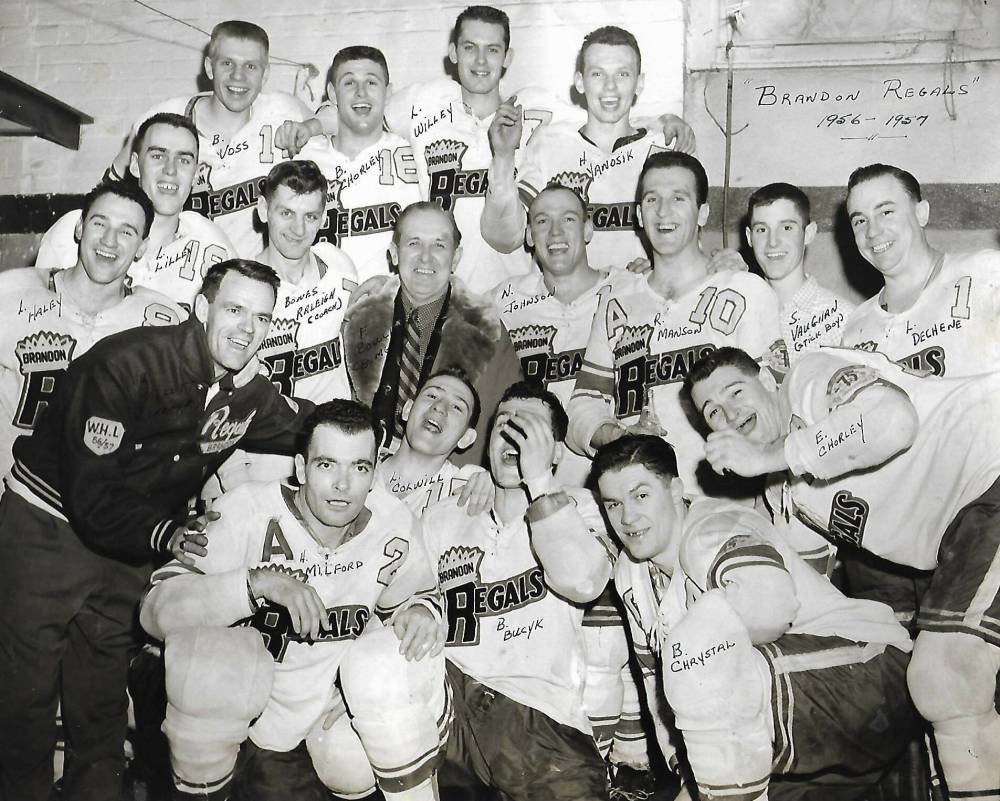
The 1955-56 Brandon Regals celebrate their Western Hockey League championship. Someone thoughtfully added the names of all the players at some point. (Courtesy Manitoba Hockey Hall of Fame)
“It was a problem to work in a game of golf in the summer, and community excitement in the activities of the hockey club was so keen that few organizations would plan their programs until they had looked over the schedules.
“Sport was demanding and hectic but we loved it. The playoffs probably reached their peak in the community for the 1948 series for the Memorial Cup, when Brandon’s Wheat Kings lost in eight games to the Montreal Royals.
“Fans were limp when those games were over. It is reported that some of the more intense fans suffered mild heart attacks and on medical advice have had to remain away from exciting events since that time. But those who were among the fortunates able to get tickets for the hockey playoff can verify that was the ultimate in sports frenzy.
“We had our great moments in baseball too. The sportsmen behind the Greys saw that we had the best — or reasonably close to it. Brandon never did break even on operation costs, even in the very hey-day of the game here. While the city was boasting of its great club, generous promoters were digging deep into their own pockets to make us proud of their reputation.
“But fan interest is fickle. Even champions become losing propositions. We do not have to look further than the Regals of the past season, probably the most entertaining club ever to represent Brandon in any sport.
“Owner Jim Piggott reported a loss of around $24,000. The Greys of the current year, furnishing a brand of baseball that ranked with the best ever, dropped $14,000 or thereabouts. These losses sounded the death knell of these great clubs in this community.
“What to do about the future? Start from the bottom again, and try and revive our sagging interest in the amateurs? That’s possible, but even now those connected with the sponsorship of the simon-pure teams, admit that they cannot get the parents out to see their offspring play.
“There will be a hopeful few, those who surmount the difficulties of the present and the past, and gamble on a new venture. But it’s a bleak picture at its best.
“There are those who are of the opinion that we should give sports promotion a rest for two or three years. Maybe they are right. Certainly it would be foolhardy to suggest that we could recapture our old-time enthusiasm within that period.”
(The $24,000 loss incurred by the Regals is equivalent to losing about $286,000 now.)
The world did move on.
A year later, the Brandon Wheat Kings returned from intermediate hockey to the Manitoba Junior Hockey League for the 1958-59 season and have been playing junior ever since.
The fate of the Regals wasn’t quite as positive.
As most people would have guessed, splitting home games between Saskatoon and St. Paul, Minn., wasn’t the bonanza that Piggott thought it would be.
On the ice, the St. Paul-Saskatoon Regals won their season opener 4-2 over the Edmonton Flyers on Oct. 16. By Nov. 8, Maurice Smith reported in the Winnipeg Free Press that — wait for it — Piggott was unhappy with attendance.
“Jim Piggott, owner of the Saskatoon-St Paul Regals is disappointed at the attendance at Western Hockey League games in Saskatoon … The average has been only 1,800 and Piggott says an average of 3,600 is needed to break even … Piggott points out that if only 10 per cent of Saskatoon’s residents supported hockey 7,800 people would be on hand for every game…
“He has offered to revamp the Saskatoon Arena free of charge to accommodate that many … It presently holds approximately 5,200 … Piggott went on record that if fans did not give the Regals better support for the balance of the year pro hockey will probably be finished in Saskatoon for all time after this season.”
Meanwhile, the team was in last place and travelling farther than any other club to get there.
If schadenfreude — the German word for the experience of taking pleasure from the troubles of others — was baked into a giant cake, The Brandon Sun was going to need a lot of ice cream.
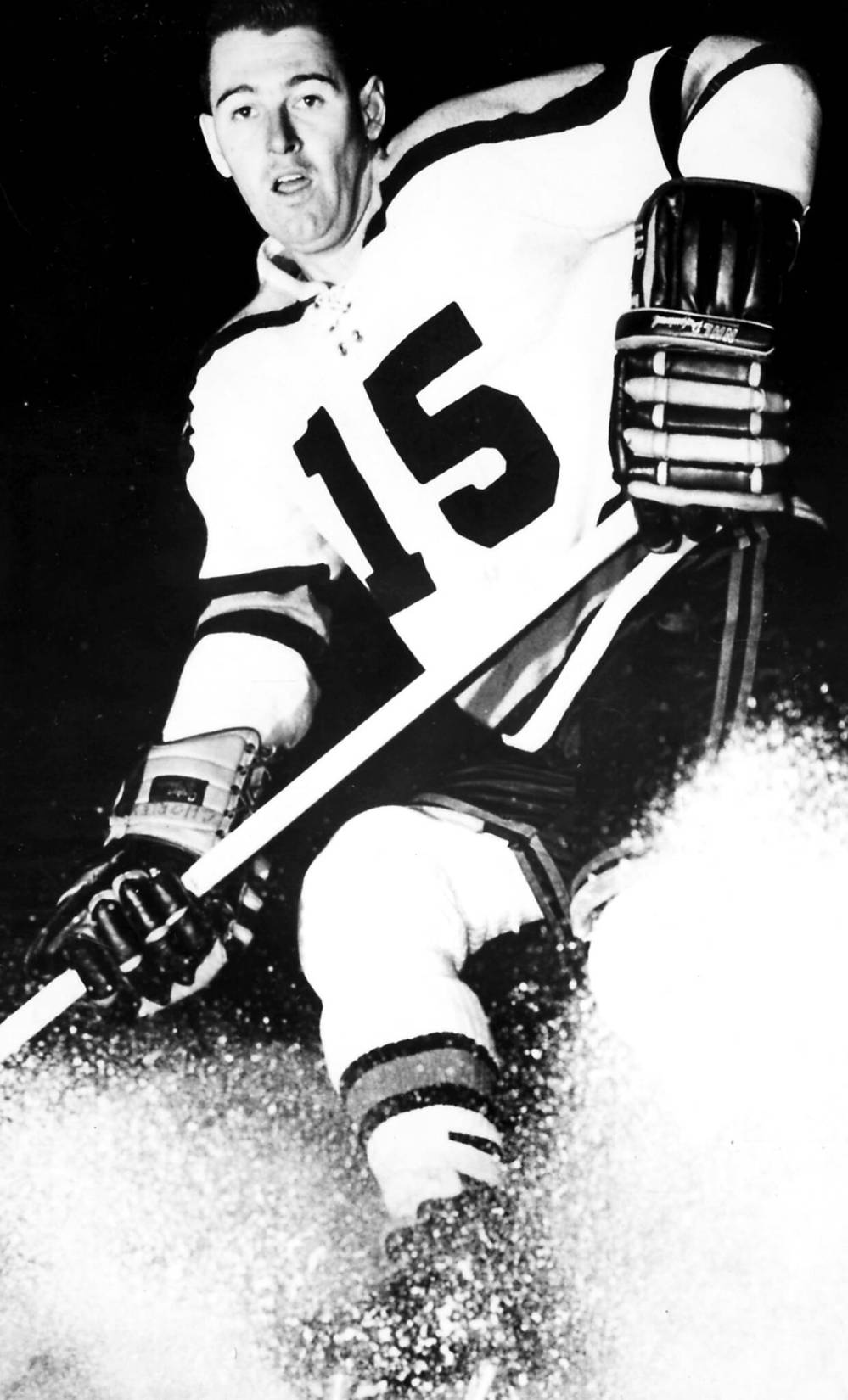
Elliott Chorley of Winnipeg played two seasons with the Regals, starting in Regina and then moving to Brandon. He later coached the Wheat Kings in their first season in the Western Canada Hockey League in 1967-68 and skated with the Brandon Olympics of the Canadian Senior Hockey League in 1975-76. He was inducted into the Manitoba Hockey Hall of Fame in 2001, and died in 2008. (Brandon Sun file photo)
On Jan. 9, 1958, in an item below a banner story about the Wheat Kings intermediate team beating the Dauphin Kings 4-3 in their home opener, the Regals troubles spilled out in a story by the Canadian Press.
“CALGARY (CP) — Frank Boucher’s roaming Regals apparently haven’t found a permanent home yet in the Western Hockey League.
“Regals, who stepped into the league’s Prairie division after Saskatoon Quakers quit the WHL, began their first season in 1955-56 at Regina.
“Stiff competition by Regina’s junior Pats for fan support forced Regals to finish the season at Brandon, Man. This season they became Saskatoon-St. Paul Regals, splitting home games between Saskatoon and the Minnesota city.
“Coach Boucher, commenting on suggestions that Regals may operate from St. Paul only next season said no decisions have been made about the club — now owned by Jim Piggott of Saskatoon — and it’s not really thinking too much of the future right now, just the present.
“However, Boucher added: “Saskatoon has not lived up to expectations. It has us a bit worried. If there is any change so far as operating from one instead of two cities, there is little possibility the change will happen this season.
“A complete switch to St. Paul, if it happens, will only come next year. But we have not really thought about next year too much.”
“Attendance at Regals’ last two home game bear out Boucher’s concern. Their last Sunday game at St. Paul drew 3,500 fans — some crowds have exceeded 5,000 this season — while at Saskatoon the last crowd was 1,300.”
In a twist, on Feb. 24, The Brandon Sun reported the Regals would be back in Brandon to meet the Winnipeg Warriors on March 8 after the game was approved by league president Al Leader.
By the end of the season, the Regals finished fourth in the four-team Prairie Division with a record of 25-45 and missed the playoffs.
They drew just over 26,000 fans in 16 home dates in Saskatoon and averaged just over 2,600 fans a game in St. Paul.
The failure of the St. Paul-Saskatoon experiment wasn’t exactly a shock when it was announced the team wouldn’t be returning to Minnesota. After one more season playing under the old Saskatoon Quakers name, Piggott folded the team.
He traded his dormant Saskatoon franchise for the WHL’s struggling Victoria Cougars in 1959, and ran them while also expressing his interest in a move to Los Angeles. By April 1959, the Sun ran a piece from the Seattle Times that Los Angeles and San Francisco were joining the WHL and that Piggott had won the rights to L.A.
But it didn’t happen overnight, with the move delayed because San Francisco didn’t have an appropriate building and they wanted two teams in the area.
Piggott moved the Cougars south for the 1961-62 season and renamed them the Los Angeles Blades, but due to issues with the rink, couldn’t play any home games until November.
By Sept. 12, 1961, Piggott’s attention had apparently returned to Brandon.
In his Sun Settings column, Laurie Artiss eviscerated Piggott after quoting at length from a rather odd and vicious takedown of the sport of hockey that ran in the Los Angeles Times.
“We now assume the LA entry in the Western League has much to look forward to in the way of purple, passionate prose from local scribes. It shouldn’t happen to a dog — not even Jim Piggott.
“Perhaps this explains why Piggott, who has bounced from Regina, Brandon, St. Paul, Saskatoon and Victoria in his search for the all-mighty buck, got panicky recently. The prospect of another egg in L.A., made him remember his Brandon Regals — or to be more specific — the local Citizens’ Committee, that aided in the operation. So now the frantic Mr. Piggott is suing some six Brandon businessmen for the “losses’’ he reportedly incurred here.
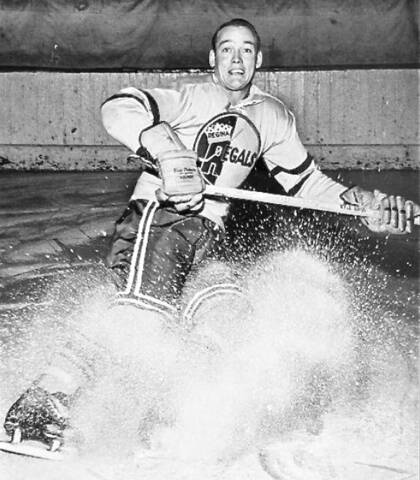
Brandon Regals star forward Norm Johnson is shown in a Regina Regals jersey prior to the move to Brandon. He finished second in scoring behind Ray Manson in the championship season in 1956-57, and went on to play 14 more professional seasons. He died in 2016. (Courtesy Manitoba Hockey Hall of Fame)
“Have fun in L.A., Mr. P. You and that ‘writer’ deserve each other.”
Piggott’s goal was to one day own a National Hockey League team, and with expansion coming west and a WHL team in California, he thought he had his foot in the door.
He applied for the NHL franchise in Los Angeles but it went to Jack Kent Cooke when he formed the Kings in 1967. Within months, Piggott sold his WHL club and left pro hockey for good.
By that time, Piggott had founded the Saskatoon Blades in 1964; They played in the Saskatchewan Junior Hockey League until he took them into the new Western Canadian Junior Hockey League in 1966, and they remain in the current junior version of the WHL now.
He died on April 1, 1979: The Jim Piggott Memorial Trophy is awarded annually to the WHL’s rookie of the year in his memory.
The final nails in the coffin for the hopes of the old professional WHL came in two ways.
First, the NHL expanded and didn’t incorporate them in their plans. Second, when the World Hockey Association started up in 1972-73 and vacuumed up pro players, the writing was on the wall.
The league was back down to six teams for the 1973-74 season — Phoenix, Salt Lake, San Diego, Portland, Seattle and Denver — and the end was nigh.
The Phoenix Roadrunners bolted for the WHA, and Seattle and Denver were granted expansion franchises in the NHL.
The league officially ceased operations on July 12, 1974, nearly 17 years after its brief and unlikely time in pro hockey’s smallest city.
On Dec. 20, 2023, the Manitoba Hockey Hall of Fame inducted the 1956-57 Brandon Regals and the 1959-64 Wheat Kings teams into a special veterans class, forever linking the two franchises.
The Wheat Kings stayed and in the next few years will celebrate a century in Brandon.
The Regals, meanwhile, lasted from Dec. 17, 1955 to July 30, 1957, a span of just 591 days. But in those 19 months, Lucien Dechene, Bob Chrystal, Norm Johnson, Don Raleigh and their teammates gave hope to a Prairie city, showing that big things can come from small places.
Seventy years later, it’s a lesson — and a team — worth remembering.
» This was the 10th and final instalment in the series.
» pbergson@brandonsun.com