
NCAA eligibility brings new faces to camp
Advertisement
Read this article for free:
or
Already have an account? Log in here »
We need your support!
Local journalism needs your support!
As we navigate through unprecedented times, our journalists are working harder than ever to bring you the latest local updates to keep you safe and informed.
Now, more than ever, we need your support.
Starting at $15.99 plus taxes every four weeks you can access your Brandon Sun online and full access to all content as it appears on our website.
Subscribe Nowor call circulation directly at (204) 727-0527.
Your pledge helps to ensure we provide the news that matters most to your community!
To continue reading, please subscribe:
Add Brandon Sun access to your Free Press subscription for only an additional
$1 for the first 4 weeks*
- Enjoy unlimited reading on brandonsun.com
- Read the Brandon Sun E-Edition, our digital replica newspaper
*Your next Free Press subscription payment will increase by $1.00 and you will be charged $20.95 plus GST for four weeks. After four weeks, your payment will increase to $24.95 plus GST every four weeks.
Read unlimited articles for free today:
or
Already have an account? Log in here »
It’s been a year since the NCAA opened its doors to Canadian Hockey League players and already there is abundant evidence that Canada’s hockey pipeline is adapting to the change.
Taking a look at the Brandon Wheat Kings’ training camp, the first thing that jumps out is the number of players vying for spots on the team. More than 80 players, divided into four teams, have come to show what they can do in the hopes of being selected to fill one of the available spots on Brandon’s roster.
The changes to NCAA eligibility created an environment in which players are less limited by their choices. As a result, there is wider interest from players and CHL teams alike to bring players to camp who likely would not have attended in the past.
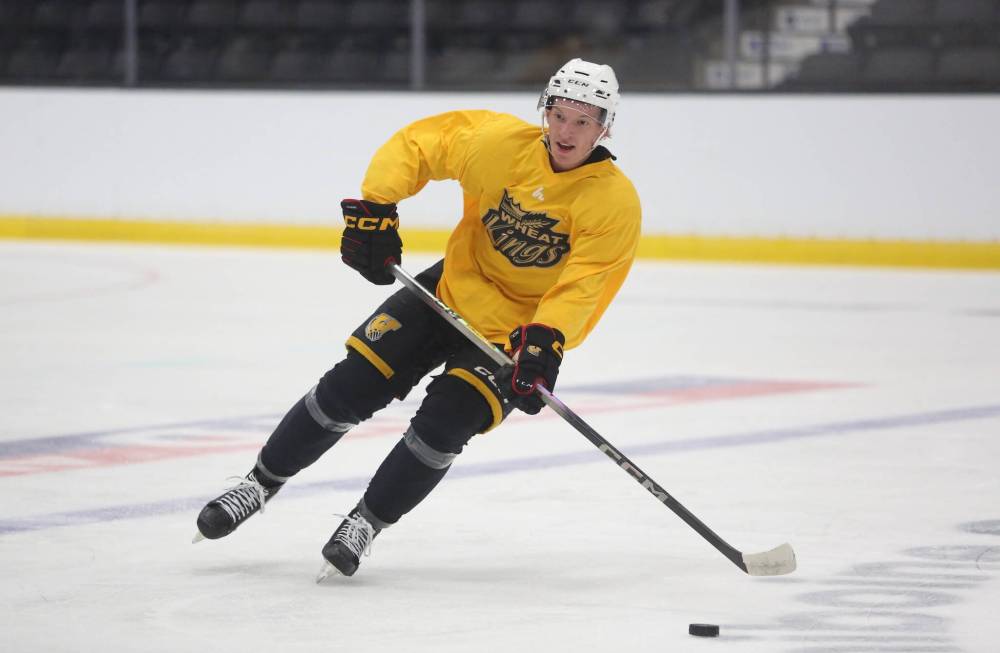
Cole Hunter skates through the neutral zone with the puck on his stick at Wheat Kings camp on Thursday. (Rowan McCarthy/Brandon Sun)
“It’s opened up so many things,” said American defenceman Paxton Packulak. “There’s just endless possibilities you can have now. You can do so many route to get where you want to be.”
U.S. PLAYERS
Born in Minot, N.D., Packulak is one of multiple Americans in attendance at Brandon’s camp. At 17, Packulak is hoping to make the jump to the CHL, something he wouldn’t have done without the changes to NCAA eligibility.
“I was thinking more USHL before they opened up the ability to play college hockey (to CHL players) because I think college is really important,” said Packulak. “But when they opened it up, I liked CHL and how the league plays out and everything so that’s why I wanted to come here and come to camp.”
There is a large emphasis on college sports being the main route for professional athletes south of the border. In years past, some American players joined CHL teams, but they did so understanding that it voided their ability to play college hockey.
Packulak is far from the only American-born player at camp this year. Look no further than Wheat Kings 14th overall selection at the 2024 Prospects Draft Colin Grubb who is coincidentally also from Minot.
While this has the potential to push some Canadian-born players off of lineups, it will also fortify the league with more elite talent.
It’s easy to talk about American-born players taking this opportunity, but the same is true for Canadian-born players who purposefully stayed at Junior A or joined the British Columbia Hockey League (BCHL) because they wanted to get a college education in the United States while playing hockey.
The Ontario Hockey League’s Ottawa 67’s gained multiple impact players last season solely because of the rule change. Los Angeles Kings fourth-round pick Thomas Vandenberg had his mind set on playing NCAA hockey and likely would never have played for Ottawa without the change.
Vandenberg, who will play for Providence College, moved to the U.S. to play for Cedar Rapids in the United States Hockey League (USHL) during the 2024-25 season despite being a fifth-round pick by Ottawa rather than void is college eligibility.
LONGER RUNWAY
Cole Hunter is hoping to make his CHL debut at 18, something that would have been very unlikely two years ago.
Drafted in the seventh round of the 2023 Western Hockey League Prospects draft by the Spokane Chiefs, the Oakburn native spent three years attending their camp in the hopes of joining the ranks of the WHL.
When he didn’t make the Chiefs roster, he returned home to play for the Waywayseecappo Wolverines in the Manitoba Junior Hockey League (MJHL). Over the course of two years he racked up 68 points in 111 games and committed to Northern Michigan University while playing for the Wolverines.
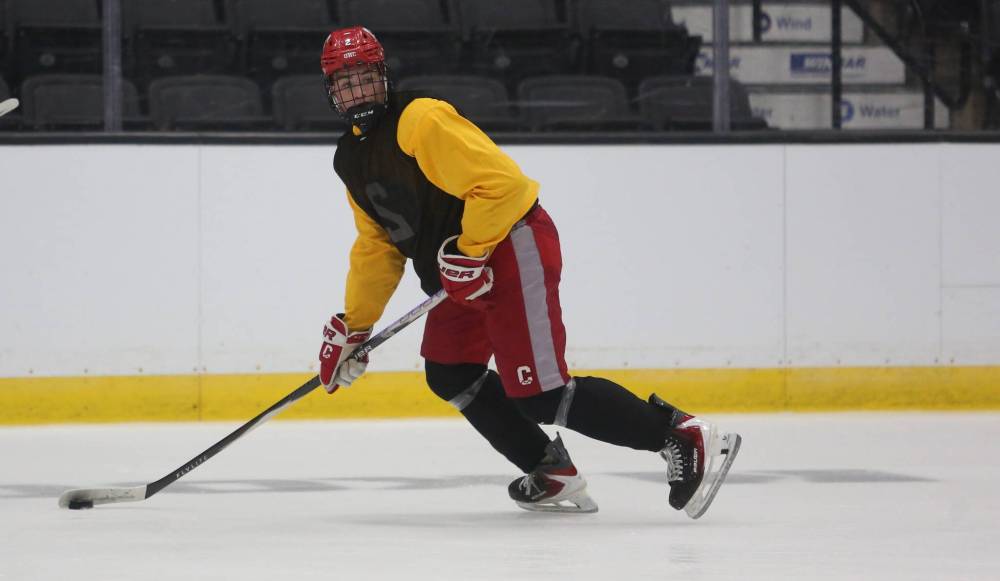
Paxton Packulak gets his head up to make a pass during a drill at Wheat Kings camp on Thursday. He is up from Minot, N.D., with the goal of cracking the roster. (Rowan McCarthy/BrandonSun)
“The MJ is a pretty physical league, and the schedules are pretty similar,” said Hunter. “It’s definitely a league with bigger guys, older guys. I think it prepares you for the next step.”
In the past, a player like Hunter likely wouldn’t have a shot at the CHL at this point in his career. The vast majority of players making it to major juniors joined when they were 16 or 17.
If you missed that window, you were much more likely to end up pursuing the college route by joining the BCHL or another Junior A league.
“Honestly, no. I didn’t really look into (college hockey),” said Hunter. “When you’re 14 or 15 you want to play in the Western League, but things don’t work out. You keep playing and see where it leads you.”
If Hunter makes the Wheat Kings, he will be one of the few players entering the league who already has a college commitment, something that would have been unthinkable even two years ago. It’s something Hunter believes will becomes more common over time.
While the commitment feels nice, it doesn’t mean you can rest on your laurels.
“You always have it in your back pocket, but they could always let you go … decommit you,” said Hunter.
For Hunter, it’s a big year. He’s proven he can play at the Junior A level. The 40 points he scored in 58 regular season games as a 17 year old are more than proof of that. What he’s looking for is a way to take a step to the next level.
“You want to be in the W, this is the highest level of junior in Canada,” said Hunter.
Ryder Riedel is also in a unique situation coming into camp. At 19 years old, he’s one of the older players at Brandon’s camp.
“I played in the AJ last year, I’m looking to make a jump to the WHL with the rule changes and all that, and Brandon was one of the teams that reached out and gave me the best opportunity, so, that’s why I’m out here,” said Riedel.
At 17, Riedel joined Coquitlam Express in the BCHL out of an interest to pursue college hockey. Last year, he played for the Olds Grizzlys of the Alberta Junior Hockey League (AJHL) and amassed an impressive 41 points in 39 games to finish second on the team in scoring.
Where in the past he might have pursued an NCAA commitment by continuing to play at the Junior A level, schools are turning more and more to the CHL to find elite talent.
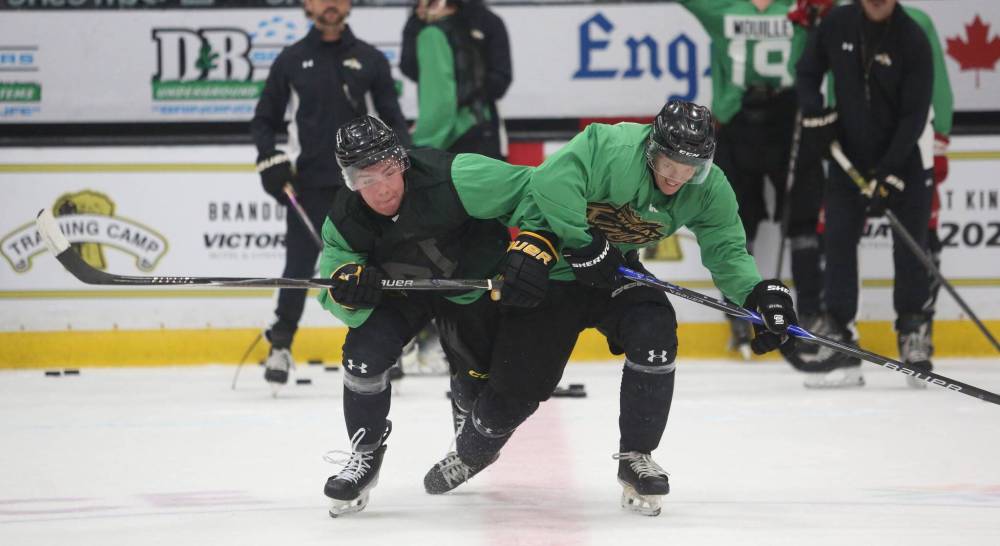
Ryder Riedel (left) battles with Caleb Potter during a drill at Wheat Kings camp on Thursday. (Rowan McCarthy/Brandon Sun)
“There are still commitments out of B.C., the AJ and other leagues in junior, but there’s definitely now a league you want to make, and that league is the CHL,” said Riedel.
With committed players leaving CHL teams earlier to join the college ranks, there are more and more spaces available to older Junior A players in the WHL, something that helps a player in Riedel’s shoes.
Just this past season, elite players like Porter Martone of the Philadelphia Flyers, Cole Reschny and Gavin McKenna all elected to play NCAA hockey over staying in major junior for another season.
“It helps me drastically,” said Riedel. “Just with how many players are going to go play NCAA off Brandon, I know there’s a few. That just opens up more room for older guys like me and other 19-year-olds.”
It wouldn’t be the first time Brandon added a 19-year-old. Last year, the team took 19-year-old defender Max Lavoie coming out of camp. He had an excellent season for the Wheat Kings and now plays for Princeton.
The reverberations from the landmark NCAA decision to allow CHL players to play college hockey are far from over. There will continue to be shifts and changes over the coming years.
The OHL just launched a new pilot program to standardize development across the province. It aims to align regulations from major junior down to Junior B while also giving OHL teams the ability to designate one 16-year-old player playing at Junior A or B to an expanded affiliate role that will allow them up to 34 games in the OHL.
The program also provides enhanced opportunities for 17-year-olds and 16-year-old goaltenders.
On the whole, a larger camp is a good thing for the Wheat Kings. It gives the team more options to put together the strongest group possible for the upcoming season. It also means more opportunity for players who are much freer to go where they pleased since the NCAA decision to allow CHL players in the NCAA.
» rmccarthy@brandonsun.com