
GRADE-POINT ANECDOTES: Big rule changes in play for volleyball season
Advertisement
Read this article for free:
or
Already have an account? Log in here »
We need your support!
Local journalism needs your support!
As we navigate through unprecedented times, our journalists are working harder than ever to bring you the latest local updates to keep you safe and informed.
Now, more than ever, we need your support.
Starting at $15.99 plus taxes every four weeks you can access your Brandon Sun online and full access to all content as it appears on our website.
Subscribe Nowor call circulation directly at (204) 727-0527.
Your pledge helps to ensure we provide the news that matters most to your community!
To continue reading, please subscribe:
Add Brandon Sun access to your Free Press subscription for only an additional
$1 for the first 4 weeks*
- Enjoy unlimited reading on brandonsun.com
- Read the Brandon Sun E-Edition, our digital replica newspaper
*Your next Free Press subscription payment will increase by $1.00 and you will be charged $20.95 plus GST for four weeks. After four weeks, your payment will increase to $24.95 plus GST every four weeks.
Read unlimited articles for free today:
or
Already have an account? Log in here »
This should be mandatory reading for all volleyball spectators this fall.
Volleyball Canada has passed a significant list of rule changes and modifications to the application of current rules, and those who aren’t caught up will surely be caught off guard next time they watch a match.
They’re all straightforward changes that will make the sport easier to officiate and remove some of the grey areas around judgement calls. However, one change will take time for everyone, from players to coaches, referees and spectators, to get used to.
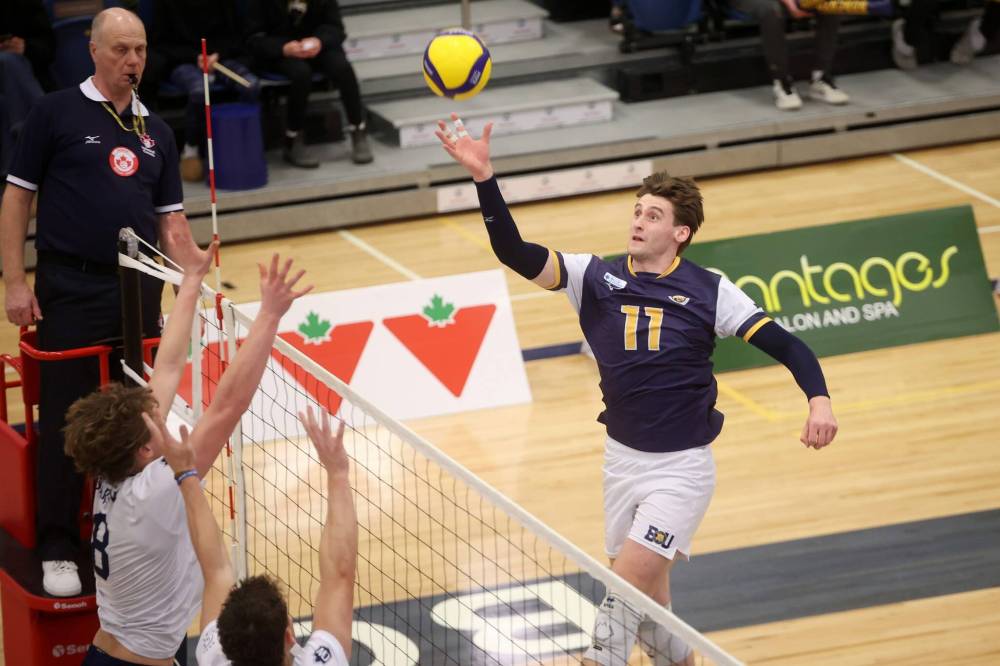
Volleyball Canada has passed a rule regarding attacks, forcing players to make tips quicker, rather than catching and throwing the ball down. (Tim Smith/The Brandon Sun)
CEILING IN PLAY
The first change is simple: A ball contacting the ceiling above the playing area is not necessarily out of play anymore.
If the ball hits the ceiling, rafters or anything attached to the ceiling or rafters — such as a basketball backboard — and stays on the same team’s side, play continues.
If the ball goes over the net or stays stuck, it is ruled out.
The portion of the ceiling in play is the area above the court and the free zone, which typically extends to the team benches and bleachers. It’s up to each venue’s host to clearly define this area, so officials can ensure both teams know what’s in and what’s out.
It may seem strange, but especially with the number of low ceilings in Westman gymnasiums, the fact that solid digs that clip low-hanging rafters are no longer being punished so severely is a good thing.
DOUBLE CONTACT
Sets on a team’s second contact of three are no longer penalized for double contacts, as long as the ball stays on their side.
If you attend Brandon University matches, you’ve seen this one in play during the 2025-26 season.
Previously, a set that left a player’s hands with spin was deemed to have hit one hand shortly after the other, rather than simultaneously, and immediately shut down. Those are allowed now, though catching and throwing the ball is still a fault.
Many volleyball purists shook their fists at the sky when this rule passed, as it appears to take some of the skill out of setting.
On the other hand, the change results in fewer rallies ended by referees’ whistles, allowing for more spikes, blocks and digs.
We want the athletes to decide matches, not officials, and this change is a step in the right direction.
PUSH, CARRY, CATCH, THROW
Here’s the big one.
As the rules of volleyball have been relaxed over the years, attacking has evolved to the point of slam dunks, “power tips” and other borderline-illegal techniques becoming commonplace.
Not anymore.
Attackers must now spike the ball or tip it quickly with the fingers of one hand. It must rebound off the hand, not be accompanied by the hand for any length of time.
It’s a fault if an attacker palms the ball, dunks it, makes it move in multiple directions, tries to “wipe” it off a block and out of play or uses two hands to tip.
Some catch calls by referees may seem harsh at first, but the change will remove what have essentially become unstoppable attacking manoeuvres.
There will be growing pains as everyone adjusts to the new rules, but give it a year and I’m certain the prevailing sentiment will be that they should have been implemented sooner.
» tfriesen@brandonsun.com