
EXPLAINER: The meticulous path to ideal Olympic curling ice
Advertisement
Read this article for free:
or
Already have an account? Log in here »
We need your support!
Local journalism needs your support!
As we navigate through unprecedented times, our journalists are working harder than ever to bring you the latest local updates to keep you safe and informed.
Now, more than ever, we need your support.
Starting at $15.99 plus taxes every four weeks you can access your Brandon Sun online and full access to all content as it appears on our website.
Subscribe Nowor call circulation directly at (204) 727-0527.
Your pledge helps to ensure we provide the news that matters most to your community!
To continue reading, please subscribe:
Add Brandon Sun access to your Free Press subscription for only an additional
$1 for the first 4 weeks*
*Your next subscription payment will increase by $1.00 and you will be charged $20.00 plus GST for four weeks. After four weeks, your payment will increase to $24.00 plus GST every four weeks.
Read unlimited articles for free today:
or
Already have an account? Log in here »
Hey there, time traveller!
This article was published 16/02/2022 (1513 days ago), so information in it may no longer be current.
BEIJING (AP) — Curling ice has come a long way in the 600 years since the Scottish began sliding stones across frozen lochs.
A modern curling sheet like one at the Ice Cube venue in Beijing is made with ultra-purified water and maintained at a precise range of temperature and acidity. Then, an ice-maker sprays on the little bumps — or pebbles — that enable the stones to bend their way to the target.
The high-tech and intricately choreographed process gives the athletes a consistent — or at least predictable — field of play they can rely on as the matches and tournament go on.
“You can make all the shots, and that’s all you want,” Canadian Brett Gallant said this week. “There’s not a shot you can’t play because of the ice.”
Here is how the ice-makers do it.
THE GOAL
An ideal curling sheet provides 4 to 6 feet of swing, allowing the rocks to bend around blockers on their way to the target. The four different sheets at the Olympic venue should all play the same way, and in both directions, for the entire event.
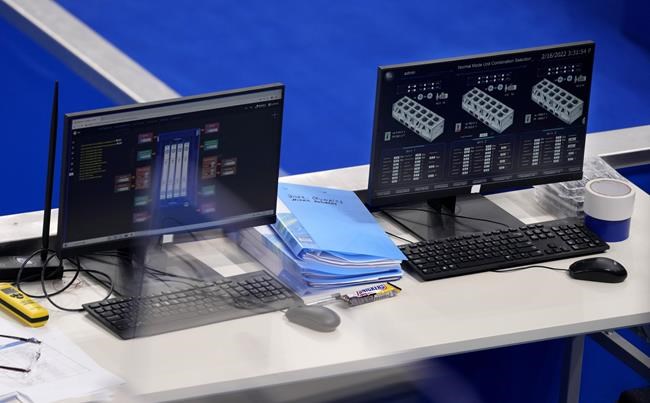
Head USA Curling ice technician Shawn Olesen, who is on the ice-making staff at his second Olympics, eyes three monitors from rinkside to make sure the refrigeration units under the ice and the fans controlling arena temperature are working properly. He also watches the matches to see if the players appear to be compensating for some flaw in the surface.
“We’ll see where they put the broom, and where the rock ends up,” Olesen says. “If they’re calling for less curl, that’s a problem. Or too much — if it swings one way or the other too much — that’s a problem. They need to be prepared for the same thing, every time.”
THE PEBBLES
To reduce the friction as the rock slides, drops of water are sprayed over the surface to form little bumps of ice called pebbles. Getting them the right size and consistency takes years of practice.
“Unlike hockey ice … if we’re completely flat and smooth, the stone won’t travel,” says Dan Ostheimer, the ice-maker at the Broomstones Curling Club in Wayland, Massachusetts.
“The stone itself is kind of like the bottom of a coffee cup, where you’ve got just a small rim that touches the ice,” says Ostheimer, who also works for USA Curling at some of its national events. “With the pebble, we actually reduce how much of that that actually sits on the ice, the running surface.”
THE PROCESS
Curling is the busiest sport at the Olympics, with 19 straight days of competition featuring up to four matches in up to three sessions per day. The ice needs to be resurfaced between each session.
As soon as matches end, the crew scrapes off the old pebbles with a machine that is a cross between a Zamboni and a lawnmower. Others sweep and shovel the shavings away.
A member of the crew wearing a tank on his back moonwalks down the ice, waving a spraying nozzle from side to side. Evenly distributed pebbles are crucial.
“From club to club, you get those variations, but when you get up to the high — national, world — levels, those guys, they’re throwing pebble so consistent,” Ostheimer says. “It is very, very nicely done.”
Then the pebbling process is repeated using a nozzle with a larger hole, and another scrapper nips the top of the pebbles off.
THE WATER
It’s not just any old tap water for the Olympic curling surface.
The water for the ice is cleaned of impurities by a multi-tank reverse osmosis system; the water for the pebbling has also been de-ionized. (While good tap water might have a level of impurities at 500 parts per million, the ice for the pebbling is ideally under 4 ppm.)
It’s heated in a metal urn to 80 degrees Fahrenheit (27 Celsius) for the first pass and 125 degrees Fahrenheit (52 Celsius) for the second pass. Also important: pH.
“A lot of that science has actually developed over the past probably 50 years or so and has really improved the ice conditions, which has changed the sport a lot,” Ostheimer says.
THE ICE CUBE
The former Beijing Summer Games swimming venue hosting this year’s Olympic competition has a few quirks that the ice-makers have had to deal with.
The air was exceptionally dry, so humidifiers were lined up along the perimeter to pump in moisture. Cold air was coming in at one end when people were opening a door, so a hot tub — a holdover from the building’s swimming days — is left running to combat the influx of cold air.
With seven days of mixed doubles followed by 12 more of team curling — most bonspiels have one or the other — there was also a worry that the ice won’t last.
Olesen was keeping an eye on that, too.
THE MASTER
Swiss-Canadian Hans Wuthrich is working his fourth Olympics as the head ice-maker. He arrived in mid-January to start getting ready for the Winter Games.
Just as with the athletes, working the Olympics is an accomplishment and an honor for ice-makers.
“We’re really familiar with all these ice-makers that are here. You kind of learn their tendencies and what the ice feels like,” American Chris Plys says. “The reason they’re here is because they’re the best in the world.”
___
AP Sports Writer Jimmy Golen is in Beijing covering Olympic curling for the third time. Follow him on Twitter at https://twitter.com/JGolen. More AP Olympics: https://apnews.com/hub/winter-olympics and https://twitter.com/AP_Sports