
MJHL training camps underway with player limit
Some teams not allowing fans
Advertisement
Read this article for free:
or
Already have an account? Log in here »
We need your support!
Local journalism needs your support!
As we navigate through unprecedented times, our journalists are working harder than ever to bring you the latest local updates to keep you safe and informed.
Now, more than ever, we need your support.
Starting at $15.99 plus taxes every four weeks you can access your Brandon Sun online and full access to all content as it appears on our website.
Subscribe Nowor call circulation directly at (204) 727-0527.
Your pledge helps to ensure we provide the news that matters most to your community!
To continue reading, please subscribe:
Add Brandon Sun access to your Free Press subscription for only an additional
$1 for the first 4 weeks*
- Enjoy unlimited reading on brandonsun.com
- Read the Brandon Sun E-Edition, our digital replica newspaper
*Your next Free Press subscription payment will increase by $1.00 and you will be charged $20.95 plus GST for four weeks. After four weeks, your payment will increase to $24.95 plus GST every four weeks.
Read unlimited articles for free today:
or
Already have an account? Log in here »
Hey there, time traveller!
This article was published 19/09/2020 (2080 days ago), so information in it may no longer be current.
NEEPAWA — A Manitoba Junior Hockey League season like none other is underway.
On Friday, MJHL teams across the province began their training camps, in preparation for an Oct. 9 start to the regular season.
Traditionally, MJHL camps are a big spectacle. Each team invites anywhere from 50 to 60 of their top prospects, draft picks, returning players and free agents to the weekend-long camp.
From there, rosters get whittled down as teams play five or six exhibition games.
But the league introduced new guidelines for athletes, staff and fans to follow because of the COVID-19 pandemic. Camps were capped at 34 players and teams are limited to just a pair of pre-season contests. While following league and provincial health mandates, teams have implemented their own rules to ensure safety of team personnel and fans alike.
If you’re a spectator hoping to take in an MJHL training camp in Westman this weekend, here’s what you need to know:
VIRDEN OIL CAPITALS
This year, Virden Oil Capitals camp is closed to the general public, allowing just immediate family members and billet families to attend.
General manager and head coach Tyson Ramsey only invited athletes who’d be battling for a spot on his roster. The 15-year-olds usually invited to camp were cut out this year, as they’re too young to actually make the team. Instead, most of those kids were invited to skate at Virden’s prospects camp, held in early August.
The Oil Caps began charging a pay-to-play fee for the athletes last year. Even though the MJHL is a gate-driven league and lower attendance numbers throughout the season can hurt a team’s bottom line, Ramsey said the fee for athletes to play this season will stay at the same rate it did last year.
With the 34-player limit at training camp, Ramsey had to be extremely particular with who he invited to train.
“It’s a different thing, we have 16 returning players. That’s a little unique it itself, having so many players returning from last year’s team,” Ramsey said.
“We’re looking forward to getting started.”
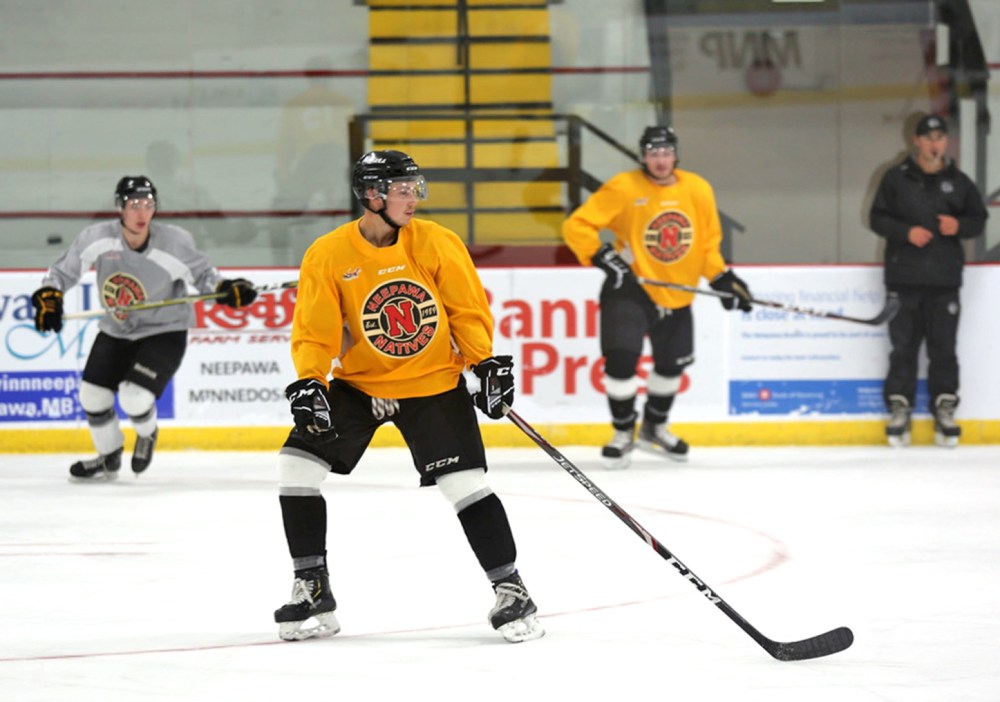
NEEPAWA NATIVES
The Neepawa Natives are opening their training camp to the public, with physical distancing and COVID-19 protocols put in place, including mandatory masks and hand sanitizer use at the entrance. GM and head coach Ken Pearson said the system seemed to work very well at development camp.
This season, making sure everyone is following COVID-19 protocols at all times is on the top of his priority list.
“Things are going to be a lot more on us as coaches, to make sure guys are following those restrictions, as far as wearing masks, social distancing and staying out of the public as much as they can, especially this weekend and into the preseason. So I think that’ll be the biggest difference as a coach, ensuring all these rules are followed,” Pearson said.
The amount of kids invited this year had to be cut down by nearly half.
Earlier this month the team had their development camp, directed towards the 15- and 16-year-olds on the team’s protected list. About half a dozen of those kids are moving on to main camp, with returning players and some of the older free agents they recruited.
Pearson thinks the smaller amount of athletes invited to camp this year will make it all the more competitive.
“From a coaching side, it’s going to be nice to see the guys compete a lot earlier in camp and harder than maybe they would. The first day of camp is usually a practice, you get through the first game that day and it’s not played as intense. But as it goes along, things pick up,” Pearson said.
“I think now with a smaller group that’s going to happen Friday right when we get going off the hop and hopefully that carries into next week.”
Pearson said the biggest loss he thinks every team in the league will be feeling is not having all the U.S. players come down for training camp. He estimates most teams have around 10-12 players come up from the States every year to try out, but with border restrictions that isn’t going to happen.
Instead, the coach did his recruiting almost exclusively in Manitoba this year. When the pandemic began, the organization made the call to focus on having local, Manitoba-born kids recruited to their camp this season.
“I’m looking forward to getting this COVID group going, it’s been a long time for everyone, myself included. I think we’re all just excited and happy to be able to continue and start up this great game again.”
DAUPHIN KINGS
Only three 16-year-olds will be at the Dauphin Kings training camp this weekend, to save room for older players on the team’s 34-athlete invitation list. Younger players were invited to a prospects camp over Labour Day weekend instead.
GM and head coach Doug Hedley said parents and families will be allowed into the building as long as they have a mask on and follow physical distancing requirements. With a large building that usually holds a capacity of 2,000 people, they’ll also welcome in some fans on a first-come, first-serve basis, as long as everyone is physically distanced and the building doesn’t go over 35 per cent capacity.
At the Kings’ camp, like others, players and staff will be subject to a temperature check and COVID-19 screening prior to entering the building. Instead of using only two dressing rooms, they’ll split athletes up into four throughout the weekend. Players have to take their equipment home at the end of every day, so the dressing rooms and other facilities can be properly sanitized.
While the Dauphin Kings haven’t had a pay-to-play fee before, with COVID-19 looming there’s the potential for it to be introduced this season.
“It won’t even be close to some of the teams, where it’s $4,000 or $6,000, or $12,000 by the (Winnipeg) Blues,” Harnett said. “It’s more like a $300 travel fee for the month, over five or six months. No more than $1,500 at the end of the year. That could be introduced at some point this year, a lot of it is going to depend on the sponsorship and how it goes with the schedule,” Hedley said.
With practices scheduled throughout the week and games played almost exclusively on weekends, Hedley said this season reminds him of the way a college hockey program is run.
“I think for the development part for the players, it’s going to be huge to be on the ice four times a week for practices for sure, and then in the gym for strength training,” Hedley said.
“We basically only play one game a week at home, it’s going to be an event, like a college program where they gear up for one game a weekend. Hopefully it creates lot of excitement.”
WAYWAYSEECAPPO WOLVERINES
The Waywayseecappo Wolverines are the only Westman team not opening up their training camp to any spectators this year. Instead, they’re live streaming their inter-league game, the Joe Brandon Cup, for fans to watch from the comfort and safety of their homes. The game starts Sunday at 2 p.m., and can be watched through the Wolverines’ Facebook Live stream.
During the camp, the Wolverines plan on limiting drills that would make players have more contact than normal. While it may take some time for players to get used to the new environment of hockey they’re playing in, GM and head coach Taylor Harnett thinks they’ll manage.
“One of the positives is that we’ve going through this pandemic for six months or so, so it’s kind of been a way of life for everybody for quite sometime. A lot of our players should be used to the new normal. When we get to the rink we’re going to have to be careful and do our best to stay safe,” he said.
Harnett usually has more than 60 players at training camp, but they were able to shortlist it. In his experience, everyone has been extremely understanding about the fact teams are doing what they can to play as safely and productively as possible.
“This pandemic has made each and everyone of us have to adjust,” Harnett said. “We’re just adapting to what’s required to play.”
REGULAR SEASON
Because of COVID-19, fans need to expect a different game-day experience from years previous.
During the pre-season, the seating capacity at MJHL games will be capped at 35 per cent.
Once the regular season begins on Oct. 9, up to 50 per cent capacity will be allowed in arenas. The escalating scale was put in place to allow MJHL teams and staff the opportunity to apply return-to-play guidelines in a regulated and controlled approach.
At games, members of the same household won’t be required to physically distance. Spectators are expected to remain in their seats for the entire game, including intermissions, except for moving directly to a washroom, concession or when exiting the facility.
The league itself isn’t enforcing a mask-wearing policy, but is strongly suggesting spectators do so. Some of the teams, however, including all Westman-based teams are enforcing a mandatory mask-wearing policy on their own.
Fans are advised to stay at home if they’re feeling unwell, even if symptoms are mild. Spectators on the concourse won’t be allowed to gather this year, either. People should always be moving, except while in line for concession or in the washrooms.
While MJHL teams traditionally make a big point of getting out and about in the community they play for, autograph sessions with players and team personnel won’t be permitted. In-game promotional items can’t be tossed into the crowds this year, either.
On the ice, coaches can use the Hockey Canada Network app, which supplies COVID-19 safe drills and practice plans.
Players are being told to avoid handshakes, fist bumps, hugs or physical contact throughout the game, including during goal celebrations.
MJHL teams haven’t seen action since March 13, when their 2019-20 campaign was suspended due to COVID-19.
» dshewchuk@brandonsun.com
» Twitter: @devonshewchuk