
Learning the ropes
Advertisement
Read this article for free:
or
Already have an account? Log in here »
We need your support!
Local journalism needs your support!
As we navigate through unprecedented times, our journalists are working harder than ever to bring you the latest local updates to keep you safe and informed.
Now, more than ever, we need your support.
Starting at $15.99 plus taxes every four weeks you can access your Brandon Sun online and full access to all content as it appears on our website.
Subscribe Nowor call circulation directly at (204) 727-0527.
Your pledge helps to ensure we provide the news that matters most to your community!
To continue reading, please subscribe:
Add Brandon Sun access to your Free Press subscription for only an additional
$1 for the first 4 weeks*
- Enjoy unlimited reading on brandonsun.com
- Read the Brandon Sun E-Edition, our digital replica newspaper
*Your next Free Press subscription payment will increase by $1.00 and you will be charged $20.95 plus GST for four weeks. After four weeks, your payment will increase to $24.95 plus GST every four weeks.
Read unlimited articles for free today:
or
Already have an account? Log in here »
Hey there, time traveller!
This article was published 03/11/2010 (5771 days ago), so information in it may no longer be current.
Gil Cheung is standing at a whiteboard scribbling blue lines across a drawn-up key, frenetically connecting Xs to Xs and Os to Os.
The head coach of the Brandon University Bobcats men’s basketball team is giving an artist’s rendering of what part of the Bobcats offensive and defensive schemes will look like this season.
Sitting in on — and intently observing — my first university coaches’ meeting, there’s only one thing running through my head: How am I supposed to remember all of this?
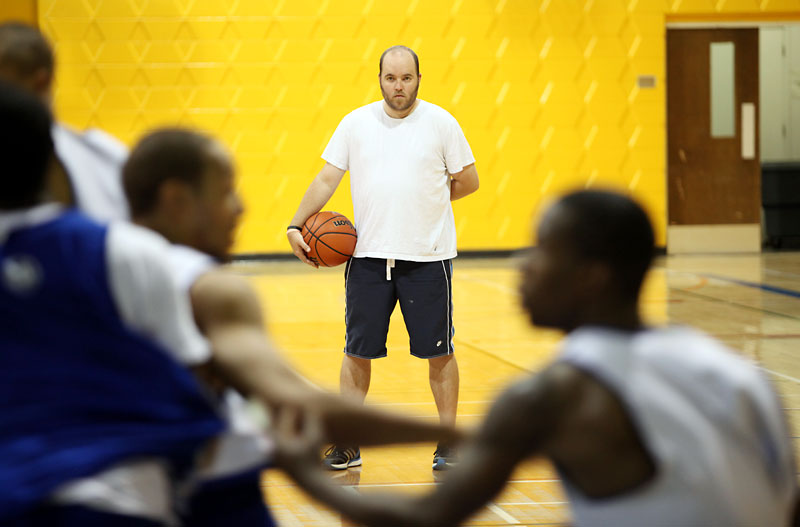
Cheung invited me to become a de facto member of his staff recently — sitting in on meetings, observing team preparations and getting a hands-on participatory role in practices.
It’s early October and I’m readying for my first practice, preparing to be introduced to a team that I think is going to respond collectively with a "who the heck is this guy?"
I played in high school and was a late cut at Brock University. None of this is to paint any glowing resume of hoops experience, but rather to suggest that while Cheung wasn’t exactly getting John Wooden on his staff, he also wasn’t getting John Ritter.
The life of a reporter is one confined to the sidelines. Here’s a small glimpse into how I got in the game.
"I want you to remember this face, here. Okay? This is the guy behind the guy behind the guy." — Trent Walker, Swingers
At the first practice, Cheung gathers his team at centre court and explains to them who the newcomer is.
"Anything that Coach Larkins says," he says, "you treat it like it was coming from either Coach Wielenga or myself."
I consider this to be a tremendous leap of faith.
After all, a handful of these players have never seen me before and others likely have no idea of the level of my basketball acumen (whatever that is). There’s no time to doubt or question though: Practice is starting and what on earth I’m doing there is of very little concern now.
My baptism into university hoops begins with dipping a toe in the pool — I’m the passer in a full-court lay-up drill that helps the players get their legs and allows me to settle in as well. I spend the next five minutes giving textbook one-arm push passes that, I silently think to myself, should be put on YouTube. The extension, the follow-through, the perfect placement of each pass.
Yes, it’s true: I’ve mastered one of the most basic, easiest fundamentals in sports. No. Big. Deal.
* * *
It’s always bothered me when people say basketball isn’t a contact sport. If you say that, you’ve never played it. Period.
I can think of a lot easier things for one to be doing with their day than trading elbows and banging with 250-pound dudes over a couple feet of stained maple real estate.
Not that I needed to be informed of it, but this fact is hammered into me, literally, during a drill in which the Bobcat bigs are called upon to dive into the key, seal the defender (me) and get a solid post-up before finishing at the rim. I’m equipped with a black blocking pad to absorb the initial blow while also providing a slight nuisance to the player trying to score. I assume it wasn’t implemented to save Cheung’s players from the physical pounding they were undoubtedly going to endure from an imposing presence like myself.
As the practice takes on a more instructional angle, I haven’t said much yet and I know why. My original objection to Cheung’s idea stemmed from not wanting to come in and be a gimmick or intrusion, and I told him as much. He told me it wouldn’t be like that, but the notion is still in my head and I sense it’s holding me back from …
"NO MIDDLE! DENY MIDDLE!"
A player got lazy on defence … and I found my gym voice.
With that out of the way, and by the time Cheung starts introducing his zone defence to the players, I’m comfortable jumping in.
"You guys can shoot but there’s more to the game than shooting. There’s fundamentals and defense." — Norman Dale, Hoosiers
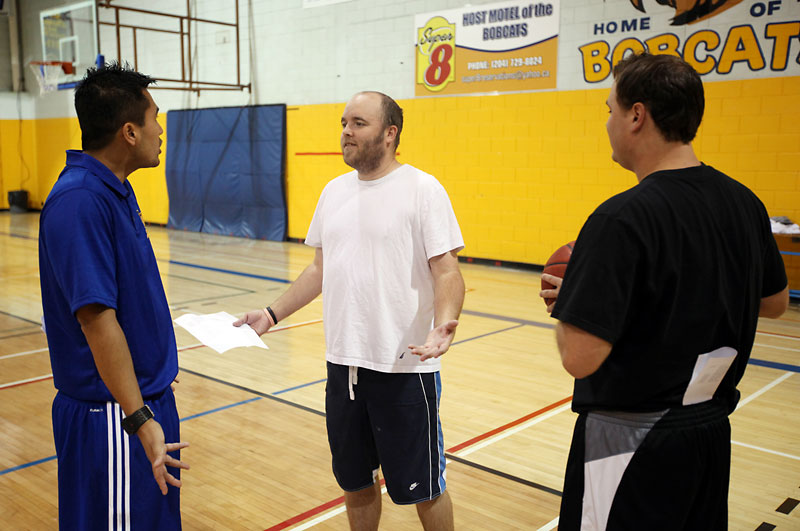
In the midst of soaking in all the complexities of offensive and defensive systems, often the little things get forgotten. However, if I told you directions through a city you’ve never been to before — only I gave you 35 steps to get there and another 20 different options to end up at the same place — you might just forget that you were supposed to pick up milk along the way.
It’s the same when the whiteboard comes alive and 10 players are on the floor acting it out, trying to remember every tiny detail that has been engrained in them over previous weeks, while not forgetting those that they’ve learned over previous years. Coaches, of course, rarely tolerate this. They want perfection and there’s no place for flaws in the pursuit of perfection.
I attended a coaches clinic in Blair, N.J., this summer and one of the keynote speakers, a head coach of an NCAA team in the Big East, routinely referred to his players as idiots, said tongue-and-cheek and meant to get a laugh from the other coaches, but also an indication of the patience level that can exist among coaches who have a lot riding on whether or not a player applies what they’ve learned.
Cheung is not shy to single out players who are out of position or who seem checked-out mentally. For their part, the players have been good about accepting that and playing through it. It’s part of the unwritten contract when you play at an elite level — this isn’t elementary school anymore, so you’d better be thick-skinned. These Bobcats have improved daily at finding the positives in criticisms.
"How you expect to run with the wolves at night, when you spend all day sparring with the puppies?" — Omar Little
A quote from the greatest TV show in history (HBO’s "The Wire"), is a good lead-in for preparation, a key to success that not only applies to the players, but also to a coaching staff.
Coaches are going to stress to their players the importance of being prepared for every possible scenario, but the coaches themselves have to be better prepared than anyone when the bullets start to fly, meaning practice planning, and wringing everything you can out of a two-hour session, is crucial.
Cheung has each day’s practice printed out with points of emphasis, talking points for each coach, and a minute-by-minute breakdown of what’s happening when.
One day before their non-conference schedule opens, the Bobcats are provided with a player-by-player blueprint of the national champion Saskatchewan Huskies, the team they’ll face the following day.
The Huskies, a team that lost its leading scorer (Showron Glover) from a season ago, simply reloaded in the backcourt with import Jamelle Barrett and former Husky and Bobcat Rejean Chabot. The players gather in a classroom, poring over U of S personnel notes and tendencies. Cheung believes his team is better at absorbing information when it’s live, rather than when it’s on the whiteboard, so the team is ushered up to the gym after about 15 minutes in the class.
With everything scheduled to the minute, frustration can quickly set in if a coach feels like he is having to spend too much time extrapolating on concepts that he feels should be second nature.
One such moment is about to come. Cheung doesn’t believe his players are remotely intense, or attentive, enough on the eve of a tremendous challenge. An hour in he pulls the players together and sternly issues an ultimatum: Stop practice now and board the bus, or get back to work and act like it matters to you.
It’s a rhetorical question, really, so the Bobcats answer it the only way it was meant to be answered and seconds later they’re back on the floor.
The following day, Chabot scores 24 and Barrett 15 in a93-60 Saskatchewan cakewalk. There’s a reason why "games aren’t won on paper" is a common turn of phrase in the sports world.
"One person struggles, we all struggle. One person triumphs, we all triumph." — Jason Lyle, Coach Carter
Judging by their performance in their first practice back since their season-opening victories over Thompson Rivers, the players are thinking they’re pretty sweet. The effort from the opening drill is lacklustre and Cheung’s body language isn’t hiding his disdain. After guard O’Brian Wallace throws up an ill-advised lob on a fastbreak, Cheung’s seen enough and orders his team to spend the next 15 minutes running lines, a punishment to all for the transgression of one. When the running stops, and a few frustrated words are shared, Wallace takes ownership of the mistake and apologizes to the players. Veteran guard Nathan Grant tells him don’t worry about it. It’s done.
It’s a small, but not insignificant, moment of unity.
Not long after that, the team is split into two groups, one of which I’m assigned to, for a three-on-three drill on the wing that focuses on defending off-the-ball screens and one-on-one in the post.
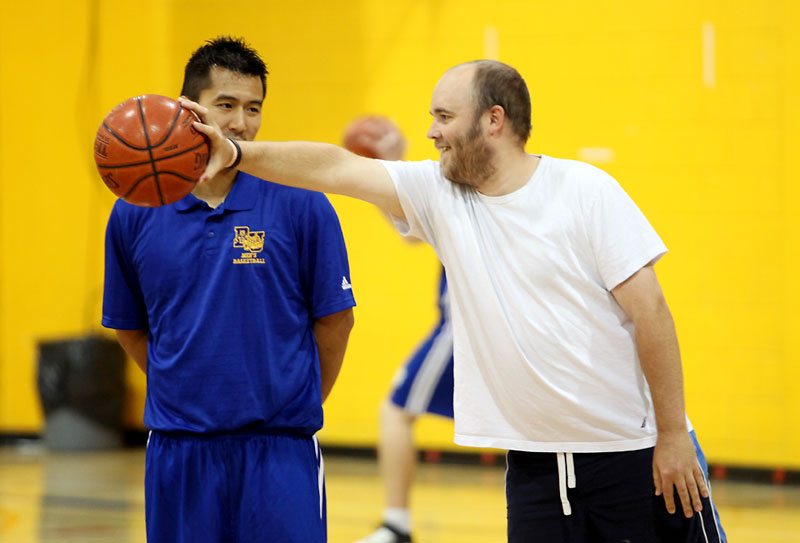
Suffice to say, the unplanned workout from earlier in the practice is now showing its effects in the form of sloppy play and mental errors. Because it’s just me policing the drill, it’s not crazy to suggest they at least subconsciously think they can get away with cutting a few corners.
Not a chance.
"Guys, I know there’s about 1,000 other places you’d like to be right now," I start out, "but right now you’re …"
The rest of the sentence isn’t fit for print. Let’s just say a colourful adverb is dropped, followed by my comparing their play to, in so many words, canine testicals.
Just because you’re playing a game, doesn’t mean it’s always going to be fun …
"Without a little work I don’t think you can get past an old-timer like me." — Don Haskins, Glory Road
… But it is, after all, still a game. And games are fun.
That simple fact can get lost in the midst of running lines and the monotony of learning offensive sets. Trying to lighten the mood and give the players something more enjoyable to work on, Cheung sets up a three-point contest with him, Wielenga and myself as a team.
Confession: It had been months since I shot a ball and the results were as expected. I took the paint off the rim, shooting 1-for-too many as our team loses. I know Cheung and Wielenga, so I know what’s coming next.
"Bring something to the table Larkins," Cheung says.
Wielenga echoes.
It’s (partially) in jest, but that doesn’t mean I am not a bit vexed by the whole brutal affair. I walk off the floor, my thoughts basically written out as "%$^& @#$% $%^&!!!!!!".
A week later, we’re back at it. Same teams, same stakes.
Splash.
The stroke feels better, one shot falls, then another, then another. Wielenga and Cheung set the pace, and this time I keep up with it.
When sorting through the tedium of basketball vernacular — flop, reign, skinny, show, blitz — it’s easy to forget why everyone gets involved in the game in the first place.
It’s fun to win.