
Priestner trades goal stick for guitar
Advertisement
Read this article for free:
or
Already have an account? Log in here »
We need your support!
Local journalism needs your support!
As we navigate through unprecedented times, our journalists are working harder than ever to bring you the latest local updates to keep you safe and informed.
Now, more than ever, we need your support.
Starting at $15.99 plus taxes every four weeks you can access your Brandon Sun online and full access to all content as it appears on our website.
Subscribe Nowor call circulation directly at (204) 727-0527.
Your pledge helps to ensure we provide the news that matters most to your community!
To continue reading, please subscribe:
Add Brandon Sun access to your Free Press subscription for only an additional
$1 for the first 4 weeks*
- Enjoy unlimited reading on brandonsun.com
- Read the Brandon Sun E-Edition, our digital replica newspaper
*Your next Free Press subscription payment will increase by $1.00 and you will be charged $20.95 plus GST for four weeks. After four weeks, your payment will increase to $24.95 plus GST every four weeks.
Read unlimited articles for free today:
or
Already have an account? Log in here »
Hey there, time traveller!
This article was published 12/05/2020 (2215 days ago), so information in it may no longer be current.
In an odd way, James Priestner can thank the Brandon Wheat Kings for his promising new career.
The 29-year-old former goaltender and his band Rare Americans are close to signing a record deal with a major label. Priestner learned the guitar and began to write songs after Brandon traded him to the Prince George Cougars in 2009 and the Edmonton product was searching for ways to fill his time.
“The world is spooky,” Priestner said. “You never know why things happen the way they do and why some people come into your life at the time that they do and why they leave when they do. If everything was meant to happen for a reason and that’s the way the world works … I don’t know.”

Priestner was born in London, Ont., but moved to Winnipeg soon after and lived there until he was two. The family ultimately ended up in Edmonton, where Priestner grew up.
He first took to the ice around six or seven at a nearby arena, taking skating lessons from a female teacher. The family had a cabin south of Edmonton at Pigeon Lake, and one of their neighbours would build a rink.
“I remember taking a vehicle out onto the lake and putting the lights on when it got dark,” Priestner said. “I was taking out a player’s stick and trying to stickhandle and skate around.”
Later, when he began playing organized hockey, skating at the outdoor rinks with his buddies also became a favourite pastime.
The Priestner family includes three brothers, Jared, who is the oldest, and Saskatoon Blades general manager Colin.
“I followed exactly everything Colin has ever done,” Priestner said with a chuckle. “Colin was a goalie and then he went into tennis, and I went into tennis and also a goalie, and then Colin was a songwriter who released a couple of albums, and I did that too.
“Ironically, in a weird twist, Colin ends up in the WHL and I have nothing to do with it.”
Hockey was certainly a passion James shared with his father, Mike, who purchased the Saskatoon Blades in 2013. The game brought the pair much closer together.
“My dad just loved hockey, and he always has,” Priestner said, noting his father, who was also a goalie, played in the Western Canadian Hockey League with the Kamloops Chiefs in the 1974-75 season. “When I ended up getting drafted by Kamloops it was kind of a full-circle moment. He just loved it. We had such a great bond because he was always the coach. No matter how much he was working, he always wanted to be a coach and be at practice. It was a big bonding experience for my dad and I.”
Priestner said that for any young athlete who plays at a high level, the kid is ultimately the one who has to drive that desire and motivation. When he was about 12, he decided he wanted to gently improve his tennis game, so he started attending a sports school across the city that allowed him to practise every afternoon.
Hockey practice would follow right after, so he spent a lot of hours in the car with his mom, Patricia, as well.
“As much of a sacrifice as it was, and I can’t thank them enough, I don’t think either one of us would trade it for the world with how well we go to know each other in those years in all those hours in the car talking and sharing music,” Priestner said.
“I remember that so fondly and I think my mom and dad do as well.”
After playing a couple of games up front when he started into hockey, Priestner quickly gravitated back to the net. His dad surprised him one day with a used blocker and catcher, and the die was cast.
“I didn’t want to take them off,” Priestner said. “We went in the basement and were shooting a tennis ball and I was catching it.”
From then on, he played net. But it quickly gravitated beyond just the gear.
“After while it becomes your identity,” Priestner said. “It becomes the thing that all of a sudden you’re pretty good at. You form an identity of who you are and that becomes part and parcel.”
He liked that it allowed him to be different than his peers, something he already felt anyway.
Priestner attended the Canadian Athletic Club prep school as he got older. He was named the top goaltender in the Alberta Major Bantam Hockey League in the 2005-06 season, and the Kamloops Blazers came calling in May 2006 when they took him in the second round with the 31st overall pick.
He said the pressure to perform really started in his draft year.
“It was such a pivotal moment because everything changed,” Priestner said. “Hockey was so fun up until that point and then at that point it just became a different thing. With the parents even, it was all they could talk about.”
He said they all became obsessed with it at the time.
On draft day, the competitive teenager was annoyed he hadn’t gone in the first round because a team had promised they would grab him and then decided on another player.
“I wanted to be a first-round pick so bad that it almost took some of the excitement away,” Priestner said with a laugh.
He quickly came around to being a member of the Blazers, and made his debut on Feb. 23, 2007 in a 6-5 loss to the Chilliwack Bruins.
Priestner earned a spot on the 2007-08 Blazers squad as a 16-year-old, appearing in 24 games with a 3.41 goals-against average and a save percentage of .873 on a Kamloops team that went 27-41-2-2.
He said moving away from home wasn’t that difficult, in part because his parents had exposed their three boys to a lot through travel and because they had diverse interests.
“I had seen a lot more of the world than my peers who were farm kids and never been outside their province,” said Priestner, who said it might have been hardest on his mother. “When it came to me leaving, I felt like I was kind of an adult already.”
He said the biggest transition may have been moving in with a different family and eating their food.
The toughest part came on the ice. Priestner said it was a huge step up, and something illustrated at camp when some of the team’s National Hockey League alumni were on the ice.
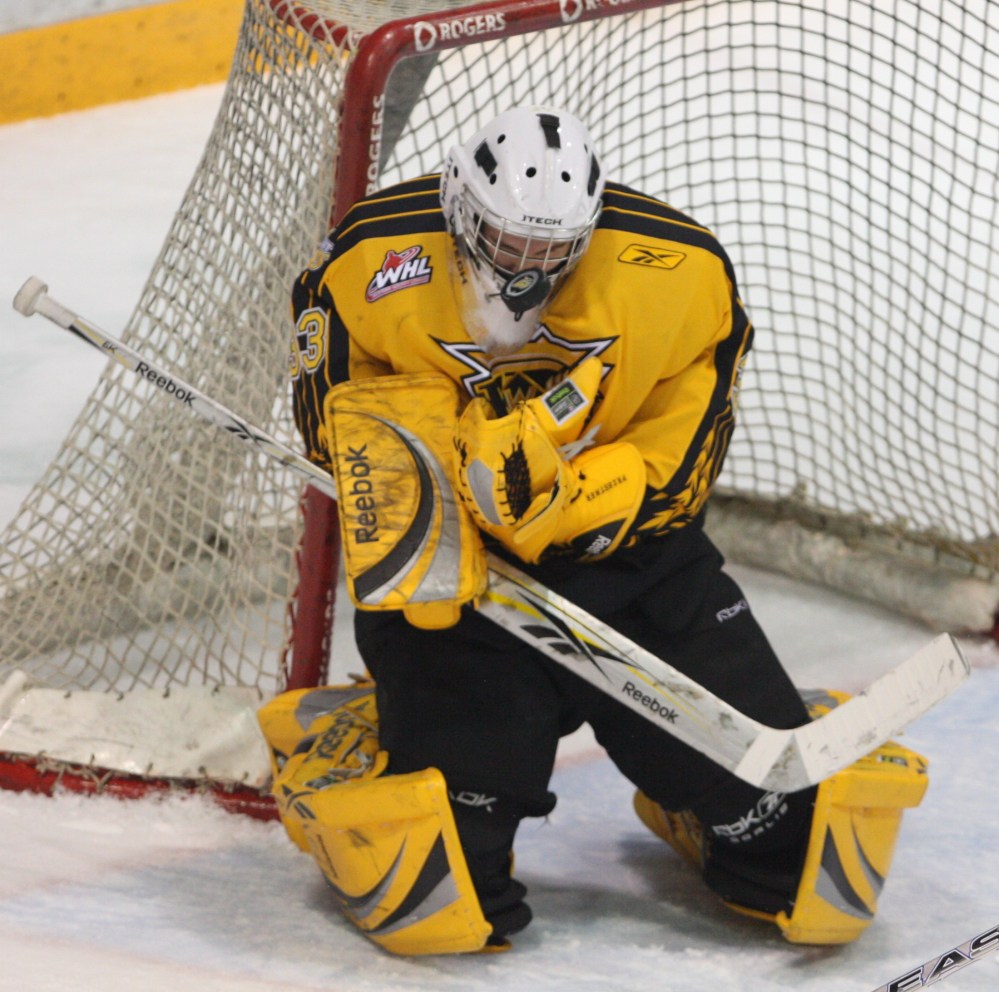
“I remember a couple of two-on-ones where the pass came across and the shot, and I was nowhere near the puck,” Priestner said. “I was like ‘Holy (crap), this is a different pace and everyone can shoot.’”
One nice thing for him was that he shared the crease with his best friend, Justin Leclerc, a Saskatoon product who spent parts of five years in the league.
After making 24 appearances in his rookie season, the Blazers were being sold and Priestner’s father put in a bid. Vancouver businessman Tom Gaglardi ultimately purchased the club, putting James in an awkward spot.
“There was just naturally some kind of tension there,” Priestner said. “It wasn’t manufactured tension or anything, it was a natural byproduct of the situation. I definitely didn’t want to be perceived as the kid whose dad tried to buy the team because I felt like I had made it on my own merits.”
Kamloops had fired former Wheat Kings coach Dean Clark the previous season and replaced him with Barry Smith. Priestner and Smith didn’t get along well, so the young goalie wasn’t surprised on Sept. 29, 2008 when the Wheat Kings acquired him for a third-round pick in the 2009 WHL bantam draft.
(Kamloops selected Brandon Morley, who went the college route.)
“When I got traded to Brandon, I was really happy actually,” Priestner said. “It was a cool town, I had amazing billets and instantly when I walked into the room it was just a totally different culture. I could tell it was much more of a winning culture. Obviously (head coach and general manager) Kelly (McCrimmon) ran a real tight ship and was a pretty particular guy. He does things the way he wants them and people typically buy into the program. We also had a really strong team. I could just feel the presence of leadership.”
The Wheat Kings went 48-19-3-2 with a team led by forwards Brayden Schenn, Jay Fehr, Andrew Clark, Matt Lowry and Scott Glennie, plus a defensive corps that included Colby Robak and Keith Aulie.
He shared the net with Andrew Hayes, who he knew a bit from Edmonton.
“We got along fine,” Priestner said. “There was no tension between us, we were always trying to help each other out and make each other improve.”
Priestner played 29 games for the Wheat Kings, posting a record of 17-7-1-1 with a 3.08 goals against average and an .883 save percentage.
“It was fun,” Priestner said. “It was exciting. Even practices were exciting because I had a bit of a competition with them individually. Brayden and I would stay on the ice and try different little shooting drills. We’d place little wagers on how many times he scored or I stopped him.”
Priestner said it was a competitive group, with the different lines even competing against each other in practice to see how many goals they could score. That pushed the goalies to stop as many shots as they could.
He said it was a high-risk, high-reward team that pushed on offence but also allowed a lot of great opportunities.
“We had a lot of games that were 5-4 because we were creating chances back and forth,” Priestner said. “It was a different way of playing.”
Priestner was billeted by the Janz family, and spent a lot of evening playing cribbage and talking with Gail, who he said became like a second mother to him.
Brandon also grew on him as a positive, communal city, and he enjoyed the good crowds and strong support shown by fans.
However, it all changed for Priestner again on Aug. 20, 2009 when he was sent to Prince George for a third-round pick in the 2011 draft and the rights to 19-year-old defenceman Aaron Ness, who never played a game in the WHL but spent 24 games with the Arizona Coyotes last season.
Brandon used the third-round pick to take John Quenneville.
Priestner was well known to Cougars head coach Dean Clark, who drafted Priestner while he was with the Blazers. Priestner never asked for a trade, but had spoken to Brandon’s goalie coach at the time, Matt Cockell, who now serves as general manager of the Winnipeg Ice. Priestner told Cockell he wanted the top job.
“My future felt a little uncertain in Brandon,” Priestner said. “I didn’t know if I was going to be an 18-year-old backup or what the plan was moving forward with the Memorial Cup that year. In hindsight, I think I wanted to be a starting goalie so much at 18 but that’s stupid. If I could go back and change it I would have tried to fight and express to Kelly how badly I wanted to stay in Brandon.”
He never really connected with the city of Prince George, and had a terrible relationship with one of his teammates that bothered him. After 12 games, he visited Clark at his house and told him he was finished.
“I didn’t feel very welcome in PG, and from the beginning I didn’t like it all,” Priestner said. “I totally lost my desire to play hockey at that point. My heart just wasn’t in it anymore. I think it’s the one time in my life I’ve every really dealt with depression.”
He fell out of shape and then returned to Edmonton, where he joined the family business, a large car dealership chain called GoAuto.
Priestner learned the business for five months and then headed out on a backpacking trip. It opened his eyes to a lot of things and motivated him to return to the ice.
“I didn’t want my career to end like that,” Priestner said. “I didn’t have the same desire to go play in the NHL or anything like that but I wanted to end my career on a different note.”
After getting back in shape and working with a goaltending coach again, he called Clark to ask for a tryout.
He made 37 appearances with the Cougars, posting a 3.77 goals-against average and .878 save percentage, and has hardly worn skates since.
He completed his WHL career with 103 appearances, posting a 3.62 goals-against average and a .876 save percentage with four shutouts.
The life-changing element of his time in Prince George actually came off the ice. The 19-year-old wasn’t in school and wasn’t allowed to have a part-time job so he started taking guitar lessons to fill his time when the Cougars weren’t on the road.
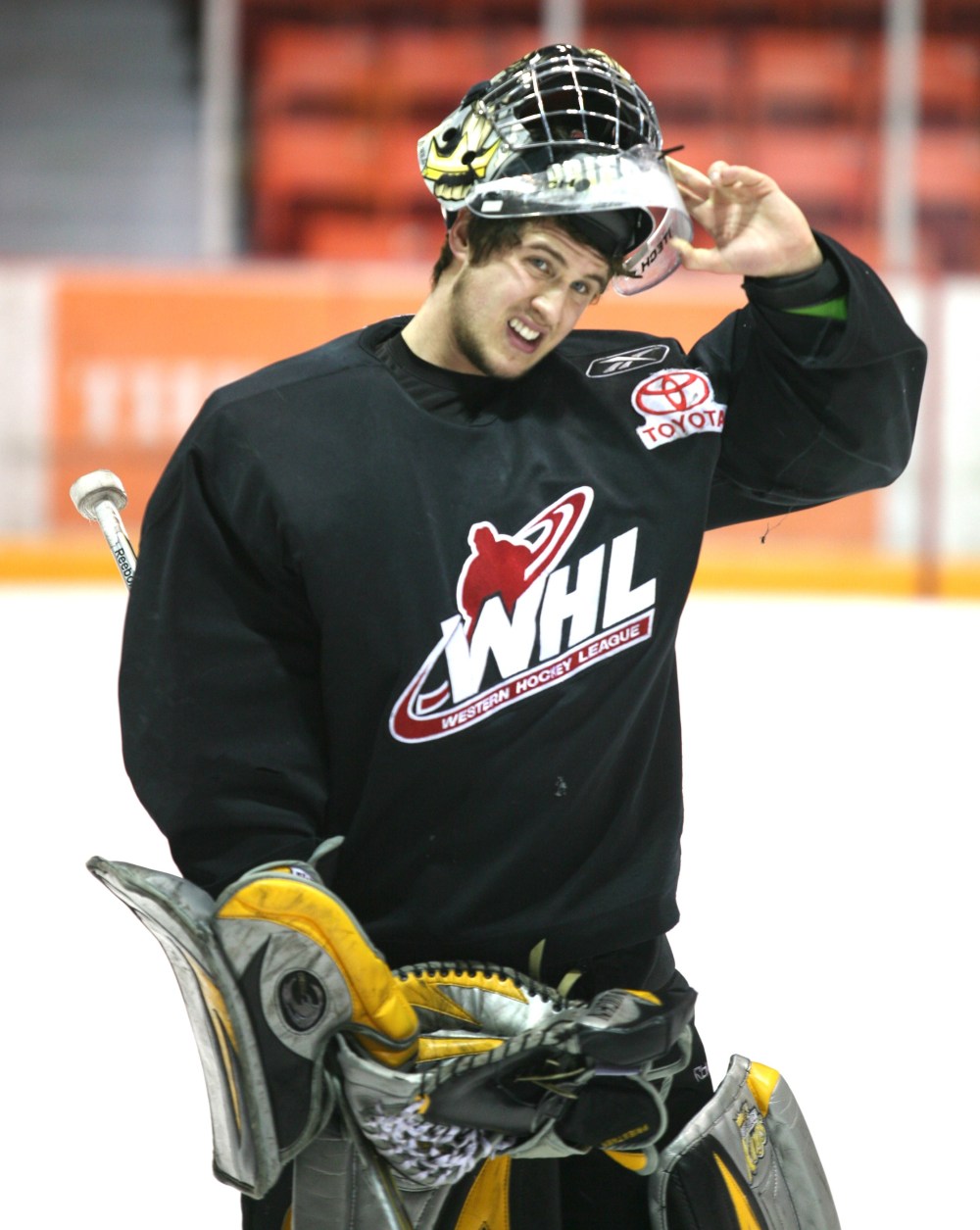
“I learned a cover song and took the same kind of chords and chord progressions and really quickly wrote a song,” Priestner said. “It was ‘Woah, what the hell just happened?’ It felt like a ghost took over my body or something and I didn’t know if I could ever do it again.”
He wrote another song the next day, and then challenged himself to write a new one every time he had his weekly guitar lesson. His guitar instructor encouraged him, telling Priestner he had never seen anything like it before.
“I just fell in love with it,” said Priestner, who actually recorded a couple of songs that season and he even got to play a song in front of Sarah McLachlan prior to her concert in the city. She also encouraged him to stick with it.
“That was a big turning point in my life,” Priestner said.
After leaving Prince George, he went to a music school in Vancouver and was working for the family business remotely.
He was playing a lot of open microphone shows, taking singing lessons and meeting people in the music industry. When he was 23, he returned to Edmonton for a year for a different job — continuing to work on his music at the same time — and then was offered a more time-consuming promotion.
“That was the fork in the road for me,” Priestner said. “I was still obsessed with music and that was all I wanted to do, even though it seemed like it was impossible, it was the thing my body wanted to do and I didn’t feel like I could give up on it yet.”
He declined the offer and moved back to Vancouver to study audio engineering and production. Things started to take off after that as he worked in the studio every day.
“That was when things changed for me,” Priestner said. “I was taking my songs and learning how to produce them now. A good song and good production are what makes a hit happen.”
His band, the Lunas, which also included drummer Ian Cardona, guitarist Lubo Ivan and bassist Chad Watson, was formed at that time and they played a lot of shows around Vancouver. They also toured Canada twice, including a show in Brandon, and released an EP.
His next step forward came in an unusual way. He went for a holiday with his brother Jared, who is 10 years older, to give the pair a chance to hang out.
James joked that he would bring his guitar, and after they had a couple of beers, they could write a song together. Jared, who had never written a song before, assured James they would create a whole album instead.
“Sure enough, 47 beers later or whatever, we were there 10 days and I think we wrote 14 songs,” Priestner said. “We had this great songwriting chemistry.”
Jared was more of a punk rocker so he liked things fast, while the Lunas had more of a groovier sound.
James quickly disbanded the Lunas and called his new project, the Rare Americans. His suspicions about the new songs were quickly confirmed when the new band went viral with their first animated video for the song Cats, Dogs, & Rats.
“We had no idea what was going to happen when we put it out there, and all of a sudden it blew up,” Priestner said.
Since then, their animated videos have drawn tens of millions of views. They began to talk to a record company last November, with the intricate, complicated contracts taking months to finalize.
“We could get ourselves to a certain level independently, but in order to have mainstream success, we need a relationship and the power of the machine,” Priestner said.
The band also includes Ivan from the Lunas.
They won’t mount an extensive tour until they build more demand, which they plan to do with additional releases and more of the animated videos they’ve become known for.
“It’s the only thing in my life I’ve ever been able to do for 12 hours a day, go to sleep, and then wake up and want to spend another 12 hours doing it,” Priestner said. “I’ll do that every single day for years. I don’t know what it is about it, but I’m obsessed with every single aspect of it.”
He said the lessons he learned in the WHL didn’t completely sink in at the time, but have served him very well since. Now he puts in full days plotting the band’s course, taking singing lessons, writing and doing the many other behind-the-scenes jobs that are fundamentally important in the music business.
“I think one of the greatest gifts in my life was athletics, just the discipline it teaches you and the next level of hard work that’s required to compete at a high level,” Priestner said.
“It makes you understand how high the threshold is.”
» pbergson@brandonsun.com
» Twitter: @PerryBergson