
Hockey gave Hicks many opportunities
Advertisement
Read this article for free:
or
Already have an account? Log in here »
We need your support!
Local journalism needs your support!
As we navigate through unprecedented times, our journalists are working harder than ever to bring you the latest local updates to keep you safe and informed.
Now, more than ever, we need your support.
Starting at $15.99 plus taxes every four weeks you can access your Brandon Sun online and full access to all content as it appears on our website.
Subscribe Nowor call circulation directly at (204) 727-0527.
Your pledge helps to ensure we provide the news that matters most to your community!
To continue reading, please subscribe:
Add Brandon Sun access to your Free Press subscription for only an additional
$1 for the first 4 weeks*
- Enjoy unlimited reading on brandonsun.com
- Read the Brandon Sun E-Edition, our digital replica newspaper
*Your next Free Press subscription payment will increase by $1.00 and you will be charged $20.95 plus GST for four weeks. After four weeks, your payment will increase to $24.95 plus GST every four weeks.
Read unlimited articles for free today:
or
Already have an account? Log in here »
Hey there, time traveller!
This article was published 27/09/2020 (2078 days ago), so information in it may no longer be current.
While competitive hockey ended for Ken Hicks more than four decades ago, its impact remains.
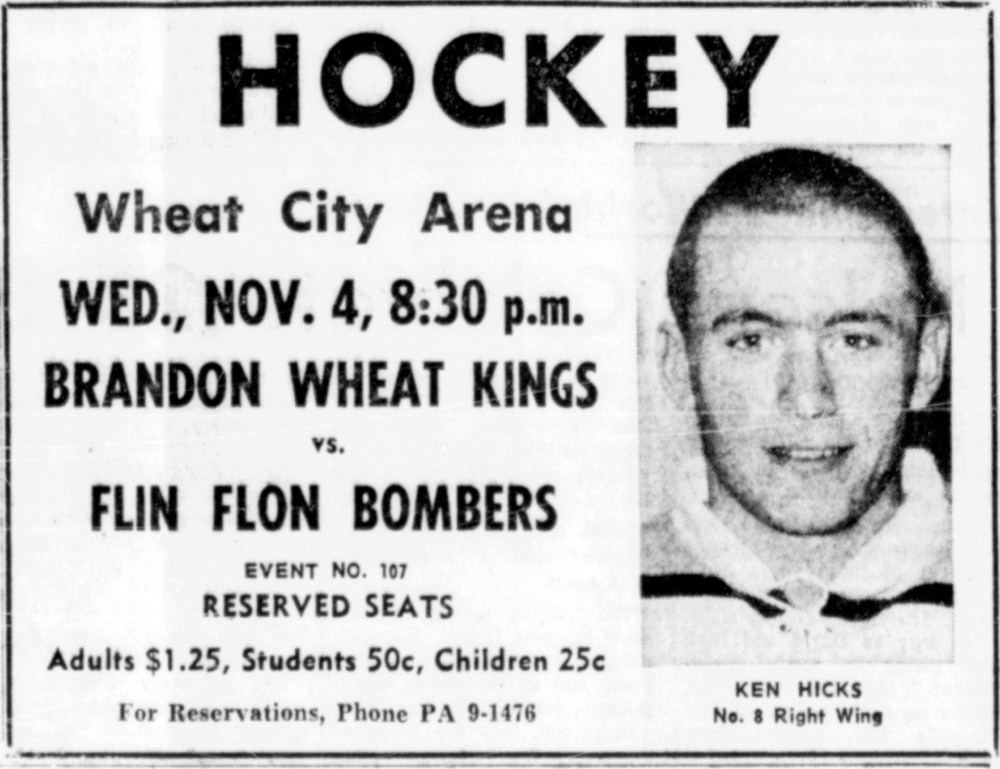
Hicks, who played parts of three seasons with the Brandon Wheat Kings from 1963 to 1967, remembers wondering when he left his home in Swan Lake what kind of people he would encounter. He was pleasantly surprised.
“It didn’t matter where I went, there were always good people,” Hicks said. “Of course when you go somewhere to play, you’re in a group right away so the next thing you know, you know 20 guys. And then it spins out from there and you know quite a few people. I remember thinking that no matter where I went, I always met good people.”
He thinks back to how many people he met over the years who treated him well and he never saw again, which makes him even more grateful. He said it taught him to respect a wide variety of opinions.
He also seized on some of his father’s advice.
“I remember my dad telling me that travelling is like an education if you want to use it that way,” Hicks said. “I’ve often thought of that and it’s true. I guess I got to do a lot of travelling through hockey that I wouldn’t have done otherwise.”
His hockey journey began in Crystal City, where he was born. He was raised by parents Ed and Veryle in Swan Lake, which is straight south of Austin and a 141-km drive from Brandon.
His father came to Swan Lake to play hockey, and the veteran found a job as postmaster there.
While there was a small, dark, natural-ice rink in Swan Lake — Hicks started skating at age three — there wasn’t a strong cohort of local players so Hicks made the 30-km trip to play in his parents’ original hometown, Pilot Mound.
“We had a pretty good group there,” Hicks said. “We won some provincial championships. It was good.”
His grandparents still lived in Pilot Mound, so he would stay with them on the weekends to be close to the rink.
With the benefit of hindsight, he’s grateful to his parents for all they did to allow him to play.
“They sacrificed, there was no question,” Hicks said. “Dad had a decent job, but there wasn’t a lot of money floating around. Back at that time, women were pretty much the housewife, they weren’t really working out, so there was one income, so they probably sacrificed for me to play. I really appreciated that, and when you get older and realize it, then you really appreciate it.”
The teams in Pilot Mound had the added benefit of a pair of former pro players who came back to help out, Tom Rockey and Jim Moore, who would sometimes lend a hand at practice.
“It was a good time, we had a good group,” Hicks said. “The people who were managing, they looked for games so back at that time, we did a fair little bit of travelling just because people were interested.”
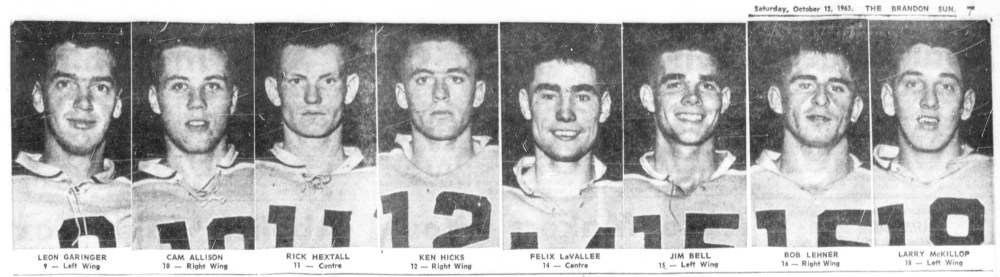
The Pilot Mount juvenile squad won a provincial title in 1963 in Hicks’ 16-year-old season, and his efforts were noticed at the final in St. Lazare when Wheat Kings owner and general manager Jake Milford spotted him.
“As you graduated in years and got more interested and wanted a chance to play junior hockey, Brandon was the place to go,” said Hicks, who was always a forward and usually played centre.
“I remember getting butterflies reading this letter (from the Wheat Kings) and thinking ‘Holy smokes, I’m going to camp.’ You would go to camp and there might be 100 kids there and you’re from a small town and you walk in the dressing room and don’t know anybody. It’s intimidating.”
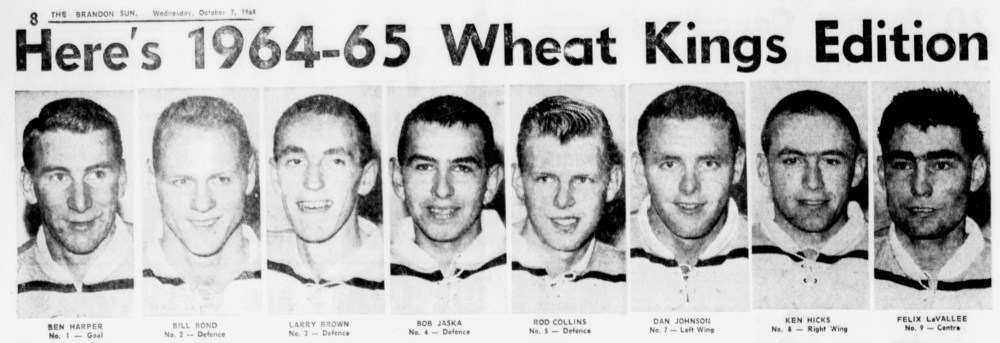
Hicks earned a spot in his 17-year-old season in 1963-64, but it wasn’t a good year for a rookie to make an impact. The Wheat Kings enjoyed their finest season to date when they posted a record of 27-1-2, winning the MJHL title for the third year in a row and fourth time in five years.
On a team that featured Jim Murray, Bob Ash, John Vopni, Ron (Spike) Huston and Leon Garinger, it was tough to carve out a meaningful role. It was a significant step up from juvenile, where each team might have two or three guys capable of playing junior.
“When you went on the ice with all these guys like Ash and Murray and Spike, everybody was good,” Hicks said. “You’re trying to fit in and make yourself better. Of course there was the coaching end of it. We never had a lot of coaching, we had a lot of managing. The drills were all new and it was all really interesting because you weren’t used to it. It was quite an experience.”
He also had to get through an initial starstruck phase. The guys he heard interviewed on the radio and watched play in years past were suddenly his teammates.
“I was walking around thinking ‘Holy smokes, I’m actually out here with these guys,’” Hicks said. “It was somewhat intimidating but after time you start to fit in and gain friends but it was an experience that you were kind of pinching yourself to see if it was true.”
Hicks said Ash, who served as team captain, was one of the guys who made sure he felt welcome.
Milford eventually decided the 17-year-old Hicks needed more ice time, so he loaned him to the St. Boniface Canadiens for the duration of the season.
It gave Hicks a chance to play for both the home team and the visitor at the old Wheat City Arena.
“We thought the building was great,” Hicks said.
“It was bigger, there was more seating, the ice was bigger and everything about it had a lot of history. It was an eye opener to go there compared to what we were used to. It just seemed like every time you went there it was something new and an experience that I enjoyed.”
He said that Wheat Kings team was a powerhouse because of its skating and puck movement, along with a loaded lineup from goaltending out.
Hicks returned to Brandon for the 1964-65 season, but after putting up 15 points in 27 games, history repeated itself when he was sent to the Fort Frances Royals of the Thunder Bay Junior A Hockey League.
“It was really a downer for me,” Hicks said. “… It was hard. You’re 500 miles from home and having a hard time but they treated me really well.”
He also spent his 19-year-old year in 1965-66 there after management refused his request to release him, but they agreed he could become a free agent after the season ended.
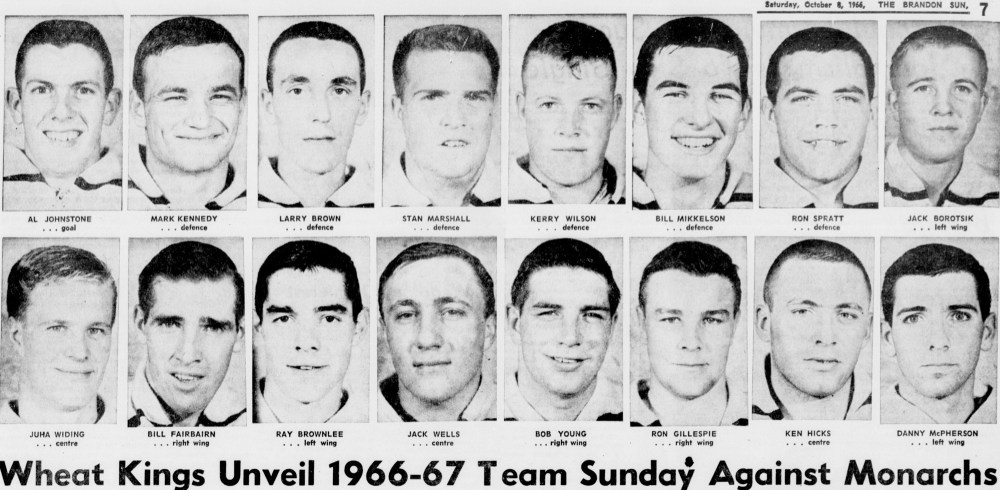
As a result, he returned to Brandon for his 20-year-old campaign in an era when teams could carry an unlimited number of players that age. That 1966-67 Brandon team featured a pair of superstars in Bill Fairbairn and Juha (Swede) Widing, along with a talented supporting cast that included Ray Brownlee, Cal Swenson, Jack Wells, Jack Borotsik, Larry Brown, Bill Mikkelson, Ron Spratt and goalie Al Johnstone.
Widing was the top centre, with Hicks and Wells in the middle on the next two lines.
“Swede and Billy were exceptional,” Hicks said. “Jack Borotisk was a rookie and he played really well and Jack Wells was a guy who could score and was tough. A kid by the name of Bob Young was big and physical and could score. Bill Mikkelson on defence, an NHLer, and Larry Brown, and Al Johnstone was our goaltender, and then with Eddie Dorohoy behind the bench. It was a good year.”
Hicks, who was billeted on 13th Street with Mikkelson and Wells, enjoyed a sensational season, piling up 31 goals and 54 assists in just 53 games. He said Dorohoy was a great coach to play for.
“He was just a breath of fresh air,” Hicks said. “He was full of energy, never quit talking and the guys liked him. He was kind of a change from the old-school coaching. He seemed a little more advanced to me with his ideas and his personality.”
Hicks said a couple of Dorohoy stories stand out.
The old Wheat City Arena players’ boxes were tiered, so Dorohoy stood behind them on a higher level. One night, he was giving the officials a steady stream of advice.
“He was being very vocal with the referees and then his top plate fell out,” Hicks said. “I remember looking around and he was trying to grab it to get back in his mouth. He was just a character.”
At that time, CKX sport director Marv Saxberg hosted a television show, and when the team learned Dorohoy was the guest, all eyes were glued to the television.
“We knew that he was going to do a lot of talking,” Hicks said.
“Saxberg said ‘Good evening folks, this is Eddie Dorohoy, coach of the Wheat Kings. How are you doing Eddie?’ Well, Dorohoy just took over and Marv never got another word in until the show was over, I don’t think. We were at home just roaring and laughing.”
The Wheat Kings and their northern rivals the Flin Flon Bombers had both returned to the MJHL that season from the Saskatchewan Junior Hockey League, which had folded with the advent of the new Western Canadian Junior Hockey League.
Flin Flon finished first with a record of 42-6-0 with Brandon in second with a record of 47-9-1. The Bombers played less often, with 12 four-point games.
The Bombers lineup boasted the powerful combination of Bobby Clarke, Reggie Leach and Gerry Hart, all of whom enjoyed long NHL careers.
“You could just tell that Clarke and Leach were special,” Hicks said. “I thought at that point Reggie Leach was the more natural hockey player than Bobby Clarke, but Clarke, being a diabetic, wouldn’t give up. He would do anything to win. They were young but you could tell they were going to be special.”
It proved to be a fierce rivalry, and that certainly didn’t exclude the top players. Hicks remembers one especially bitter battle.
“Fairbairn and Gerry Hart just hated each other,” Hicks said. “They were both the same size and they just growled at each other every time they saw each other.”
The rival squads met in the league final, where Flin Flon prevailed 3-2 in a well-played, best-of-five series. Hicks and Johnstone were picked up by the Bombers for the Memorial Cup and went north to practise with the club, but first Flin Flon had to win their next series in the Western Memorial Cup semifinals. Instead, the Bombers were beaten by the Port Arthur Marrs 4-2 and the pair were never eligible to suit up.
On June 7, 1967, the NHL held its amateur draft one day after the expansion draft, and the five-foot-seven, 167-pound Hicks was picked third overall by the upstart California Golden Seals. In a very different era of the draft, only 18 players were selected, with just three ever appearing in an NHL game.
See ‘Hicks’ — Page B2
“My game was a skating game,” Hicks said. “I had to have that because of size. I enjoyed being on the ice and skating and really worked at it. That worked for me. Back in minor hockey days, I could always put the puck in the net, but all that changes as you go up in levels. You don’t get as many chances and everyone is better, but I still managed to score pretty good.”
Hicks went to California’s camp that fall in Port Huron, Mich., and one memory stands out.
He rode to practice one day with NHL goaltending legend Jacques Plante, who was there helping out as a coach prior to resuming his career a year later, and Bobbie Baun, the veteran Toronto Maple Leafs defenceman who had been claimed in the expansion draft.
“I knew I wasn’t staying there and they knew that too,” Hicks said. “They told me ‘If you get a chance to go to the Central League, that’s the league to go to for young guys.’ Here I am, sitting in the backseat of this vehicle with Plante and Baun thinking ‘Holy smokes, this is something.’”
The Golden Seals didn’t have a dedicated farm team, and incredibly, after he left that first camp, he never heard from the organization again.
Hicks landed with former Brandonite Fred Creighton and the Charlotte Checkers in the Eastern Hockey League with his close friend and Brandon teammate Spratt. After putting up 38 points in 54 games in Charlotte in the 1967-68 season, Hicks was sent to the Jacksonville Rockets, where he added 11 more points in 16 games.
“You have to get used to those things,” Hicks said. “You’re a number in the end.”
He started the 1968-69 season in Jacksonville but it wasn’t a good place for him. The team didn’t get much ice time, and the ice was terrible quality anyway.
“It wasn’t a hockey atmosphere and I wasn’t happy,” Hicks said. “I actually came home, and through Freddy Creighton knowing somebody in Cranbrook, the next thing I got a phone call saying we would like you to come out.”
The Royals, who played in the senior Western International Hockey League, found him a job and he spent parts of five seasons there. After the 1972-73 season started, Hicks and former Wheat King Jack Mahon left Cranbrook to join the Calumet-Houghton Chiefs in Michigan in the old professional incarnation of the United States Hockey League.
“We were at that age when you get the bug to try something and move on,” Hicks said. “That’s what we did. It was OK. Probably in the end Cranbrook would have been a good place to settle down and stay there.”
In the 1973-74 season, Hicks was named to the USHL’s second all-star team. One year later, after the 1974-75 season, Hicks reached the end of the road with pro hockey.
He had been working a seasonal job with the provincial transportation department out of Treherne, but was offered a full-time permanent job doing highway maintenance.
“It went from seasonal for one year to a full-time job so I had to make that decision,” Hicks said. “Rather than going back to Calumet, I thought if I have a chance for a year-round job, I better maybe start looking at that. I got married in the meantime, and was there for the next 36 years. It’s hard to believe.”
He and his friend Rod Collins put a senior team together, which did give him a competitive outlet. He also coached minor hockey.
Hicks has two children, both of whom live in Alberta. He has a four-year-old granddaughter, who was down for a visit this summer.
It’s more than 53 years since Hicks last wore the wheat sheaf on his chest, but he’s grateful for the opportunity.
“Even today in these little towns, you mention the Wheat Kings and once in a while I’ll have someone ask me ‘Did you actually play for the Brandon Wheat Kings?’” Hicks said. “I say ‘Ya, you can’t tell by looking at me but I actually did.’
“It’s 50 years ago but I still take pride in that.”
» pbergson@brandonsun.com
» Twitter: @PerryBergson