
Huston took unorthodox path to NHL
Where are they now: Brandon Wheat Kings alumni
Advertisement
Read this article for free:
or
Already have an account? Log in here »
We need your support!
Local journalism needs your support!
As we navigate through unprecedented times, our journalists are working harder than ever to bring you the latest local updates to keep you safe and informed.
Now, more than ever, we need your support.
Starting at $15.99 plus taxes every four weeks you can access your Brandon Sun online and full access to all content as it appears on our website.
Subscribe Nowor call circulation directly at (204) 727-0527.
Your pledge helps to ensure we provide the news that matters most to your community!
To continue reading, please subscribe:
Add Brandon Sun access to your Free Press subscription for only an additional
$1 for the first 4 weeks*
- Enjoy unlimited reading on brandonsun.com
- Read the Brandon Sun E-Edition, our digital replica newspaper
*Your next Free Press subscription payment will increase by $1.00 and you will be charged $20.95 plus GST for four weeks. After four weeks, your payment will increase to $24.95 plus GST every four weeks.
Read unlimited articles for free today:
or
Already have an account? Log in here »
Hey there, time traveller!
This article was published 21/10/2020 (2052 days ago), so information in it may no longer be current.
You would be hard pressed to find a more unlikely path to the National Hockey League than that of Ron (Spike) Huston.
The former Brandon Wheat Kings forward, who spent three seasons with the club from 1962 to 1965, was playing senior hockey with the Calgary Stampeders of the Western International Hockey League during the 1970-71 campaign. Three seasons later, he made his NHL debut on Jan. 16, 1974 with the California Golden Seals at age 28.
That came after he was cut by the old professional Western Hockey League’s Seattle Totems at the start of the 1967-68 season following the arrival of a bunch of players sent by the Montreal Canadiens.
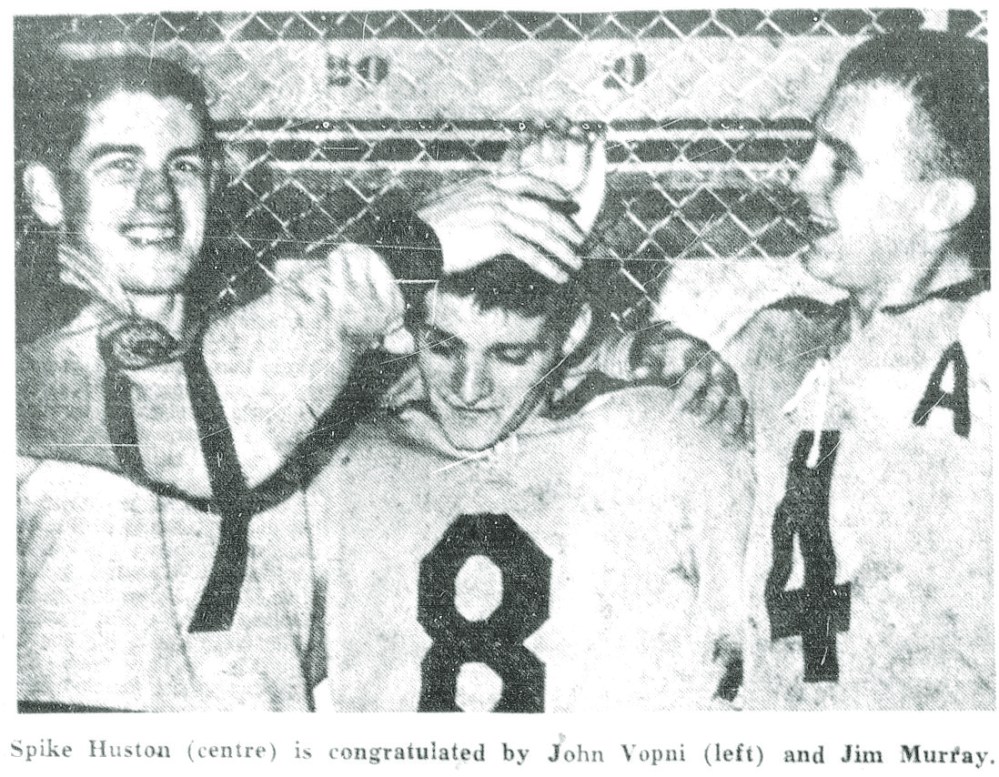
“They gassed me and that’s when I figured my NHL career was over,” Huston said with a chuckle.
He was born in Manitou and lived on a nearby farm until the family — father Jim, mother Agnes, brother Bill and sisters Eunice and Ellen — moved to Brandon when he was a few years old.
Huston began skating soon after at a slough down by the Assiniboine River because it was the first thing that froze over. The East End also had a pair of outdoor rinks for figure skating and hockey, and after firefighters laid down the first flood with their fire hoses, the youngsters would migrate there.
Bill, who was about three years old and died in 2019, also played hockey. During a winter carnival at the rink one year, Spike won his age group in a skating race and also captured the two above that. Eventually he faced kids three years older than he was and met Bill in the final.
“I was right behind him all the way to the last turn and I went by him and he reached out his hand and got disqualified,” Huston said with a chuckle. “Oh, my dad ripped him apart. He was a pretty good hockey player but he was a little shy so he quit after that.”
Hockey’s loss proved to be fastball’s gain as Bill was later inducted into the Manitoba Softball Hall of Fame as an individual player in 2006 and as a member of the 7up team in 2009.
Spike said his parents were big boosters of the brothers playing hockey.
“Every year I got a new pair of skates and I got them sharpened every week even then,” Huston said. “There was only bantam and midget at that time, there was no peewee or anything like that. We played school hockey and you had to be in Grade 5 or 6 to play. Once a week down at the old (Wheat City Arena), we played 24 minutes straight time, two periods. Anyway, I started playing when I was in Grade 3, not in Grade 5.”
Other than his last two years of school hockey when he moved back to the blue-line to get more playing time, Huston was always a forward.
Growing up, Huston was a fan of the Manitoba Junior Hockey League’s Wheat Kings. When they ceased operations for four seasons from 1954 to 1958, he attended games featuring the minor professional Western Hockey League’s Brandon Regals, who played the 1955-56 season in the Wheat City Arena, and then half of the 1956-57 campaign after a move to Regina proved unsuccessful.
Part of the adventure of going to games was exploring the old Wheat City Arena, which sat in the current location of the Brandon Police Service building and parking lot. It was built in 1913 and demolished in 1969.
“You would walk around the outside and the offices were in the front and our dressing room was in the opposite corner in the back,” Huston said, adding it inspired youngsters to make the jump to the big team. “When you were playing bantam or something, you always wanted to play for the Wheat Kings.”
After leading the midget league in 1960-61 with 51 points despite missing time due to a toboggan accident, the Wheat Kings signed Huston for the 1961-62 season.
He suited up that year with the Reston Rockets in the SouthWest Intermediate senior league, which was led by player-coach Glen Lawson.
Huston earned a spot as a 17-year-old on the 1962-63 Wheat Kings squad under general manager Jake Milford, joining the team for a pair of MJHL championships as they went 32-7 that season and 27-1-2 a year later.
“We were the far superior team in the league,” Huston said. “Jake got whoever he could get. The Winnipeg teams all got their kids out of Winnipeg so we had a big advantage that way.”
The 1962-63 squad was led by the high-scoring duo of Bob Stoyko and Dennis Hextall, with Bob Ash and Jim Murray anchoring the blue-line.
It was a big step up for the youngster, who was five-foot-nine.
“Oh for sure,” Huston said. “Everybody was bigger and stronger. You noticed a big difference.”
While it was a rugged game in the early 1960s, it was nothing like the age of the battling Broad Street Bullies that the Philadelphia Flyers ushered in more than a decade later.
“We had some guys who would fight but there wasn’t a whole whack of fighting in those days,” Huston said. “There weren’t guys in your lineup just to fight.”
He played 20 games with the Wheat Kings that season as head coach Ron Maxwell eased him into the lineup, but quickly felt comfortable in the dressing room with area players Ash, Murray and his minor hockey teammate Bob Jaska.
“It wasn’t overwhelming,” Huston said. “You’re happy as heck to be in there and have a stall.”
Huston said it was nice to skate in the Wheat City Arena, which always good ice. It was also great to simply play at home.
“We had lots of fan and everybody knew you,” Huston said. “I called Brandon my home.”
Huston was one of the few Brandonites who made the team at that time. He said Milford figured local players simply found their way into more trouble.
“He didn’t like me,” Huston said of Milford. “He thought we were partying too much.”
Huston added with a chuckle that Milford was probably right.
Huston’s game quickly grew. As an 18-year-old in the 1963-64 campaign, he exploded for 30 goals and 20 assists on the top line with John Vopni and Leon Garinger.
The trio finished in the top three spots in team scoring.
“I was always a good skater,” Huston said. “Some people didn’t think I was too fast but I could keep up with most guys. I could shoot the puck pretty well and I could stick handle. I would rather pass the puck than score. If we had a 2-on-0 with no goalie, I would pass it over to the guy beside me. It’s how I played. Lots of coaches said to me I didn’t shoot enough but I could score my share.”
He became close to teammates such as Larry McKillop and Rick Hextall, but they were discouraged from going to the billet homes of out-of-town players. He quit school in Grade 11 and had to get a job, working as a bricklayer’s helper.
He had good leadership from his coach Maxwell, who Huston really liked.
“Ron was a great guy,” Huston said. “Excellent coach and a pretty good hockey player himself. He played lots of senior hockey in Brandon and had a son that played hockey. He was a great coach.”
Even with all of their success in the MJHL, they were never able to advance to the Memorial Cup, which at that time was awarded to the top Junior A club. The Wheat Kings fell to their arch-rival Edmonton Oil Kings both years in the Memorial Cup’s western qualifier.
“Edmonton had a good team, and we really, really had a good team,” Huston said.
After his second season, Huston and several of his teammates attended the NHL camp held by the New York Rangers, the team that held territorial rights over Brandon players in the pre-draft era.
However, everything changed for Huston and this teammates prior to the 1964-65 season.
The club shifted to the Saskatchewan Junior Hockey League for two seasons over having to pay the Winnipeg teams to travel to Brandon, and also for competitive reasons.
“It was good,” Huston said of the move. “I think the teams were quite a bit better. We were as good as them but they had good teams, where the Manitoba junior league didn’t have all good players.”
There was also another bit of huge news for Huston in the summer of 1964, as the 19-year-old got married.
In his 19-year-old season, Huston posted 39 points in 52 games, down from the year before. One reason was that his year came to a screeching halt just before Christmas in 1964 when he and forward Erv Ziemer collided during a drill in practice.
“We were having line rushes and the line before was supposed to come down the boards,” Huston said. “Well, I’m looking back at the puck and we ran into each other. He hit me just underneath my nose. I only got cut for I think three stitches — in fact I say the doctor must have been drunk when he sewed me up because there were only three — but I went to the hospital for over a week and I didn’t remember anything.”
It was Huston’s first concussion. His wife brought him his Christmas presents in the hospital and he happily opened them. When he got home with a newly functional memory a week later, he was surprised all over again to see what he received.
After the 1964-65 season, Huston was invited back to New York’s camp, but chose not to attend. He had been told he would likely be assigned to the St. Paul Rangers of the Central Professional Hockey League, where Milford had moved to serve as GM, and he didn’t think he would get a fair shot because of their past issues.
“That’s how I ended up in Cranbrook,” Huston said. “I think Jake knew what he was doing, but he had a kick on for Brandon kids. He said ‘You guys cause too much trouble.’ Bobby Ash and Jimmy Murray wouldn’t say boo, they wouldn’t go out of line, but I was out drinking a little bit and he didn’t like it.”
The Rangers called and called for him to come, but Huston instead chose to join the newly formed Cranbrook Royals of the Western International Hockey League. He and Brandon teammate Eddie Maher headed out for the hockey and the guarantee of a good job.
“I hadn’t been on skates all summer and I got to practice and the guys were horrible,” Huston said. “I was thinking ‘What the hell are we getting into?’ It was brutal but they wanted to sign me. I said ‘I’m not signing until I get a job.’”
They found the players positions as a labourer building a fish hatchery outside of Cranbrook, but the hour drive each way and eight hours of back-breaking work weren’t quite what they envisioned.
The team found Huston a job at the rink and Maher ended up as an electrical apprentice. Huston enjoyed the new job, but eventually he joined Maher as an electrical apprentice.
Huston spent two years there until his boss — “a great guy and a real hockey fan” — was electrocuted. After time with another electrician, he went out to a pulp mill north of Cranbrook.
Meanwhile, things were also going well on the ice, other than being sent back to Cranbrook by Seattle in 1968.
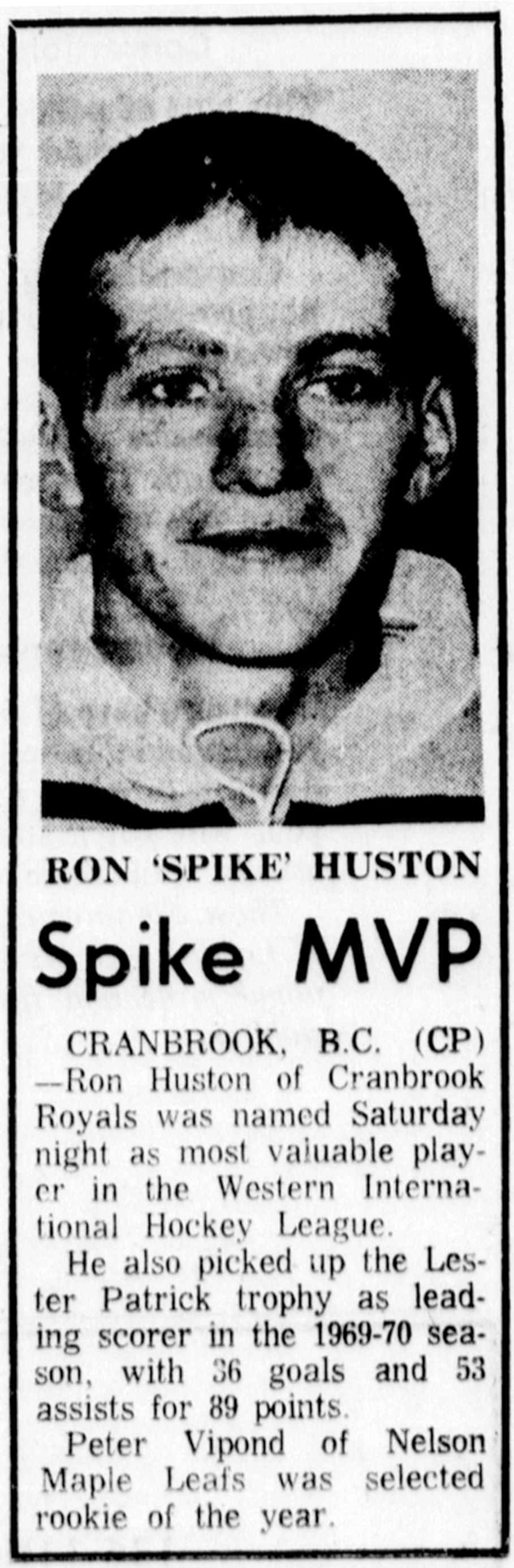
In fewer than 50 games each season on a bad team, Huston posted 59, 81, 88 and 89 points, and was named league MVP three times.
The newly formed Philadelphia Flyers listed Huston and invited him to join their Eastern Hockey League affiliate. He went down for a couple of weeks in 1968 but didn’t enjoy the hockey so he returned to Cranbrook.
He was also picked up by the Spokane Jets for the 1970 Allan Cup, making an important connection with former NHL goalie and current Jets head coach Al Rollins. Spokane won the Canadian trophy, with Huston scoring in five consecutive games en route to the title.
After the 1969-70 season, Huston joined the Calgary Stampeders senior team to move the family closer to better schools because his oldest son had been born partially deaf.
The Stampeders put the family in a new house, and they began to settle in. But at Christmas that year, the team owner died and the new owner only committed to finishing the season.
Huston put up 42 points in 40 games, but more importantly, he was noticed.
The Boston Bruins, who had just won the Stanley Cup, invited Huston to their 1971 training camp. He went down and they wanted to sign him for a $7,000 bonus and $8,000 salary, but the next year he had to play for $8,500. That wasn’t enough to lure him.
“I likely had the team made, but I wasn’t playing for that,” Huston said.
Fortunately for him, Spokane wanted Huston for an entire WIHL season so he went there instead, leading the league in scoring, winning a second Allan Cup in 1972 and making more under the table than he would have with the Bruins.
Two years later, Rollins was with the Salt Lake Golden Eagles of the old professional Western Hockey League and he reached out to Huston again.
“He said ‘Why don’t you turn pro?’” Huston said. “I said ‘Because you won’t give me enough money.’ ‘How much do you want?’ ‘I want $16,000 a year.’ ‘You got it,’ he said, so I went to training camp.”
The Golden Eagles were the farm team of the California Golden Seals, so Huston found himself at an NHL camp for the third time.
“(Rollins) said ‘We have bunch of young centres, draft picks in Oakland, so I don’t know if I’ll be able to put you on centre,’” Huston said. “I told him I don’t care were you put me as long as you don’t put me in goal.”
He was sent back to Salt Lake for the 1972-73 campaign, and in his first year of professional hockey, posted 84 points in 72 games and was named rookie of the year at 28 years old.
He started the 1973-74 season in Salt Lake, but was called up to the NHL’s Golden Seals after Christmas. He made his NHL debut on Jan. 16, 1974 — three months shy of his 29th birthday — in Oakland against the visiting Toronto Maple Leafs.
“These are all the guys you see on TV,” Huston remembered of that night.
He certainly knew how to make an impression, contributing two goals and three assists in his first four games. He went on to post 13 points in 23 games in the NHL that year.
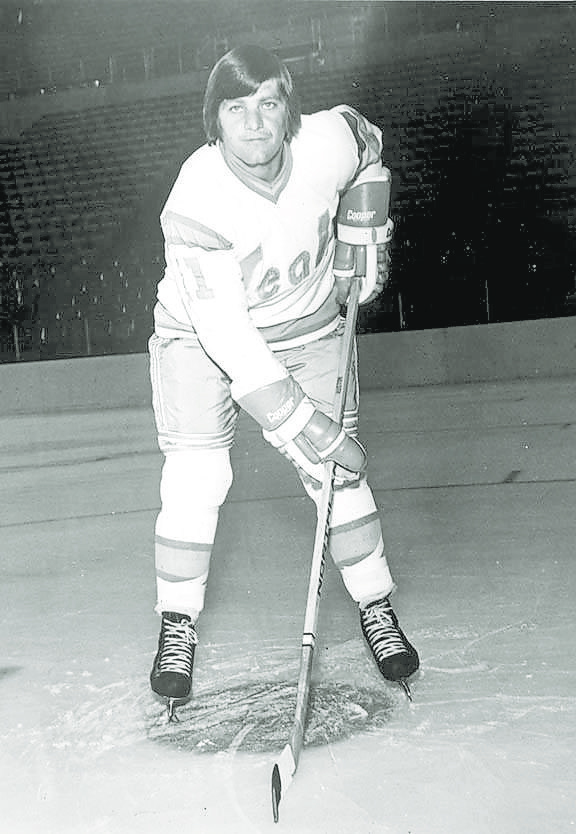
Huston made the Seals out of training camp the next season, but missed nearly a month when he suffered an injury in December. Still, his 33 points in 56 games placed him eighth in team scoring.
He still had another year on his contract, but when his old friend Rollins joined the Phoenix Roadrunners of the upstart World Hockey Association and gave him a call, Huston admitted he wasn’t happy in Oakland.
“But I wanted to be in the NHL,” Huston said. “I didn’t want to be in the World Hockey Association. He said ‘Come on!’ and I thought about it and thought about it and I decided I might as well go with a guy I know I’m going to get along with. I phoned Oakland and told them I wanted out of my contract.”
Huston spent the 1975-76 and 1976-77 seasons in Arizona, earning 125 points in 159 games with the Roadrunners. But in his last season there, the third-year team sold players to pay its bills and folded after the year ended.
“I wish I would have stayed in Oakland as it turned out,” Huston said. “I stayed in Phoenix two years and then the team folded. I was getting up in age. I was supposed to go to Indianapolis (Racers) and I kick myself that I didn’t go.”
The sticking point was that Huston wanted a contract before he would report to camp, something the team couldn’t do. The move cost Huston the chance to play with a young Wayne Gretzky.
Instead, Huston went back to Spokane for two more seasons — winning another scoring crown and fourth WIHL MVP award — returning to Cranbrook for the 1979-80 campaign. His playing career ended after the 1983-84 season at age 39 after he was enlisted as a player-coach for the Elk Valley Blazers senior team in Fernie.
“Cranbrook still wanted me to play but I said no,” Huston said. “I had enough with hockey. I was just going to play old-timers.”
He sold cars for two years, and then served as sales manager for six years at another dealership. Eventually he went back to electrical work, doing that for a while until he decided to run a hotel in Saskatchewan for a friend.
“I always wanted to run a hotel so I went out there,” Huston said.
After four years, he returned to Cranbrook to run a hotel there, and finished up his career back in the electrical field. He still works part-time, doing three or four jobs per week.
“I don’t usually take on too big of jobs,” Huston said.
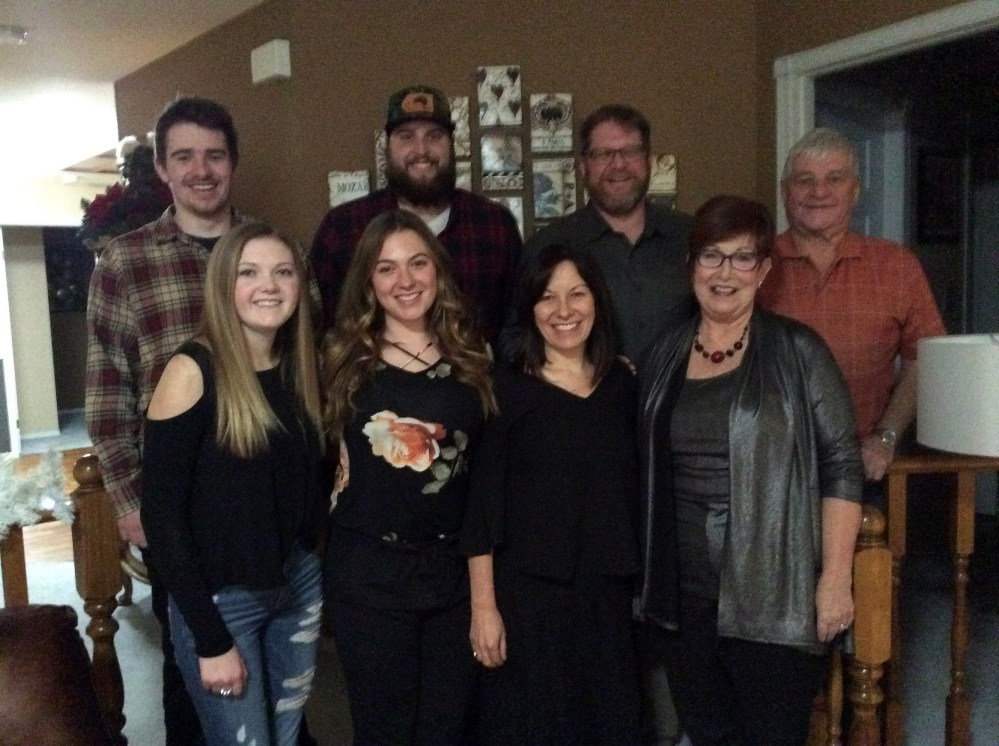
Huston, who remarried to wife Beckie in 1981, still lives in Cranbrook. His sons Chris and Dean each have two children.
He remained a big fan of the game, holding season tickets to the Kootenay Ice before the franchise moved to Winnipeg in 2019.
“It was really nice,” Huston said. “Even when the Wheat Kings came to town, I always used to check to see who was playing. Playing for any major junior is good and playing or any pro team is good. It’s all superior.”
It was also a nice reminder of the squad he played with more than five decades ago.
While things never quite happened as smoothly as they could have, it certainly all worked out.
“If things would have went right, I likely should have turned pro right from the Wheat Kings,” Huston said. “It didn’t work out that way.”
» pbergson@brandonsun.com
» Twitter: @PerryBergson