
CROWE’S NEST: Regina hub allows for unique WHL season
Advertisement
Read this article for free:
or
Already have an account? Log in here »
We need your support!
Local journalism needs your support!
As we navigate through unprecedented times, our journalists are working harder than ever to bring you the latest local updates to keep you safe and informed.
Now, more than ever, we need your support.
Starting at $15.99 plus taxes every four weeks you can access your Brandon Sun online and full access to all content as it appears on our website.
Subscribe Nowor call circulation directly at (204) 727-0527.
Your pledge helps to ensure we provide the news that matters most to your community!
To continue reading, please subscribe:
Add Brandon Sun access to your Free Press subscription for only an additional
$1 for the first 4 weeks*
*Your next subscription payment will increase by $1.00 and you will be charged $20.00 plus GST for four weeks. After four weeks, your payment will increase to $24.00 plus GST every four weeks.
Read unlimited articles for free today:
or
Already have an account? Log in here »
Hey there, time traveller!
This article was published 01/07/2022 (1337 days ago), so information in it may no longer be current.
Branden Crowe spent six seasons broadcasting games for the Brandon Wheat Kings, and it provided some unforgettable moments.
Crowe, who left the team in April after accepting a job with Hockey Canada, travelled with the Western Hockey League team on the bus and never missed a game during his tenure.
He and The Brandon Sun’s WHL beat writer, Perry Bergson, sat down to revisit the top five storylines that developed in his time, which spanned from the start of the 2016-17 campaign to the end of the 2021-22 regular season.
The conversation, which was edited for clarity and brevity, finishes today with the fifth instalment of a five-part series.
THE REGINA HUB
It took the Western Hockey League some time to decide what it was going to do with the seven Manitoba and Saskatchewan-based teams, but on Feb. 12, 2021, it elected to proceed with a hub in Regina. The Wheat Kings entered the seven-team hub on Feb. 27 after self-quarantining a week earlier. Each player and team official was tested upon arrival, and kept in isolation until it was shown they didn’t have COVID-19. At that point, the players were assigned dorm rooms at the University of Regina’s Paskwaw Tower, where four single bedrooms were connected by a common living room and kitchen.
The team began practising on March 5. The season started on March 12 — a stretch of 370 days between games — with Brandon playing 24 times in 48 days, all at the Brandt Centre. The Wheat Kings dropped their opener on March 12 in a 4-3 overtime loss to the Moose Jaw Warriors. After beating the Winnipeg Ice 3-2, Brandon dropped a 5-3 decision to the Prince Albert Raiders and were a decidedly unimpressive 1-1-1-0 after three games. After a 6-4 loss on March 22 to the Saskatoon Blades, Brandon sat at 3-2-1-0 after facing each team once. It proved to be a turning point. The Wheat Kings won their next eight games, an incredible streak in a 24-game season.
The streak ended when they fell in overtime to the Regina Pats and suffered another defeat at the hands of Saskatoon. With a tight race shaping up between Saskatoon, Brandon and Winnipeg for the top spot, Brandon reeled off another seven-game winning streak to put themselves out of reach.
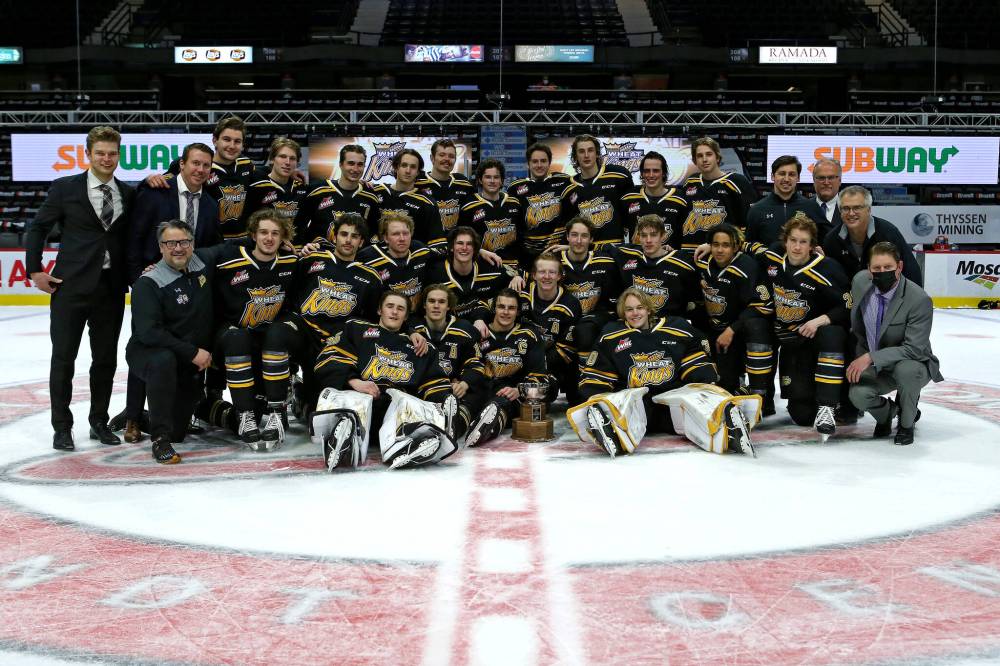
They clinched the banner in their second last outing, a 5-1 win over Regina on April 25, in part because they beat the Ice all four times they played them.
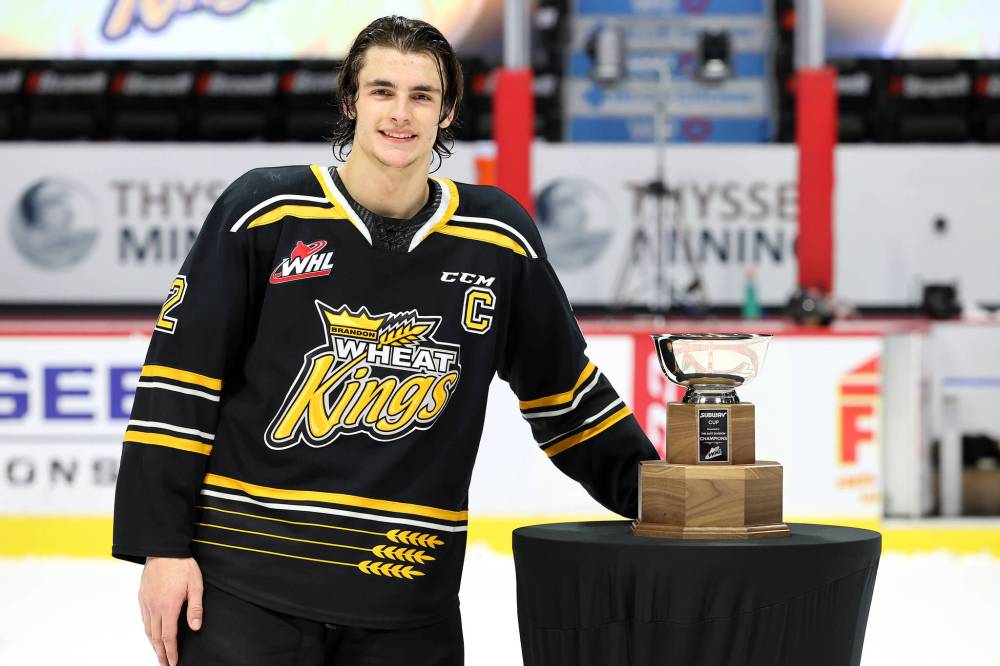
The season came to a close on April 28 with an anticlimactic loss to the Blades that had no impact on the final standings. The Subway Cup trophy was presented after the game ended.
• BERGSON: “When they were starting to talk about a centralized location for the 2020-21 East Division season, Brandon was certainly under consideration and in the discussion but it ultimately ended up going to Regina. Do you have any insight into that?”
• CROWE: “I don’t know if Brandon was an option because of the building’s ability to maintain ice without fog getting into April. I think that and they were starting to bring back some events that were pre-booked. I know some teams voted for Brandon under one roof — two practice rinks, a main rink, a hotel and the restaurants all right there — but for whatever reason it didn’t work out.”
• BERGSON: “Let’s talk about you before we talk about the team. How do you prepare for two months away from home?”
• CROWE: “It’s a little more difficult for me than a lot of radio broadcasters in the league because of where I live (near Virden) and the fact we have animals, chickens and sheep. At the time we also had dairy cows here. We raised up a bunch of Holstein steers for meat. Luckily my wife (Brandi) grew up on the farm we live on, so for her to do the chores for two months wasn’t a huge deal. I didn’t have to find someone. At the time, I had been out of the game for so long and I would have done anything. I worked at the golf course, I installed headstones, I worked in the oil field. I had done pretty much every job I could do to pay the bills between COVID starting and the hub starting. I didn’t care how many days it was, I was so excited to get back into it. At the time, province to province travel was limited, so even though Regina is only three hours, I couldn’t rip home for a Sunday and fix a fence.”
• BERGSON: “Your experience was a little different from the players because you weren’t inside the actual bubble. Let’s talk about them. You were dealing with them the same way I was from my couch, via Zoom. What contact did you have with the players?”
• CROWE: “I stayed in a hotel with (then general manager) Darren Ritchie but they were like apartments so we had a full kitchen so you didn’t have to eat out every night. We were also the runners for all the groceries and supplies. We weren’t able to be face to face with them, so there were two ways we would deliver groceries. We would take Darren’s truck or my truck, go get groceries, go to the college where they were staying and Scooter (equipment manager Scott Hlady) or (assistant equipment manager) Jody (Normington) would roll a laundry cart out into the parking lot and we would load up the groceries and then roll it back to the door or we would meet them at the rink, and Scott would unlock the box of his truck and we would load the groceries and he would drive away.”
• CROWE: “I think the first couple of weeks, the players were super excited and were having the time of their lives, but I think by week three they were starting to get a little cooped up. But at that exact point, I think the team started to realize ‘Holy smokes, we can win this thing.’ I think the winning balanced out the insanity of living in a concrete dorm room without being able to go outside. I could see them getting frustrated with being there, but at the same time they were playing some really good hockey.”
• BERGSON: “I think one of the other things that really helped was that they didn’t just have to socialize with the guys in their room. They were able to socialize as a team. You can pick any three people in the world — this probably goes for everybody — and it doesn’t matter how good of friends they are, if you’re cooped up with them in an apartment, they’re going to start to rub on you in some way. I think it was good for them to have the freedom to meet with their other teammates. But as you say, the fact that they were winning was key. Imagine if you won four or five games. You would just be staring at the clock and calendar every day.”
• CROWE: “You did see a few players leave the hub. It’s tough for these kids. They had great amenities — I don’t want to paint the picture they were living in Alcatraz — but they could look out the window at the football field and not go throw a ball around. You couldn’t go outside and listen to the birds. You had to stick to your routine and stay inside your walls. I think winning put a bandaid on it. Even (head coach) Don (MacGillivray) said winning and preparing like it was playoffs gave them an extra shot in the arm. They were coming to win. They didn’t just want to win, they wanted to roll over teams. The rivalry with Winnipeg, there was nobody in the building but you could just feel the hate between the two.
“Even with Prince Albert you could feel the hate. It got to the point that (head coach) Marc Habscheid accused Don MacGillivray of running up the score in a game and then I snapped back at him and the coaches got into it. This is stuff that happened in the 1990’s Western League, not a bubble with no fans. It was intense, especially in the last two weeks.”
• BERGSON: “To Brandon’s credit, they had one other thing that a lot of teams didn’t, and that was Jared Jacobson brought in extra food for them. They were getting awfully tired of the food available internally and he was bringing in meals from The Keg.”
• CROWE: “That’s where I got lucky because as the delivery boy, Mark Derlago, who is in charge of meals, would throw an extra meal on and I would go to Fuddruckers and pick up 45 burgers, fries and milkshakes and have one for me. Or I would go to The Keg and drop off 40 steaks and potatoes and have one for me. It was between Earls and The Keg and Original Joe’s and Fuddruckers and I even did a couple of McDonald’s runs for the boys just to get a burger into them.”
• CROWE: “Once the players caught on that I was doing deliveries, I would get a message from say, Ty Thorpe in the morning ‘This is what the boys want.’ It would be five Coca-Cola slurpees, 10 Kit-Kat bars and some M&Ms. I would go into 7-Eleven and load up a cart and take nothing but candy and junk food back to the guys because that’s what they wanted.”
• BERGSON: “Trust Ty to come up with the list, because he’s the guy who had the foresight to bring a giant television to the dorm. He was prepared.”
• CROWE: “He was prepared, but Ty is very much into what he puts into his body, so you would get the list and it would be a generic list of candy and sugary stuff, and then Ty would ask for one per cent milk, whole wheat bread and some lettuce. You knew what stuff was going to what room. Mini eggs were a big thing. They had a Whole Foods store where you could buy things in bulk, and the amount of mini eggs I bought in the hub, thousands.”
• BERGSON: “Imagine the calories those teenagers were burning playing every other day and practising. Even though they weren’t travelling, it was really a compact, tough schedule.”
• CROWE: “They also did team meetings, Zoom meeting with alumni, Kelly McCrimmon spoke to them as a team, Ryan Pulock and Mark Stone phoned in. I think they did some mental performance stuff and had a poker tournament and pool tournament. They were always going. I think Don, who comes from a family where his wife is an educator, Mark Derlago’s wife is an educator, Doug Gasper had taken over for Darren Ritchie and he was a former principal. I think they all realized the importance of keeping their minds engaged, and not letting them just sit in their cell and stew, especially after a bad game. I think they did an unreal job of keeping the players focused.”
• BERGSON: “Let’s talk about some of the performances on the ice. One of the neat things about watching and covering junior hockey is how a player at 16 is a different player at 19. Braden Schneider became the guy we thought he was going to be, and was even more dynamic offensively. He was outstanding. You saw Ben McCartney take a massive step up. Ridly Greig developed into the guy he’s going to be, Jake Chiasson was outstanding with those two, Nolan Ritchie made his return to the lineup after a terrible injury in 2019, Marcus Sekundiak and Reid Perepeluk were just blowing up people.”
• CROWE: “That was the most fun hockey I saw in six years doing play by play. It really sucks that the fans couldn’t watch it live. The only other player I can compare Perepeluk too in my time would be Dmitry Osipov, who once or twice a night would just have a thunderous hit. But Perps was more than that. It was every time he was on the ice. When he and Sekundiak were out there, other teams were shaking in their boots. The Keystone fans would have a statue of Perepeluk in front of the Keystone. He was a throwback to Jordin Tootoo.”
• BERGSON: “When Tootoo played here, the opposing defencemen couldn’t get rid of the puck quickly enough. That was the sense you got with Sekundiak and Perepeluk too.”
• CROWE: “Mark Derlago and I have watched this 100 times because it’s so funny. On the very first shift of the hub against Moose Jaw, they started Sekundiak and Perepeluk and the puck gets dumped in. Sekundiak goes to get it, makes the check and Perps is coming in the other way and Perps hammers Sekundiak behind the net by accident. He misses the Moose Jaw player and the two go down. Everyone was like ‘Whoa.’ Everyone thought the hub would be a feel-it-out, let’s-go-slow process, and 30 seconds in you have two freight trains colliding at 200 pounds each. That set the tone.
“Ty Thorpe played some of his best hockey as a Wheat King. Nolan Ritchie, what a story with the leg. I remember sitting with Darren, and not only as a GM but as a father, he was worried about the first contact. Is Nolan going to be scared to have it happen again? In the first game, almost at the bench, he got caught knee on knee on that same leg and I thought ‘Oh no.’ He got to his knees, seemed to shake it off like a dog and went to the bench and he was perfectly fine.”
“Braden Schneider was the best player in the hub. Peyton Krebs was good but Braden Schneider was the best player in the hub. To watch him dominate … he had never been overly offensive but how many times was he involved in an overtime winner, either a setup or scoring? He had two overtime winners. He just took the ball and ran with it, and McCartney the same thing. McCartney said after they realized that all eyes were on them as two drafted guys. The OHL wasn’t playing, the Q wasn’t going, the NHL hadn’t started yet, so what are they watching? They are watching you every night, every shift so you can’t take a night off. Schneids said a few times, ‘We just knew it was our time to make a name for ourselves.’”
• BERGSON: “One other really smart thing Brandon did was essentially what I would call assigned seating. They didn’t just let the buddies go into rooms together. You put two rookies, Rylen Roersma and Nate Danielson, in with Greig and McCartney. That’s done on purpose. You put your two rookie defencemen, Logen Hammett and Jacob Hoffrogge, in with Schneider and (Chad) Nychuk. They wanted the older guys to impart the culture and an awareness of what’s expected as a Wheat King to those guys before they left.”
• CROWE: “If you let those guys pick their own roommates, then you have cliques.”
• BERGSON: “You’d have all the old guys together and all the young guys together.”
• CROWE: “The first couple of years, it was always old guys sat with old guys, young guys sat with young guys. But after the hub, it just felt different. We’d go to a meal and you would have a good mix of old and young. Obviously they talked about it and the older guys knew why they were doing it. I think moving forward, it was ‘We’re all one.’ Dave Lowry hated the word rookie. Hated it. They were first-year players and there were no rookie duties, no bus loading, none of that stuff because that segregates your team and it makes the rookies bitter toward the old guys, and makes the old guys think they can take advantage of the young guys. That carried into the hub.”
• BERGSON: “The first couple of years you were here, those were the teams that were especially segregated. The Alberta guys hung together, the old guys, the young guys, and that’s the worst thing. You just want 23 guys who are friends.”
• CROWE: “They would never make it public, but I don’t think at any point there was an issue in the hub that needed to be addressed. Sure, some guys were probably loud after hours or whatever and they played video games too late at night, but there was never a disciplinary situation. I know other teams had trouble with guys trying to leave or acting out. That was just a cohesive group.”
• BERGSON: “They learned early on, if they didn’t know already, that there wasn’t going to be any interdivisional play so they were playing for the Subway Cup. Nobody I talked to discounted that or said we’re not playing for the Ed Chynoweth Cup, so it doesn’t matter. Every one of those guys, to a man, said this is what we can win so we’re going to win it.”
• CROWE: “I think that’s the competitive nature of those older guys who had time taken away from them. I think if you had just asked some of the rookies who didn’t know better, they might have said they weren’t playing for anything, but if you asked McCartney and Perepeluk and Sekundiak and those older guys that just had a year of their careers taken away from them, I think that’s what made it. They didn’t know what was coming or even if they would even finish the hub. You could be three COVID tests away from the hub being cancelled halfway through. I know a few times in my interviews, I said ‘What are you playing for?’ and every one of them said ‘To win this thing.’”
» This concludes the five-part series.
» pbergson@brandonsun.com
» Twitter: @PerryBergson