
Swiss hot springs — more than just smooth skin
Advertisement
Read this article for free:
or
Already have an account? Log in here »
We need your support!
Local journalism needs your support!
As we navigate through unprecedented times, our journalists are working harder than ever to bring you the latest local updates to keep you safe and informed.
Now, more than ever, we need your support.
Starting at $15.99 plus taxes every four weeks you can access your Brandon Sun online and full access to all content as it appears on our website.
Subscribe Nowor call circulation directly at (204) 727-0527.
Your pledge helps to ensure we provide the news that matters most to your community!
To continue reading, please subscribe:
Add Brandon Sun access to your Free Press subscription for only an additional
$1 for the first 4 weeks*
- Enjoy unlimited reading on brandonsun.com
- Read the Brandon Sun E-Edition, our digital replica newspaper
*Your next Free Press subscription payment will increase by $1.00 and you will be charged $20.95 plus GST for four weeks. After four weeks, your payment will increase to $24.95 plus GST every four weeks.
Read unlimited articles for free today:
or
Already have an account? Log in here »
Hey there, time traveller!
This article was published 23/04/2011 (5533 days ago), so information in it may no longer be current.
Spa life has always been part of Switzerland’s zeitgeist. More than 2,000 years ago, the marauding Romans crossed the Alps and soothed their aching feet in several mineral-rich hot springs, coining the phrase "sanus per aqua" (wellness through water). In 1500, a business-savvy Swiss cardinal acquired the rights to underground springs and set about healing bodies as well as spirits. For centuries, millions of visitors have travelled to Switzerland from around the world to take the "kur." But the institutional style of Old World clinics and bathhouses is fading. Today, the hot-springs towns bubble with creativity, gastronomy and a wealth of tourism attractions. And Switzerland is home to renowned spas that dispense pioneering beauty treatments and advanced medical programs.
Travellers with a penchant for five-star luxury head to such rarefied resorts as La Reserve Geneve, a classic haven of privacy in a city that welcomes the world’s political leaders. In the Alps, the holiday paradise of Interlaken is home to the Hotel Victoria-Jungfrau, a 150-year-old beauty queen with a spa that has been modernized with stunning glass, granite and metal decor. Clinique La Prairie in Montreux is a regal establishment where elite clients are pampered with caviar facials and four-handed massages.
At these "haute-Swiss" hotels, a retreat with lodging and spa services can cost more than $1,000 a day.
Towns with natural hot springs are a lot more affordable because their public baths are open to everyone at moderate rates. Switzerland is home to about 30 spa towns with natural hot springs including: the posh ski town of St. Moritz and neighbouring Scuol; Yverdon-les-Bains on Lake Neufchatel, a rest stop for the ancient Romans; and Baden, a lively casino town on the outskirts of Zurich.
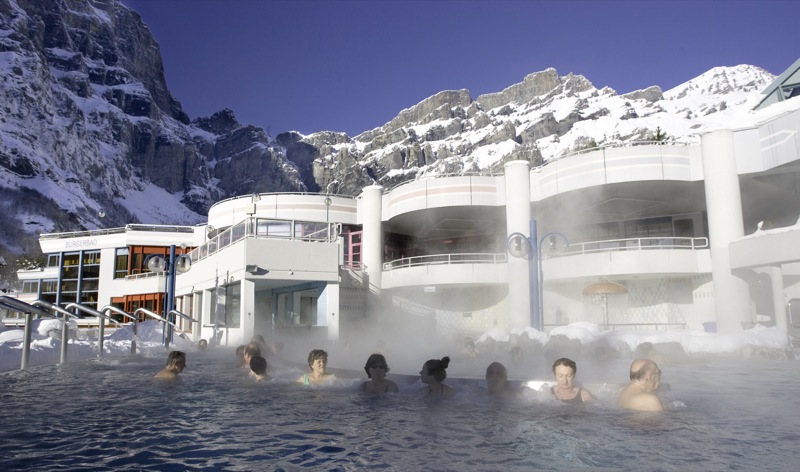
Leukerbad is the quintessential Swiss hot-springs destination, an Alpine village in the wine and ski country of the Valais region. Surrounded by snow-capped Alps, Leukerbad has it all, including downhill and cross-country skiing, hiking, mountain biking and Swiss cuisine. It’s a mostly car-free village with a charming tangle of streets that lead from the bus station to hilltop hotels, restaurants and shops.
Leukerbad’s natural beauty and the largest thermal waters in Europe have inspired many famous visitors, including Goethe, de Maupassant, Tolstoy and Picasso. Today, 1,500 locals welcome the more than 250,000 people who flock here annually from about 60 countries. They come for the restorative powers and healing qualities of the natural hot springs, which are laden with calcium and sulphites and bubble and boil underground at more than 67 C.
Cooled to between 28 C and 43 C, the springs are channelled into large pools throughout the town, including some hotels and the popular Burgerbad, or "peoples’ bath."
Locals swear by Leukerbad’s waters. The town’s marketing manager, David Kestens, takes his family for a weekly dip, year-round, to prevent colds and boost energy.
With an open-to-everyone atmosphere, the Burgerbad is a complex of natural hot-spring pools, with locker rooms and moderate entrance fees. Bathers, young and old, spend hours soaking in the 10 outdoor and indoor pools, each at a different temperature, and some with waterfalls and massage jets. With this abundant natural resource, Leukerbad has made its waters accessible to all. Occasionally, the Burgerbad goes swanky with Champagne evenings and Aqua Mystica. This after-dark sound-and-light show is held in the steamy vapours of the Burgerbad, usually at least once a month.
With a three-night package from a family-run inn like the Hotel Heilquelle, a spa vacation in Leukerbad will cost about $100 per person a day, including lodging, breakfast and the baths. That leaves room for a fine dinner ($25 to $35) at Hotel Waldhaus-Grichting, which serves specialties of the Valais region like raclette, roesti and air-dried beef and ham.
The region around Leukerbad is rich in another earthy resource. Some of the highest-altitude vineyards in Europe flourish on the outskirts of the village, supplying wine for the dinner table and grape seed for vino-therapy spa treatments. Chardonnay facials and sauvignon-spiked soaks are a potent new trend, but vinotherapy dates to the Romans. The four-star Lindner Hotel and Alpentherme is a beautiful, modern resort with hot-spring pools, tennis courts and a huge wellness centre. Here, spa-and-stay packages like Sanus Per Vinum and In Vino Veritas feature massages, body scrubs and skin treatments with grape seed oil. With use of the hotel’s private hot-spring pools, spa treatments and meals, a three-night package starts at about $230 per person a day.
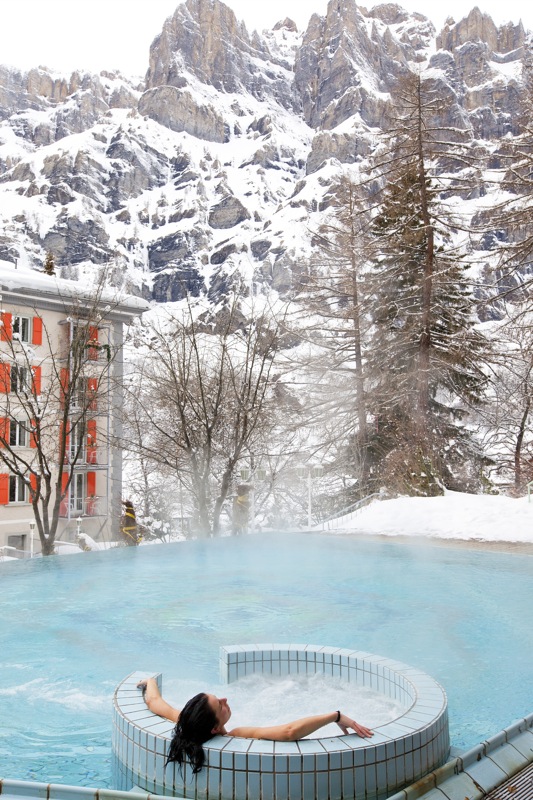
For a more exclusive hot-springs experience, with prices to match, Hotel Les Sources des Alpes, a 30-room Relais & Chateaux perched high atop Leukerbad, is the peak of luxury. It has gastronomic cuisine, ornate Old World decor and an exceptional beauty and relaxation spa whose thermal pools offer views of the surrounding mountains.
Montreux has a different beat. The sophisticated town is the star-studded jewel of the Swiss Riviera, a glamorous party place on the eastern shore of Lake Geneva. The year-round mild climate nurtures fig trees and palms, so Montreux has a semitropical look, contrasting with a backdrop of snow-tipped mountains.
Montreux has been home to such cultural luminaries as Nabokov, Hemingway and Tchaikovsky. Lord Byron’s poem Prisoner of Chillon was inspired by the medieval island prison, the Castle of Chillon, which now is a museum. In the late 1960s and early 1970s, modern music legends like Miles Davis, Ella Fitzgerald, Keith Jarrett and Nina Simone performed here, and Montreux’s fame was sealed as the home of one of the world’s most famous jazz festivals, held in July.
To relax and rejuvenate before or after the festival, check into Fairmont Le Montreux Palace, a grand Belle Epoque palace built in 1906. The Fairmont has fabulous views of mountains and water, bountiful gardens, gastronomic restaurants and popular lounges. The in-house Willow Stream Spa is a luxurious sanctuary for beauty and body treatments, indoor and outdoor pools and classes like yoga, aqua gym and Pilates.
Even at Fairmont Le Montreux Palace, which embodies European grandeur, there is a little touch of home. Its Willow Stream Spa has many treatments with products by B. Kamins, Chemist, which is produced in Montreal. The spa also has a Golf Facial Kit and a Sports Masque for weather-beaten skin. A favourite spa service with a Swiss accent is the Edelweiss Escape, which uses the oils and aromas of Alpine wildflowers to soothe mind and body.
If you have wrapped up your visit to Switzerland without a spa break, there still is time for a massage, a deep soak or a workout. Zurich’s airport has opened a sophisticated spa and fitness centre, Thermalbad Zurzach, in the Radisson Blu Hotel. It has an international vibe, with a Finnish sauna, a Turkish steam bath, consultations on Chinese medicine and treatments with Swiss products.