
It’s curtains (or drapes) for you
Advertisement
Read this article for free:
or
Already have an account? Log in here »
We need your support!
Local journalism needs your support!
As we navigate through unprecedented times, our journalists are working harder than ever to bring you the latest local updates to keep you safe and informed.
Now, more than ever, we need your support.
Starting at $15.99 plus taxes every four weeks you can access your Brandon Sun online and full access to all content as it appears on our website.
Subscribe Nowor call circulation directly at (204) 727-0527.
Your pledge helps to ensure we provide the news that matters most to your community!
To continue reading, please subscribe:
Add Brandon Sun access to your Free Press subscription for only an additional
$1 for the first 4 weeks*
*Your next subscription payment will increase by $1.00 and you will be charged $20.00 plus GST for four weeks. After four weeks, your payment will increase to $24.00 plus GST every four weeks.
Read unlimited articles for free today:
or
Already have an account? Log in here »
Hey there, time traveller!
This article was published 21/05/2011 (5315 days ago), so information in it may no longer be current.
MONTREAL — Interior designer Barbra Yaffe has design in her DNA. Her parents, Fran and Harry Markus, were both designers.
Yaffe’s earliest recollection of design infiltrating her life was her mother’s innovative interior design of Yaffe’s bedroom.
She remembers her mom painting one wall entirely black and then tracing the outlines of Disney characters like Peter Pan and Cinderella in white.
"It was a daring design for the time," Yaffe said. "And it inspired me. I loved to sing when I was young and I would look at the wall and sing all the Disney songs."
Yaffe grew up, studied art and design at the Montreal Museum of Fine Arts in the early 1960s, got married and continued the family design tradition by painting murals on both her children’s walls.
"In my son (Richard’s) room I painted a picture of a little boy standing in front of a big lion," she said. "It was a safari-themed room. I installed a hammock and filled it with stuffed toys.
"In my daughter (Robin’s) room I painted a picture of her sitting in a tree. The whole room had sort of a garden theme, very floral. I hand-painted her pillows and sheets."
The children are all grown up now and for the last 15 years Yaffe has been working as an interior designer with a specialty in residential and commercial lobbies and entrances.
"When I see richly textured fabric, it can be the trigger that sets the whole mood for the design of a room," Yaffe said.
OK, so when Yaffe designs those long flowing things that hang on windows, does she call them curtains or drapes?
"Curtains are made with fabrics that are usually lighter weight than drapes," she said. "They can be installed from ceiling to floor, but they can also be made to frame a window, halfway to the floor, unlike a drape.
"Curtains are often installed on French doors and glass cabinetry. They do not need to be lined.
"Drapes, on the other hand, are sewn to be opened and closed, fully, on a window or to be used as side panels, hanging ceiling to floor. The fabric used for drapes is usually heavier and meant to be lined."
Here is a breakdown of Yaffe’s dos and don’ts when it comes to selecting curtains or drapes.
TRY THIS
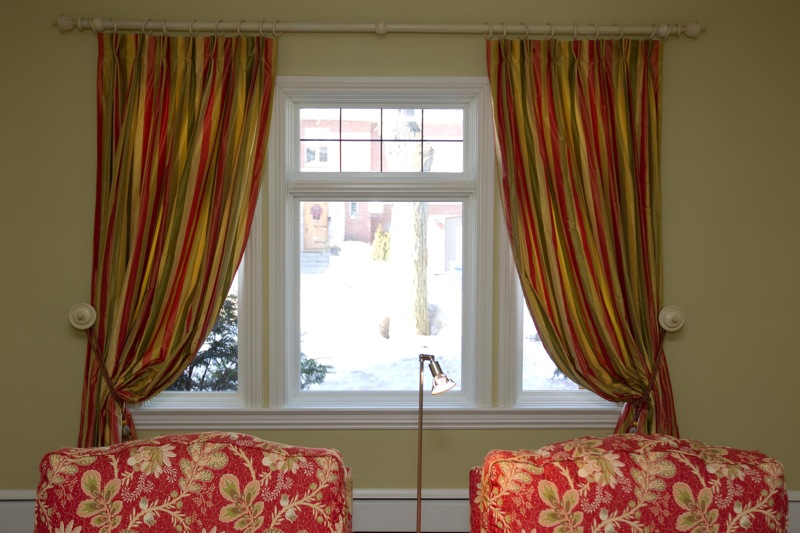
l Take proper measurements. Today’s designers recommend hanging drapes from ceiling to floor because it gives the illusion of greater height in the room and it makes the drapes look more luxurious. Measure with that in mind.
To calculate how much fabric you need widthwise, measure the width of your window and then multiply by two, or even 2.5. You need that much fabric to give the drape the recommended fullness.
"If you have the proper fullness, it doesn’t really matter how expensive the fabric is that you use," Yaffe said. "The curtain will look rich."
If you want the drape to "puddle" (be long enough to bunch up on the floor) add 20.3 centimetres to the length measurement for a discreet puddle and up to 60 centimetres for a glamorous puddle (but then be prepared to do the extra work required to keep the drapes clean.)
Keep in mind that drapes should never block a heat source and that puddled drapes will interrupt the air flow in a room to a certain degree when the drapes are closed.
l If you plan to sew the curtains yourself, or get them custom made, buy a fabric that has been pre-shrunk, or at least have an ample hem sewn in case the panel needs to be re-adjusted after washing.
l If privacy or blocking out the sun is a priority, make sure the curtain is lined with a blackout liner (an opaque, rubbery-feeling liner). Otherwise, a cotton, or polyester or cotton-polyester-blend lining will do. The most common colour for lining is white or off-white.
If you are going the custom-made route and want the curtain to have the ultimate luxurious silhouette, ask for interlining as well. Yaffe inserts 45.7 cm of flannel interlining at the top of the curtain, between the fabric and the lining, but interlining can also line the entire panel. It adds fullness to the drape and keeps cold out in the winter and the heat out in the summer. It also protects very delicate fabrics such as silk and velvet from sun damage.
Small weights sewn into the hem also help the drape hang beautifully.
NOT THAT
l It’s a matter of taste, but Yaffe avoids embellishing the fabric with too much passementerie (the word used for trim, tassels, fringe — fabric baubles of all sorts).
"I like simplicity," Yaffe said. "Too much embellishment distracts. The curtains or drapes are meant to enhance, not be the focal point. It’s about having balance in a room."
l Don’t install drapes that are too short.
"It’s like wearing a pair of pants that are too short," Yaffe said. "It looks goofy."
The bottom of a drape should be no more than one inch from the floor. Or, it should skim the top of the baseboard.
l Don’t choose expensive silk — not the most durable of fabrics — for the kitchen, where food can spatter and cooking fumes rule, for a room where the drapes get handled a lot or where there are rambunctious activities going on.
Yaffe likes to use a cotton-polyester blend for her drapes, or a silk-polyester blend, which gives the luxurious look of silk, but is more durable than pure silk.