
Lunch with Michael Cox
Advertisement
Read this article for free:
or
Already have an account? Log in here »
We need your support!
Local journalism needs your support!
As we navigate through unprecedented times, our journalists are working harder than ever to bring you the latest local updates to keep you safe and informed.
Now, more than ever, we need your support.
Starting at $15.99 plus taxes every four weeks you can access your Brandon Sun online and full access to all content as it appears on our website.
Subscribe Nowor call circulation directly at (204) 727-0527.
Your pledge helps to ensure we provide the news that matters most to your community!
To continue reading, please subscribe:
Add Brandon Sun access to your Free Press subscription for only an additional
$1 for the first 4 weeks*
*Your next subscription payment will increase by $1.00 and you will be charged $20.00 plus GST for four weeks. After four weeks, your payment will increase to $24.00 plus GST every four weeks.
Read unlimited articles for free today:
or
Already have an account? Log in here »
Hey there, time traveller!
This article was published 13/10/2012 (4932 days ago), so information in it may no longer be current.
You’re very passionate about your chosen profession. What turned you on to architecture to start with?
The summer between Grade 4 and Grade 5, I went to visit my uncle. And I saw my uncle sitting at a drawing board in the evenings and on the weekends, drawing houses, and I was led to believe, erroneously, that that was architecture. And I decided that was what I wanted to do. And I’ve spent all of the time since then discovering what architecture really is.
And what did you discover it is?
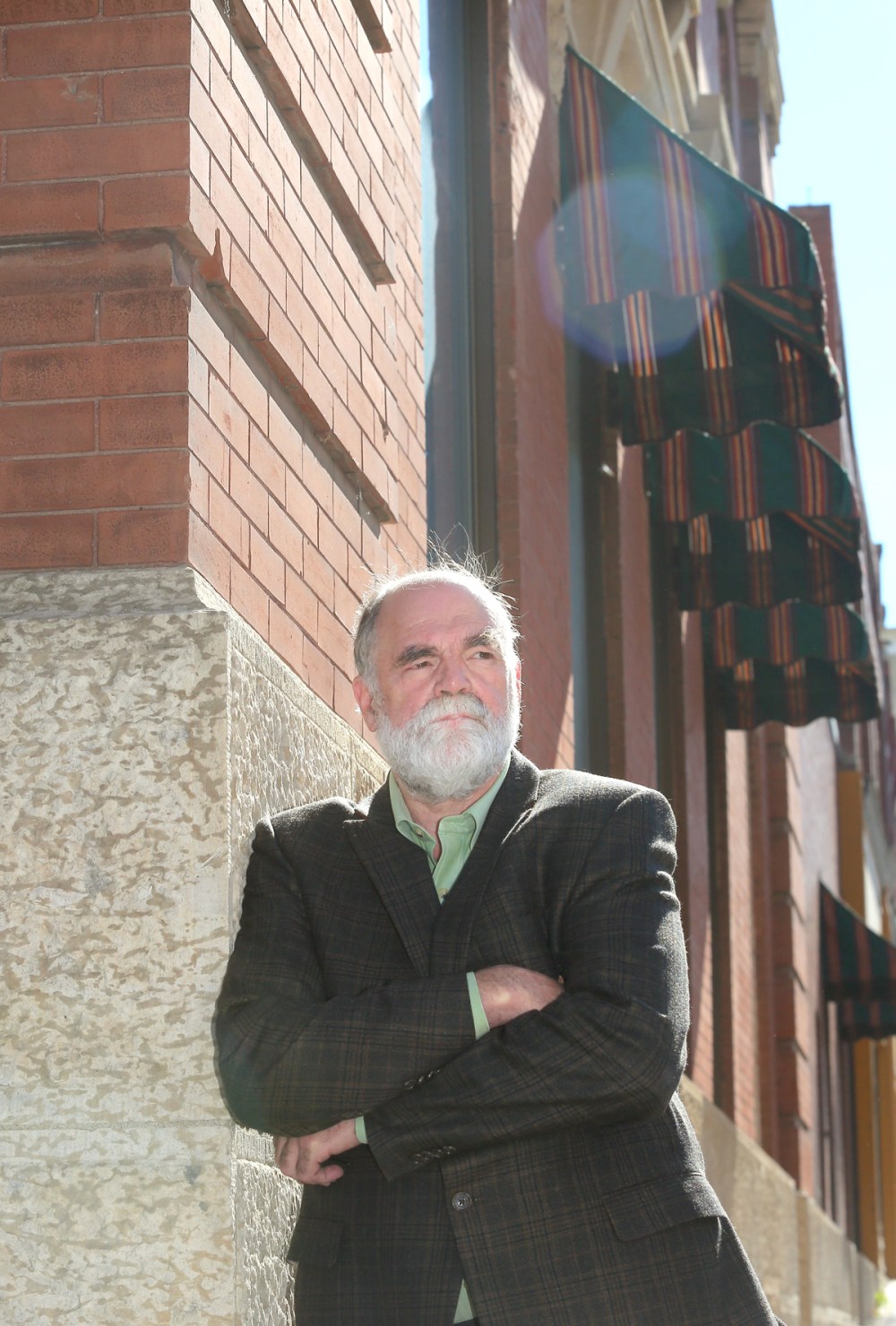
The best analogy is to think of architecture in terms of a suit of clothes. What I do, when I design a building, is build a suit of clothes for the people who live in, or work in, or use, that space. So some suits of clothes are tuxedos and ball gowns. And some suits of clothes are blue jeans and work boots. And architecture is all about the pieces in between, and making the clothes fit, as well as they can, the people who are wearing them.
Budgets are a piece of it, aspirations are a piece of it. Some people would LOVE to wear ball gowns, but can only afford blue jeans. On the other hand, people who can afford ball gowns sometimes CHOOSE to wear blue jeans.
That’s a great analogy! And we’ll come back to this. But first, what qualifications must you have to be an architect?
The practice of architecture is regulated in Canada by provincial and territorial jurisdictions. So for buildings of a certain type and of a certain size, you must be a licensed architect. There is no such thing as an unlicensed architect. If you’re not licensed if you are not registered in the provincial jurisdiction you are not an architect. You may choose to call yourself that, but you are not an architect.
And to design dwellings or places people are going to be, you’ve got to be an architect?
The line is three storeys or less, 600 square metres or less those buildings can be designed by anybody. I’m not suggesting that’s a good thing, but that’s where the law is.
The exceptions are buildings that are referred to in building-code terms as ‘assembly occupancies.’ So churches, schools, restaurants, hotels those kinds of occupancies must be designed by an architect irrespective of their size. Certain care facilities day care centres, for example, that have infants in them, or are of a certain size must also have an architect.
So most of our built environment that we see in this city can, and for the most part has been, designed without architectural services involved.
That really surprises me! So the people who would do that sort of thing would be home designers? Builders?
Could be a designer. Could be a builder. Could be your brother-in-law. It could be an evolution of a design somebody saw in a magazine from Florida, thought was a neat idea, moved things around and did a drawing. It could be a draftsman. There are all kinds of possibilities.
So exactly what is it that YOU do, then?
Let’s take a current project. Let’s take a little building that used to be a convenience-store-slash-movie-rental place. And there are some folks in town, composed largely of new immigrants to this community, who now worship in borrowed space. And they want a church of their own. And they found the resources to buy this building and want to convert it into a church. And their notion was let’s clear away all the stuff, make a big room, put up some chairs, and a platform, and an altar, and that’ll work. And they’re absolutely right a church is a gathering of people. In one sense it’s got nothing to do with the space. It can be under a tree, it can be in a factory, it can be anywhere. But it can be more than that, too.
So in the process of doing what I have to do in order to satisfy the code requirements, because this is an assembly occupancy and there MUST be an architect, I’ve had an opportunity to show the folks who are building this church that there’s a different way of arranging walls and chairs and windows and doors so that the space better fits their objectives on the days that they worship. And that’s what I do. I make things fit.
Tell me some of the local projects you’ve been involved in.
More recently, the Minnedosa United Church. Some time ago, a significant renovation to what was then Manitoba Hydro’s western regional office building on Tenth Street. Most recently, I just completed a project rebuilding a portion of the community theatre in Boissevain.
But the exciting projects are always the ones that are on the desk right now. And there are a handful of them at the moment small little projects. A couple of young fellows who are bound and determined to turn an old building at Seventh and Rosser into what I think is going to become one of the finest little restaurants and bistros in Brandon, when it gets there. They’re doing most of the work themselves and it’s taking some time, but it’s going to be quite an exciting project.
And a project that really is a great deal of fun right now up at Clear Lake, in the old campground, there have been very rigid rules about the design of the cabins. But now there’s much more design freedom, and I’m working for a client from Dauphin right now, exploring some of the possibilities that didn’t exist before by virtue of the tight regulations. So this is a tiny little 16-foot by 32-foot cottage that will be for a family of four. And it’s going to be VERY exciting!
And that’s one of the most attractive things about architecture for me, is that each project is different. And the differences are driven by the client.
What has kept you passionate about this all these years? Just what you said — meeting different people?
It’s all about the people. Architecture is one the few professions that doesn’t just allow that interaction with new friends almost all of my clients have become friends but it demands it. I can’t do my job for you until we’ve developed a trusting relationship that allows you to tell me about you. That’s what it’s all about discovery of what makes people tick, and what I can do to build a set of clothes around that so that the tick is music.
I know the Royal Architectural Institute of Canada has a campaign underway now “Every building has an architect” to try to ensure architects get credit for their work. We usually acknowledge the artist who paints the picture and the author who penned the book, but we rarely hear who designed a building. Why do you think architects’ work is often overlooked?
It’s a curious piece. A long time ago, architects were associated with, and were, in fact, master builders. They had the greatest skill set that was applied to the creation of buildings. I think in some recent cases, architects have become their own worst enemies, because the work that we celebrate amongst ourselves, the work that we give awards to, the work that we drool over, are the big dramatic pieces — the tuxes and the ball gowns. We’re impressed by sequins sometimes. And as a profession, we’ve paid less respect, generally speaking, and found less value, in the creation of what some would say was less important work. A small little theatre reconstruction in Boissevain. The small little reconstruction of an old restaurant into a new restaurant. Figuring out how to add one more bedroom to the three-bedroom bungalow because oh-oh there’s another child on the way that no one planned for, and yet that family loves that house, and the neighbourhood, and doesn’t want to have to move just because they need another bedroom, but doesn’t want the house to look as though it’s grown beyond what’s comfortable in that neighbourhood. That’s work that architects do. But that’s very seldom the work that architects celebrate. So we’ve, I think, contributed to the demise of our relevance and recognition in the world. We’ve done it to ourselves.
Your eyes positively light up when you talk about architecture! I know I’ve asked you about your passion, but I’m really interested about what fires you up about this.
You know, architecture is such a broad subject area. Some see it as being very narrowly defined ‘it’s just doing a building.’ But it’s NOT about just doing a building. Let’s take this space we’re in, for example. When you came through that door, no matter what cares and worries you brought with you, they kind of all disappeared when you came through the door. And some of it is because this is a great space the nature of this space has the effect of lightening the load. So in a little bit, that’s what you try and do in church architecture. But why not think about doing that in all of the things we live in? Why do we want to build tension in our lives?
The most important moments in our lives the birth of a child, a marriage, a death in those three instances, we choose to gather around us beautiful things. We try to find a beautiful place to celebrate those occasions. We gather up beautiful words, poems, scripture readings, lyrics to songs. We usually have music as part of it. We usually decorate the place with flowers or whatever makes the place beautiful to us.
Well, if it’s important to do that for those three occasions, why do we choose NOT to do it every day of our lives? It’s not a necessary choice. It doesn’t have to be either/or. And it’s not selfish for it to be both.