
Lunch with Dat Tao
Advertisement
Read this article for free:
or
Already have an account? Log in here »
We need your support!
Local journalism needs your support!
As we navigate through unprecedented times, our journalists are working harder than ever to bring you the latest local updates to keep you safe and informed.
Now, more than ever, we need your support.
Starting at $15.99 plus taxes every four weeks you can access your Brandon Sun online and full access to all content as it appears on our website.
Subscribe Nowor call circulation directly at (204) 727-0527.
Your pledge helps to ensure we provide the news that matters most to your community!
To continue reading, please subscribe:
Add Brandon Sun access to your Free Press subscription for only an additional
$1 for the first 4 weeks*
- Enjoy unlimited reading on brandonsun.com
- Read the Brandon Sun E-Edition, our digital replica newspaper
*Your next Free Press subscription payment will increase by $1.00 and you will be charged $20.95 plus GST for four weeks. After four weeks, your payment will increase to $24.95 plus GST every four weeks.
Read unlimited articles for free today:
or
Already have an account? Log in here »
Hey there, time traveller!
This article was published 01/12/2012 (5062 days ago), so information in it may no longer be current.
What was it that made your family choose Brandon in the first place?
We had no choice. We were refugees 34 years ago. We escaped from Vietnam to Malaysia. So Canadian government immigration interviewed us, and after they found out we were goldsmiths, they asked if we would like to come to Canada. And we said yes. And they said OK.
I think Reesor’s was maybe looking for goldsmiths, so eventually they sent us all here to Brandon.
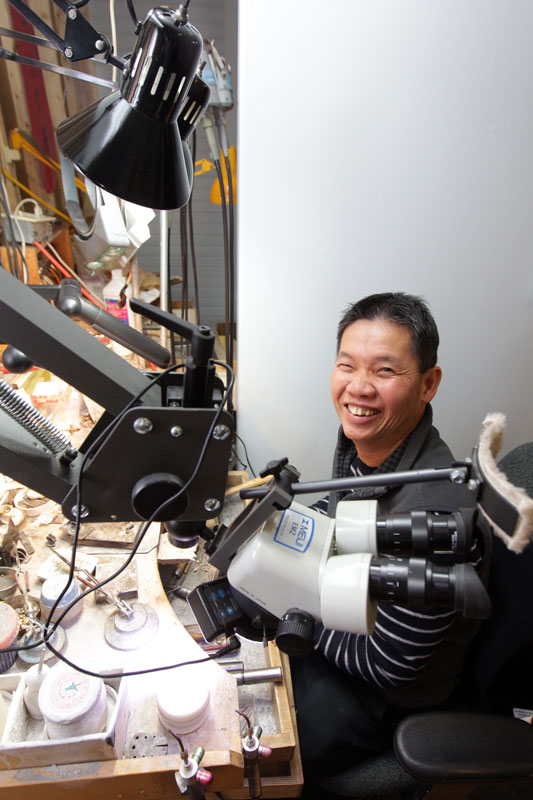
You were with Reesor’s for almost 29 years. Even though your brother had established the shop, was it at all scary to start out on your own? And what do you like about running your own business?
I really enjoy it! I’ve got more freedom and I see lots of customers very happy, and it makes me feel like I’m really doing a good job for the people. I never used to see the customers at Reesor’s.
Do you do mostly repair work, or do you do design work, too?
Mostly repairs, but I still do special custom designs. If they can give me an idea of what they want, we can change whatever they want, do whatever they want.
Do you work strictly in gold, or do you work with silver as well?
Ninety per cent of it is gold, and about 10 per cent’s the silver.
The price of gold has gone up so much has that affected your business at all?
Oh yeah. It affects sales. They’re slow. But the repair work it doesn’t bother at all. If people have something they want fixed, they fix it.
Any trends that you notice in the business these days? Are people looking for simpler designs, or more fancy ones, or does it just vary from person to person?
I think most people would like to have custom-designed pieces, but they’re labour-intensive, so they have no choice usually but to go for ready-made stuff. In Canada, it’s not usually worth me doing custom-made pieces even if people are willing to pay the high price. If you compare the time to finish a piece like that, it takes a few days’ work — just on that piece. And that amount cannot be covered.
But I’m still interested in making pieces like that. And if the repairs aren’t that busy, we can do that sort of work — we can take the extra time to fit in the custom work. But I cannot survive by working just on the custom-made because I’ll lose money if you count the time, the hours, that are put in. The repairs are the basis of the business.
With the sad news a couple of weeks ago that McCallum Jewellers is closing down after decades in business in Brandon, I have to ask: Are the bigger stores the chain stores, the department stores cutting into your business as someone who sells jewellery?
I don’t think so. Because it’s only the gold price that’s hurting people — that’s affecting most of the jewellery business. But the bigger stores — they sell different stuff than an independent store. All the products are different in an independent store. Everything is different the labour, the style, the detail, the quality. That’s why people are willing to pay more — for the quality.
Since you come from a family where everyone is a goldsmith, did you have a choice as to what career you wanted? Or was it just the family business and that was it?
Oh yeah — we had a choice. But when we were growing up, we were watching my dad working at the bench. Like there was fire and that kind of thing, and that was exciting — it was never boring at all! Every time when he was working, if I had time, and wasn’t in school, I’d be sitting and watching. Most of my brothers were like that, too. We liked to learn. And when we grew up, it was good to make a living at, too. My dad made goldsmithing into a trade for us because we were interested.
What keeps you still interested after all these years?
The repairs looked simple, but when I got into it, every day when the jobs come in, they are totally different. So you have to think how to fix it and make it faster and do it so people can afford it. If you don’t think about it this way, then you can’t be a good goldsmith for the long-term. That what made me interested. To this day, I’m still interested — thinking of methods of how to fix it easily and efficiently, and to do a good job and make the customers happy and keep them for the long-term.
What’s your favourite part of the job?
I think my favourite is the repair. Because we’ve got people who come back here and say, “Oh — you do a good job.” And they will tell other people to come to my shop. So that’s why my shop is quite busy.
Do you like to design rings or pendants, though, rather than repair them?
I like the repairs. I’m not very good with design. I think goldsmiths and designers are totally different people. I think some people make a mistake and think, ‘Oh — a goldsmith — maybe he can design that kind of thing.’ But I think that people who can design are not always good goldsmiths.
So not to say one is better or any more skilled than the other, but sort of like designers are artists and goldsmiths are craftsmen craftspeople?
Yes. And I think I know a lot more things than most other goldsmiths. For example, sizing and making rings and setting stones those are totally different jobs. Setting stones is supposed to be one person’s job. But I still can do that job. And custom-making and repair and setting — everything takes a long time to practice it. You may know it already, but you still need time to practice. That’s why it takes a long time to train one person.
Any misconceptions you think people have about the business? Are there things that people think you can do that you can’t? Or that are just really difficult? Are people surprised sometimes by the cost? Do they expect things to be inexpensive?
Yes. Some people go by the price that they paid for something — not today, but years ago. Maybe a ring with a little diamond. Years ago, the ring cost maybe only about $100. But today, if the stone falls out, and we have to do four claws and reset the stone, it costs over $100. So people, even if they bring in gold, think, “Oh! Why is the labour that expensive?” But they do not realize that we have to make the claws work and set the stone — that costs more than when the ring was made. Back then, once they cast one ring like that, they could cast maybe a thousand a day. And our work on the claws is just like custom-made. You have to go one by one. And we do it all by hand.
One thing that surprised me was that you try to encourage your customers to go for synthetic stones rather than authentic ones.
I don’t think most people can’t tell if it’s genuine or not, except gemologists or goldsmiths. I think most people 90 per cent of people — cannot tell if it’s genuine. And synthetic stones can be repaired much more easily than genuine. It isn’t as costly. Genuine stones cannot take heat. They will crack. Genuine stones can be repaired using a laser, but it’s expensive. So for the long-term, I think synthetic stones are better than genuine stones.
For the most part, then, other than diamonds, are most genuine stones soft?
Diamonds, rubies and blue sapphires can take heat. So those stones can be genuine — no problem at all for the future. Especially diamonds. But not other stones like January or February (birthstones) you pay more for those stones but you don’t get the benefit.
Do you advise people to buy 10-karat gold, or 14- or 18-karat?
I always suggest 10-karat is better — you pay less, you get a good benefit. You pay more, you don’t get a benefit. The more gold, the softer it is.
A few years ago, the young people, they thought, “I want platinum.” I am a goldsmith, and I say, “Why are you buying the expensive?” Platinum looks dull, white gold looks shiny!
But nobody wants platinum today. They can’t show off. “My ring is platinum.” So what? It’s cheaper than gold right now!