
Taiji or Tai Chi: You can have it both ways
Advertisement
Read this article for free:
or
Already have an account? Log in here »
We need your support!
Local journalism needs your support!
As we navigate through unprecedented times, our journalists are working harder than ever to bring you the latest local updates to keep you safe and informed.
Now, more than ever, we need your support.
Starting at $15.99 plus taxes every four weeks you can access your Brandon Sun online and full access to all content as it appears on our website.
Subscribe Nowor call circulation directly at (204) 727-0527.
Your pledge helps to ensure we provide the news that matters most to your community!
To continue reading, please subscribe:
Add Brandon Sun access to your Free Press subscription for only an additional
$1 for the first 4 weeks*
- Enjoy unlimited reading on brandonsun.com
- Read the Brandon Sun E-Edition, our digital replica newspaper
*Your next Free Press subscription payment will increase by $1.00 and you will be charged $20.95 plus GST for four weeks. After four weeks, your payment will increase to $24.95 plus GST every four weeks.
Read unlimited articles for free today:
or
Already have an account? Log in here »
Hey there, time traveller!
This article was published 15/12/2012 (4954 days ago), so information in it may no longer be current.
The ancient fighting forms of Taiji are a cultural norm in China. Most people know at least a few of the positions even if they do not practice regularly. It makes sense for a society this vast to engage in an activity that everyone can participate in regardless of job, money or caste. You will see giant groups of people moving in unison every night in perfect silence.
Sometimes it is eerie.
Taiji was started by two legendary figures Zhang Sanfeng from the 12th century and Wang Zongyue who taught in the 18th century. Various Daoists took this learning from antiquity into the modern age by combining philosophy and martial arts to utilize mind and body in harmony. Because it is so old, five different styles have evolved from a single method five hundred years ago.
They are the Chen, Yang, Wu Hao, Wu, and Sun styles. The Chen approach being the oldest of the five.
Philosophy is deeply ingrained in this art form. Taiji instructs you to meet hardness and force with pliability and softness. If both sides are violent, each fighter will be hurt, but if you absorb the attacks by moving with the strike you can control your opponent without force. In this way a person combines opposites Yin (empty, defense) with Yang (full, attack) to neutralize any threat.
The school that Krista and I teach English at offers free Taiji lessons every week. Not many of the foreigners participate but that is okay. This means that I have more one on one time with the instructor, Master Chuck.
For the last several months he has taught myself and another foreigner the basics — two move combinations and half of a third. The first two are easy. They are only about ten moves each, not difficult to remember. But now we are mid-way through learning a 42 pose arrangement that is actually 84 motions because each position has two parts. We have been studying it for the better part of a year. The combination is not easy, but we are trying.
For that the instructor decided to recognize our efforts.
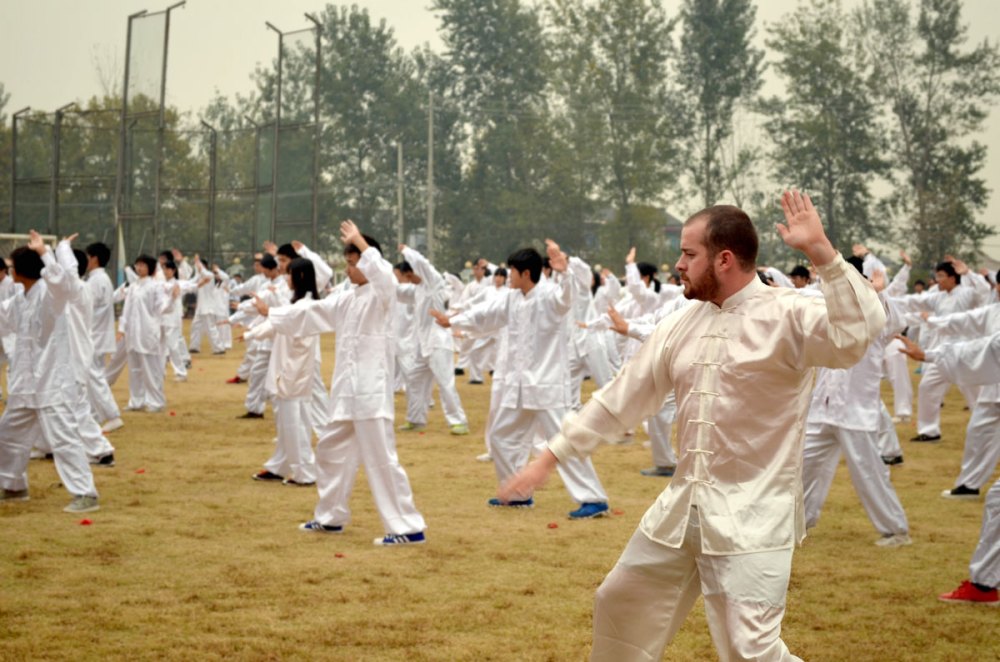
It is rare to find foreigners in China and rarer still to have them study at Taiji. Master Chuck decided to use this novelty to the school’s advantage while at the same time rewarding us. We were asked to perform the second combination of moves in front of the entire school at the annual track and field day. We were reluctant but they were insistent. And so, that is how me and the other guy Dave ended up leading five hundred students in a five minute demonstration.
It was nerve wracking.
Having to place every foot perfectly, moving with confidence and grace are very difficult. Maybe two of the three but certainly not all of them, especially grace. That is one thing I definitely lack. We survived… somehow.
Now we are back to regular classes. It is a nice change of pace from focusing on practicing for the demonstration. And, if we are really lucky, he will start teaching us how to use swords.