
Weekend Sun Shines on Cam Clark
Advertisement
Read this article for free:
or
Already have an account? Log in here »
We need your support!
Local journalism needs your support!
As we navigate through unprecedented times, our journalists are working harder than ever to bring you the latest local updates to keep you safe and informed.
Now, more than ever, we need your support.
Starting at $15.99 plus taxes every four weeks you can access your Brandon Sun online and full access to all content as it appears on our website.
Subscribe Nowor call circulation directly at (204) 727-0527.
Your pledge helps to ensure we provide the news that matters most to your community!
To continue reading, please subscribe:
Add Brandon Sun access to your Free Press subscription for only an additional
$1 for the first 4 weeks*
- Enjoy unlimited reading on brandonsun.com
- Read the Brandon Sun E-Edition, our digital replica newspaper
*Your next Free Press subscription payment will increase by $1.00 and you will be charged $20.95 plus GST for four weeks. After four weeks, your payment will increase to $24.95 plus GST every four weeks.
Read unlimited articles for free today:
or
Already have an account? Log in here »
Hey there, time traveller!
This article was published 23/03/2013 (4829 days ago), so information in it may no longer be current.
At the risk of making you blush, I used to watch Kinsmen Jackpot Bingo just to listen to you talk. Oh my god! That basso profondo of yours is wonderful!
(bashfully) Thank you. It’s the equipment, not me!
No — it’s you. And I realize we can’t control our genetics, but your voice is just so rich and so pure and so fabulous — I love it!
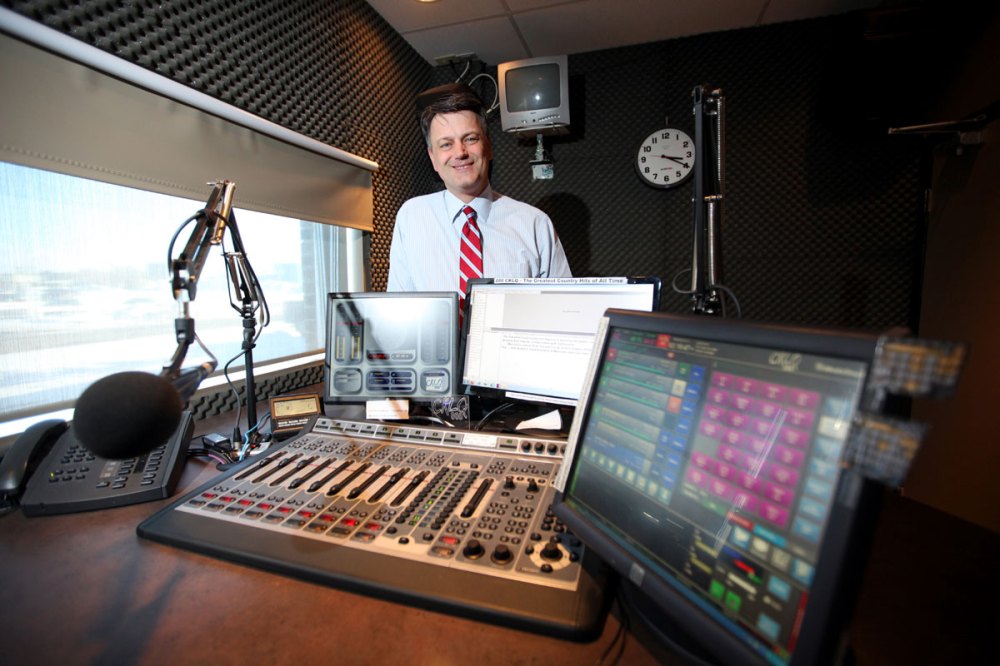
Thank you. But much like anybody else, I hate my voice.
Why?
I listen to it and I go, ‘That’s not me.’ It sounds different in our own heads, with cavities and nasal passages. I like what I hear in my head better than what I hear in recordings of myself.
Fair enough. So how did you get started doing Kinsmen Jackpot Bingo?
A friend of mine who worked at CKY Television phoned me and said, ‘Hey — we need somebody to fill in on vacation just for summer relief. It’s just an hour on Saturdays and it’s fun.’ And so I said, ‘Aw — what the heck. I’ll do it.’
So two weeks went by, three weeks, about a month, a month and a half, and I went, ‘How long is this person on holidays?’ And after a while they went, ‘Um — you’re the new guy.’ And I said, ‘I don’t WANT this job!’
But you did it for years, right?
I did it for about four years, off and on, starting in about 2001. Kathy Kennedy and I both would share it after a while because we just said nobody wants to commit their life every Saturday, because it was live.
Growing up with a voice like yours, was it weird? Did you go through puberty and then all of a sudden you’re talking from the very basement of your soul?
You know, I’ll listen to somebody like James Earl Jones, and think, ‘Now HE’S got a voice!’ And I listen to other broadcasters and I think, ‘Wow — they’ve got a terrific sound.’ The funny thing is, I never really thought too much of my voice, and I still don’t. I guess I take it for granted.
Did people comment on it, though? Was it a subject of discussion?
When I was growing up, not really. I know in high school, I always thought I’d love to get into broadcasting — it was a passion. And I never really pursued it a heck of a lot until I was in university. I was in general arts, and one day they had a career fair, and nobody was talking to the radio guy who was there — it was a morning guy named Dick Reeves. So I just wandered over and said, ‘Pretty dull, huh?’ And he said, ‘Hey! You’re the only guy talking to me!’
So the next thing I know, he said, ‘Come on down to the station.’ So I literally walked in and started operating tapes. And here’s a little trivia: Clay Young, who’s doing our news at CKLQ and Star now, when I first started in March of 1981, Clay was the one who trained me on the board.
So what was it about broadcasting you liked?
I liked the idea of communicating with people. What’s ironic is most broadcasters are fairly shy. And that’s why they can get into a control room, and it’s very quiet, and they can have a conversation without having to face the large crowds.
I like that idea. But I also really like the equipment and the technology. THAT’S what drew me into broadcasting. I remember operating these tapes, and I got a phone call about two weeks in, and the program director said, ‘When are you going to do the weather?’ And I said, ‘Well, you didn’t hire me to talk. I was just here to run the tapes!’ So anyway, that was my break.
So you started in 1981. At what station?
At CFRW, and continued on the air, running tapes. Later that year, I moved to all-nights on Q94. I worked from 2 a.m. ’til 6 a.m. I enjoyed that — I did that for about nine months, and then moved into progressively better shifts, and continued on until about 1982 — I went to CKND-TV at that time as the staff announcer. I stayed with the television station doing on-camera, doing interviews, producing a couple of different shows, I did Agri-Noon — all sorts of things — until 1987, and then I moved back to radio at CFRW. Eventually, I moved from on-air into sales for three years to understand the other side of the business.
And after that I moved back into the broadcast side — I did news, I did all sorts of administrative things, went back to university and got a certificate in management — I did that while I was working full time. Then I went back to being a program director and I was called ‘Compliancy Cam’ because I was the compliancy officer on behalf of management doing union negotiating. So I learned a lot about that. At one time, I thought I should go into law. But I stayed with broadcasting.
The opportunity here in Brandon came up in about 2006 — there was a posting saying they were looking for a General Manager at a rural-market radio station. My boss in Winnipeg said, ‘I don’t want you to go, but at the same time, why don’t you apply? It’d be a really good experience for you to go through the interview process.’ So I said, ‘Sure.’
I came out here for one interview with Don Kille and Dave Baxter, and I remember in the interview, Don asked me about the programming that we had on the air at 1290 in Winnipeg with Don Percy and ‘Info Chats.’ Don said, ‘Are you the one responsible for that horrible broadcast?’ And at the time, I couldn’t disagree, but all I said was, ‘It has changed the fortunes of that radio station, taking us from red to black. And whether it’s good or bad, it’s making money, and that’s what it’s about.’
I figured I’d pretty much blown the interview at that point, but I came back for a second interview. During that time, CHUM Broadcasting, who I was working for, was being sold to Bell Media. So I knew, one way or the other, I was probably going to have a new boss, whether it was this job in Brandon or staying with Bell. So this was a terrific opportunity at the right time.
Was it hard to give up the broadcasting end of things? Because you mentioned you still did the occasional voice-over when you came to this job…
I knew with this new position it was something I wouldn’t continue to do. I’ve been really lucky to have had exposure to pretty much every position in broadcasting, because I feel like I’ve done most of them. And I think that’s been a great foundation for me to be in the position I’m in.
I look around at the people I get to work with on a day-to-day basis — they’re the stars. I’m in awe of listening to the people who have been voices in this community for so many years — the Bruce Luebkes, the Steve Antayas, the Bill Turners, the Bill Cochranes, the Leanne Dotys, the Wayne Kozaks, the Tyler Glens. And even the new people — they’re well established. Trent (B.) is making a huge impact for broadcasting in this community. I feel SO fortunate to be able to come to work every day and work with talent like that — those voices that we hear — and of course everyone else in our building.
Having spent your life and entire career in Winnipeg, was it culture shock to come out here?
Not a huge culture shock at all, for a number of reasons. Number one, I was certainly familiar with CKX Television. At the time, Bell Media had owned them, so I was already doing some voice work for CKX-TV and doing some commercials for them.
But probably more importantly, I have roots here. My father was born and raised in Brandon — my grandmother lived over on 16th Street. And I still have a lot of family in the community.
I love Brandon. It’s a great place to put down roots. It’s a great place to raise a family. It’s probably one of the best-kept secrets until ‘Money’ magazine keeps revealing it!
But I’ve had an even better exposure to it by dealing with the Chamber of Commerce. Last year, I was president of the Chamber, but certainly working with the vice-president and secretary made me realize how good the business community is, and what the fortunes are like here in Western Manitoba. And they are somewhat different than other parts of the country. So this is a fabulous spot, and I think it’s easy to forget about how great it is when you live here. But when people drop in and see it, they admire it. They realize what we’ve got. I feel like Brandon really is on the cusp of an awful lot of good things.
Agreed! Now, the future of radio, in your estimation, with the internet being such a big, impactful thing?
You know, I love this question! And I’ll quote Steve Antaya, because we’ve talked about this. Steve said, ‘Radio is like the cockroach after a nuclear holocaust. It will come crawling out and just continue to survive.’
When television first showed up, they said, ‘it’ll be the death of radio.’ Then all of a sudden they said, ‘OK — we’re going to tape, and that’ll be the end of radio.’ And Walkmans showed up, and CDs, and mini-discs. And radio has evolved through all of this.
The one thing I’ve realized is — and it’s especially amplified in communities like ours — on a snow day, when the buses are NOT running, try listening to that kind of information on satellite radio, or streaming radio anywhere in the world. People NEED to know what’s going on in their own back yard. That’s exactly what we do — we talk about local events and local issues, and that’s on both our radio stations — CKLQ and Star FM. And we know people will come to us.
I think a really good example of that was the flood a couple of years ago when we went live down from City Hall. You don’t know it at the time, but it’s the comments that come out afterwards. People said you could go into stores, and you would hear one of our two radio stations picking up that live feed. And it was quiet — people were gathered around the radio.
So as much as technology has advanced things — I mean, here we are with iPhones that can do so much more than typical radio — but that being said, radio is free to the listener. And it is an outstanding way of communicating and staying in touch with what’s going on around you.