
Aeration devices definitely make a difference
Advertisement
Read this article for free:
or
Already have an account? Log in here »
We need your support!
Local journalism needs your support!
As we navigate through unprecedented times, our journalists are working harder than ever to bring you the latest local updates to keep you safe and informed.
Now, more than ever, we need your support.
Starting at $15.99 plus taxes every four weeks you can access your Brandon Sun online and full access to all content as it appears on our website.
Subscribe Nowor call circulation directly at (204) 727-0527.
Your pledge helps to ensure we provide the news that matters most to your community!
To continue reading, please subscribe:
Add Brandon Sun access to your Free Press subscription for only an additional
$1 for the first 4 weeks*
*Your next subscription payment will increase by $1.00 and you will be charged $20.00 plus GST for four weeks. After four weeks, your payment will increase to $24.00 plus GST every four weeks.
Read unlimited articles for free today:
or
Already have an account? Log in here »
Hey there, time traveller!
This article was published 01/03/2014 (4321 days ago), so information in it may no longer be current.
Aeration, oxygenation, letting wine breathe.
Call it what you like. But no matter which moniker you choose, there are definite benefits to the process.
While too much oxygen can make a wine go off — it spoils just like cut fruit does when it’s exposed to air — it takes a bit of time for that to happen. And before wine or fruit gets to the bad or overripe stage, it reaches its peak of aroma and flavour, which is why the number of devices available that provide rapid oxygenation has been on the rise.
In last week’s column, I wrote about three products — the famed Eisch glasses, which are able to aerate wine in two to four minutes to the same degree as an hour or two of decanting (it’s a closely guarded secret as to how the company has accomplished this, but rest assured, they really do work), the Vinturi, and an non-branded freebie aerator given away as a value-added bonus to folks who purchased select Mission Hill wines in large centres like Winnipeg during this past holiday season.
Anyway, aeration helps particularly with wines that can use it — ones that are sharp, harsh and perhaps a little rough around the edges. And generally speaking, that means less expensive wines.
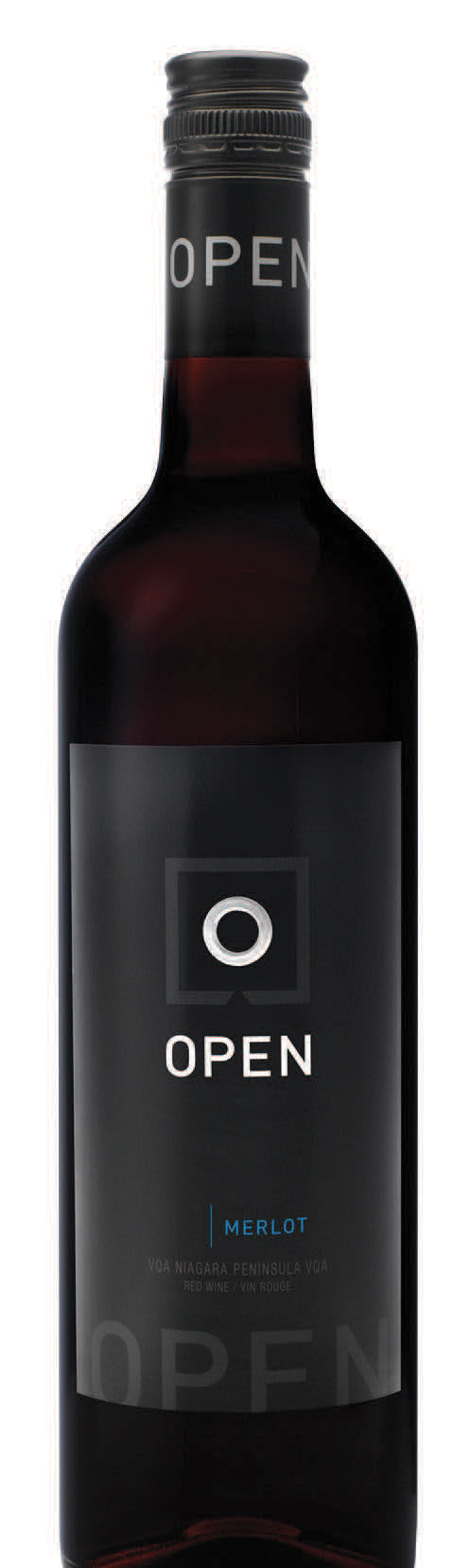
So for my test, I used the Open Merlot, which is from the Okanagan and sells for $12.49 a bottle. I like this wine a lot, especially for the price point. While it’s not full-bodied, it certainly IS full-flavoured — it’s gutsy, with plenty of red fruit and black pepper. But there’s no question it’s a bargain wine, and could use a little enhancing.
I set up three identical glasses on my kitchen counter. I poured two ounces of the Open Merlot into an Eisch glass for the requisite four minutes, then transferred the contents into one of the other glasses.
I then poured another two ounces of the Open through the Vinturi into a second glass. Finally, for the third one, as is required, I plugged the freebie aerator from Mission Hill into the bottle, and put the test amount in the glass.
I had my husband bring me each glass, one at a time, and had him keep track of which was which. So it truly was a blind taste test for softness and texture.
First off, I was surprised. All the devices made a HUGE difference. The one that had been aerated in the Eisch glass provided probably the most improvement, and while I ranked the Vinturi as second-best, it wasn’t THAT much better than the Mission Hill giveaway.
And since the Eisch sells for about $35 a glass, and the Vinturi ranges from $25 to $35, and the Mission Hill one was FREE, I decided I had to do this again with another wine just to make sure I wasn’t crazy.
(Just as a side note, while any inexpensive wine can be improved by aeration, the gizmos, all of them, seem to have a much greater effect on, or at least make a more notable difference in, red wines than they do whites, which is why I used reds for these experiments.)
So the following weekend, I set up my glasses again. This time, the wine of choice was the Finca Los Primos Malbec from Argentina, which has plenty of depth, boasts a lot of black fruit and finishes with a touch of fennel. This is a deep, dark and robust wine, especially for $10.99 a bottle. But it’s edgy, and would certainly, I thought, benefit from aeration.
So we went through the same routine again with the same three devices. And the results were pretty much identical, with a few interesting qualifications.
While I thought the Eisch glass made the Finca smoother than the other aerators, the Vinturi seemed to do almost as good a job, AND the Vinturified wine seemed somehow to have more flavour than the other two. And the Mission Hill give-away also made a substantial difference.
‘Boy — it’s a toss-up,’ I wrote in my notes about the exercise.
I tasted them all again, and wrote, ‘The Eisch wins but just by a hair. And if you left it in the Eisch glass, would the wine be OVER-aerated? Hmmm.’
I can’t truthfully answer my own question, but I suspect that might be the case. So another test is obviously in order! But to boil down the results of these ones, the Eisch did the best job of quickly aerating both wines, but not by much. And honestly, there really wasn’t much difference between the Vinturi and the free — and MUCH more compact — aerator. (I’ve seen similar ones to the freebie for $30 in boutique wine stores!)
The bottom line is, these doohickies definitely make a difference in the taste of less expensive wines (they can actually ruin, or aerate too much, an already-well-balanced and softly tannic, more-expensive one). But the flavour and texture of a $10 wine can be elevated to that of a $15 wine. And a $15 beverage can sometimes be taken up to the level of a $20 one.
So they’re certainly worthy of consideration, especially if you can get one thrown in for the price of a bottle you might be buying anyway. Mission Hill representatives have said the inclusion of the aerators with their wines was very well received this past Christmas, and that the add-on aerators might be showing up in a Liquor Mart near you before the holiday season of 2014 rolls around. As soon as I see some, I’ll let you know. It could be a treat just for you, or a gift for someone else that keeps on giving.