
Gone Gardenin’ – Try something unique
Advertisement
Read this article for free:
or
Already have an account? Log in here »
We need your support!
Local journalism needs your support!
As we navigate through unprecedented times, our journalists are working harder than ever to bring you the latest local updates to keep you safe and informed.
Now, more than ever, we need your support.
Starting at $15.99 plus taxes every four weeks you can access your Brandon Sun online and full access to all content as it appears on our website.
Subscribe Nowor call circulation directly at (204) 727-0527.
Your pledge helps to ensure we provide the news that matters most to your community!
To continue reading, please subscribe:
Add Brandon Sun access to your Free Press subscription for only an additional
$1 for the first 4 weeks*
- Enjoy unlimited reading on brandonsun.com
- Read the Brandon Sun E-Edition, our digital replica newspaper
*Your next Free Press subscription payment will increase by $1.00 and you will be charged $20.95 plus GST for four weeks. After four weeks, your payment will increase to $24.95 plus GST every four weeks.
Read unlimited articles for free today:
or
Already have an account? Log in here »
Hey there, time traveller!
This article was published 22/09/2011 (5452 days ago), so information in it may no longer be current.
A majority of prairie gardeners is rather unfamiliar with flowering cabbage and so they do not often grow these plants. So inclusion of a few of these plants may add an element of surprise for visitors to your garden and provide an interesting experiment.
Flowering cabbage and kale, ornamental cabbage and kale, and decorative cabbage and kale: all these names refer to the same plants, although the cabbages generally have smooth leaf edges, while the kales are fringed. They are all hybrids in the Brassica (Latin for cabbage) family and the last word in their Latin name, Brassica oleracea, means vegetable-like. All of them are similar in many ways to the other members of the cabbage family such as cabbage itself, broccoli and cauliflower.
Kales come in two different forms: the fringed leaved varieties whose leaves are fringed and ruffled; and the feather leaved forms whose leaf edges are finely serrated and deeply notched. All flowering cabbages and kales produce coloured leaves which are very decorative — the term “flowering” is a misnomer as the colour comes from the leaves rather than from petals of flowers. Although decorative kale is edible, it is much inferior to culinary varieties and is rarely used in the kitchen except as a garnish. They are raised almost exclusively for decorative purposes.
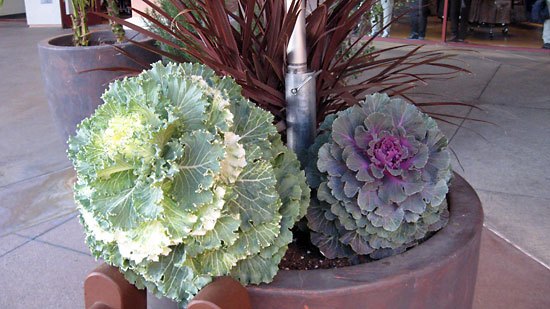
Decorative kales and cabbages take about three months from seed to produce colourful heads so usually they are purchased as individual plants at a greenhouse. They are quite difficult to grow from seed started early in the house because they demand low temperatures and bright light.
If they are not given the required growing conditions when they are small, the plants will develop elongated stems. If they have their roots restricted while being grown they will tend to bolt and not form proper decorative heads so they must be grown in large individual pots, which are difficult to accommodate indoors.
Early in the season ornamental cabbages and kales may not exhibit strong colour because low temperatures consistently below 20 degrees are required to cause the plants to lose chlorophyll and reveal their colouration, which ranges from white to pink to red-purple. Such a downturn in temperatures does not happen in our area until late August. Once nighttime temperatures drop below 20 degrees the colouration of the leaves, which takes about two weeks, will begin.
Pests and diseases that plague the rest of the Brassica family also attack decorative cabbage and kale. Flea beetles and cabbage worms are the most destructive since they attack the foliage, which is the reason for growing the plants in the first place. Since the plants are often located in very public areas of the landscape where their beauty can be appreciated, visible barriers or insecticides which are very obvious, such as potato dust, are not suitable options for deterring these pests. Luckily, because the plants are not going to be eaten, a liquid insecticide such as malethion can be sprayed on the plants to control insects.
Ornamental cabbages and kales look good in rows used to edge planting areas. I once visited a garden where the gardener had planted a row of decorative kale around the edge of a circular island bed and it was very effective come fall.
Ornamental kale can be dotted here and there in a mixed border to add points of interest to the late summer garden. Care must be taken to not allow the neighbouring plants to crowd the kale plants or they may not perform well.
I particularly like a kale plant included in a mixed container. They can be planted near the edge of the container and allowed to sort of hang over the container’s edge which makes for an interesting composition.
Decorative cabbage and kale add unique touches to any landscape and because they are relatively rare thus far in local gardens, they will be sure to arouse the interest of visitors to the garden. Make a note in your garden journal to try some next year.
Albert Parsons is a consultant for garden design and landscaping who lives in Minnedosa.
» communitynews@brandonsun.com