
Gone Gardenin’ – Let trailing plants roam your interior landscape
Advertisement
Read this article for free:
or
Already have an account? Log in here »
We need your support!
Local journalism needs your support!
As we navigate through unprecedented times, our journalists are working harder than ever to bring you the latest local updates to keep you safe and informed.
Now, more than ever, we need your support.
Starting at $15.99 plus taxes every four weeks you can access your Brandon Sun online and full access to all content as it appears on our website.
Subscribe Nowor call circulation directly at (204) 727-0527.
Your pledge helps to ensure we provide the news that matters most to your community!
To continue reading, please subscribe:
Add Brandon Sun access to your Free Press subscription for only an additional
$1 for the first 4 weeks*
- Enjoy unlimited reading on brandonsun.com
- Read the Brandon Sun E-Edition, our digital replica newspaper
*Your next Free Press subscription payment will increase by $1.00 and you will be charged $20.95 plus GST for four weeks. After four weeks, your payment will increase to $24.95 plus GST every four weeks.
Read unlimited articles for free today:
or
Already have an account? Log in here »
Hey there, time traveller!
This article was published 08/01/2015 (4156 days ago), so information in it may no longer be current.
Different kinds of plants serve different purposes in the indoor landscape. There are tall, slender plants that don’t demand high light levels that we can place in dimly lit corners in our homes, and there are flowering plants that are happiest sitting on a south-facing windowsill.
One type of plant that is very useful when creating beauty in our indoor gardens is the trailing plant. These plants are versatile, can be manipulated to perform a myriad of tasks, and sport attractive foliage — and sometimes bloom.
One of the most common trailing plants is the ivy. This venerable house plant has been used by indoor gardeners for years to beautify their surroundings.

The most common ivy grown as a house plant is English ivy and there are numerous cultivars to choose from, many of them having colourful variegated foliage and small leaves produced on long trailing stems.
As with most ivies, the distance between the leaves on the stems will depend on light levels.
If the plant is receiving some direct sun, the leaves will be close together and the plant will be quite bushy; the leaves of a plant exposed to less light will be spaced further apart. Any variegation will gradually disappear under low light conditions; the stronger the light, the more variegation the leaves will have.
Swedish ivy, which is a member of the Plectranthus plant family, has round scalloped leaves in various shades of green and many have white variegation. Members of this plant family like bright indirect light and are often grown as hanging plants.
Besides the well-known Swedish Ivy, other members of the Plectranthus plant family are useful trailing plants. Some of them are rather brittle so they have to be located where they will not be bumped or brushed against.
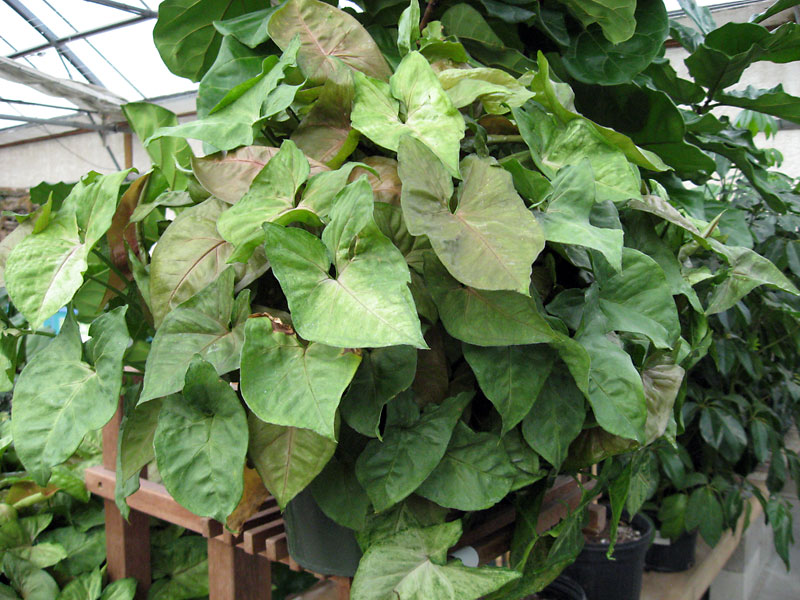
Most philodendrons are vines that trail or climb. One of my favourites is the heart-leaf philodendron whose leaves, as the name implies, are shaped like hearts.

The so-called split-leaf philodendrons are much larger plants and are often grown as upright plants although there are cultivars that have a more trailing habit.
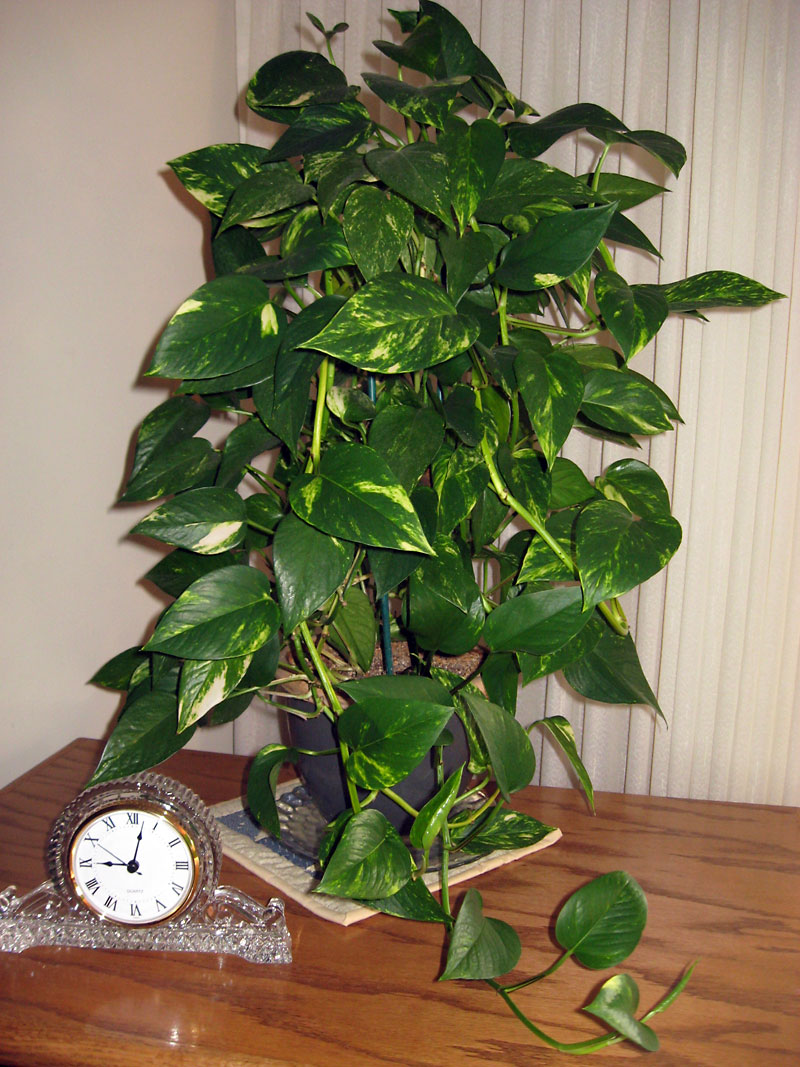
No discussion of trailing plants would be complete without mention of pothos, a wonderful low light plant that often has marvellous white or gold marbling on its bright green leaves. It is a fast growing, vigorous trailing plant whose leaves are spaced widely apart on thick trailing stems.
Grape ivies are popular because of the soft texture of their dark green foliage — one has leaves shaped like oak leaves. Other trailing plants include tradescantia, and various ferns, including the cascading asparagus fern.
With such a large number of trailing plants to choose from, it is no wonder that they serve a variety of functions in the interior landscape.
Here are some ways that trailing plants can be used in the interior landscape:
• Place a couple of pots of pothos or heart-leaf philodendron on top of the kitchen cabinets and let them ramble, allowing some leaves to cascade over the edge. Add a few decorative objects to the display and allow the vines to wind among them.
• Place a grape ivy or Swedish ivy into an attractive container and let its foliage tumble over the edge of a mantle or high shelf.
• Place an attractively variegated English ivy into a unique container — perhaps a bright, shiny copper bowl — and place it on a side table and let it ramble over the table top.
• Use trailing plants as ground covers in some of your large foliage plants such as schefflera and palms. The trailing can spill over the edges of the container and create a cascading effect.
• Train a pothos, philodendron or ivy onto a tall pole or trellis; either set it on the floor or on a shelf. The larger the container, the larger the plant will grow.
• Use trailing plants as hanging plants; use attractive containers and interesting plant hangers.
• Add trailing plants to plant groupings and have the trailing plants wind their way among the foliage of the other plants.
• Espalier a trailing vine, such as ivy, onto a part wall or room divider, or around a piano window.
Albert Parsons is a consultant for garden design and landscaping who lives in Minnedosa.
» communitynews@brandonsun.com