
Gone Gardenin’ – Add some dieffenbachia dazzle to your home
Advertisement
Read this article for free:
or
Already have an account? Log in here »
We need your support!
Local journalism needs your support!
As we navigate through unprecedented times, our journalists are working harder than ever to bring you the latest local updates to keep you safe and informed.
Now, more than ever, we need your support.
Starting at $15.99 plus taxes every four weeks you can access your Brandon Sun online and full access to all content as it appears on our website.
Subscribe Nowor call circulation directly at (204) 727-0527.
Your pledge helps to ensure we provide the news that matters most to your community!
To continue reading, please subscribe:
Add Brandon Sun access to your Free Press subscription for only an additional
$1 for the first 4 weeks*
- Enjoy unlimited reading on brandonsun.com
- Read the Brandon Sun E-Edition, our digital replica newspaper
*Your next Free Press subscription payment will increase by $1.00 and you will be charged $20.95 plus GST for four weeks. After four weeks, your payment will increase to $24.95 plus GST every four weeks.
Read unlimited articles for free today:
or
Already have an account? Log in here »
Hey there, time traveller!
This article was published 26/02/2015 (4119 days ago), so information in it may no longer be current.
Dieffenbachia is a stunning large foliage plant and it is a good choice for an interior landscape that is spacious and has relatively low light levels.
Dieffenbachia will tolerate low light, although a plant subjected to such conditions will eventually get a bit leggy and not be as sturdy-stemmed as one grown in stronger light.
Taller varieties can become top-heavy and if they are not planted in large, heavy containers, they may topple. One strategy is to put the pot into a cachepot to keep it stable.

Dumb cane is the common name for this plant, and the peculiar name is derived from the fact that the plant contains toxins that, when ingested or touched, may cause a type of temporary paralysis or skin irritation — which is never fatal and not often serious.
There is no doubt that this plant contains volatile chemicals as several cancer research projects have investigated the plant’s usefulness in developing cancer medications.
Dieffenbachia is a tropical plant and is native to Central and South American tropical regions. It is an understory plant so it is not fond of exposure to direct sunlight as the sunlight in a tropical rainforest understory is always heavily filtered.
It likes to have a porous, well drained soil; a mix of two-thirds peat moss and one-third perlite works well for this plant. The soil should be kept moderately moist but not wet as dieffenbachia can be killed if they get too wet. Bacteria and mould will develop and destroy the plant.
Dieffenbachia also likes heat, which is not unusual for a tropical plant. It will not thrive in a cool environment, and the warmer the temperatures, the happier it will be.
Dieffenbachia has a straight stem and simple (no leaflets) alternate (alternate one after the other up the stem) leaves. The large leaves, held out to the side of the stem by sturdy branches, are wide and come to a point.
Like its cousins the aglaonema, spathiphyllum, and philodendron, the dieffenbachia produces spathes rather than flowers. These are rather nondescript and are usually cut off; plants grown indoors rarely bloom.
Although the leaf tips can brown due to too much fertilizer or from lack of moisture in the soil, the dieffenbachia naturally over time sheds its lower leaves. The leaves will yellow, turn brown and curl up and drop off the plant. These unsightly leaves should be removed when they begin to yellow.
Because a mature dieffenbachia — some varieties can reach a height of two metres — will over time lose its lower leaves and have bare, rather unattractive lower stems, cuttings are usually taken from a mature plants and then the parent plant is discarded.
The terminal top shoots can be cut off and rooted in soilless mix or in water. Pieces of stem can also be used to create new plants.
The piece of a stem must have an eye for it to root and the best practice is to lay a 10 centimetre long section of stem on its side and half bury it with damp soilless mix; roots will appear in about four weeks.
A good way to do this so the cutting and soil have lots of moisture surrounding them is to root the cutting inside a plastic pop bottle — with the cap removed.
There are many varieties of dieffenbachia and they range in size from dwarf plants that grow less than 30 centimetres tall to giants that reach more than two metres in height. Leaf colour also varies widely between varieties.
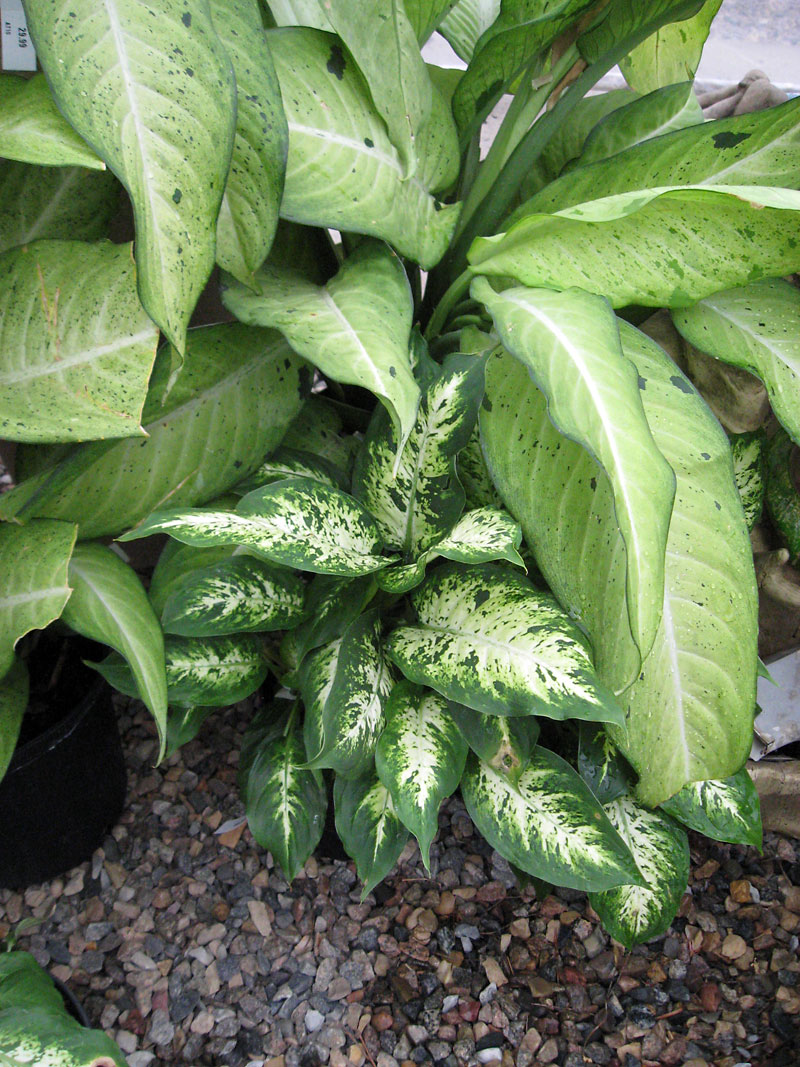
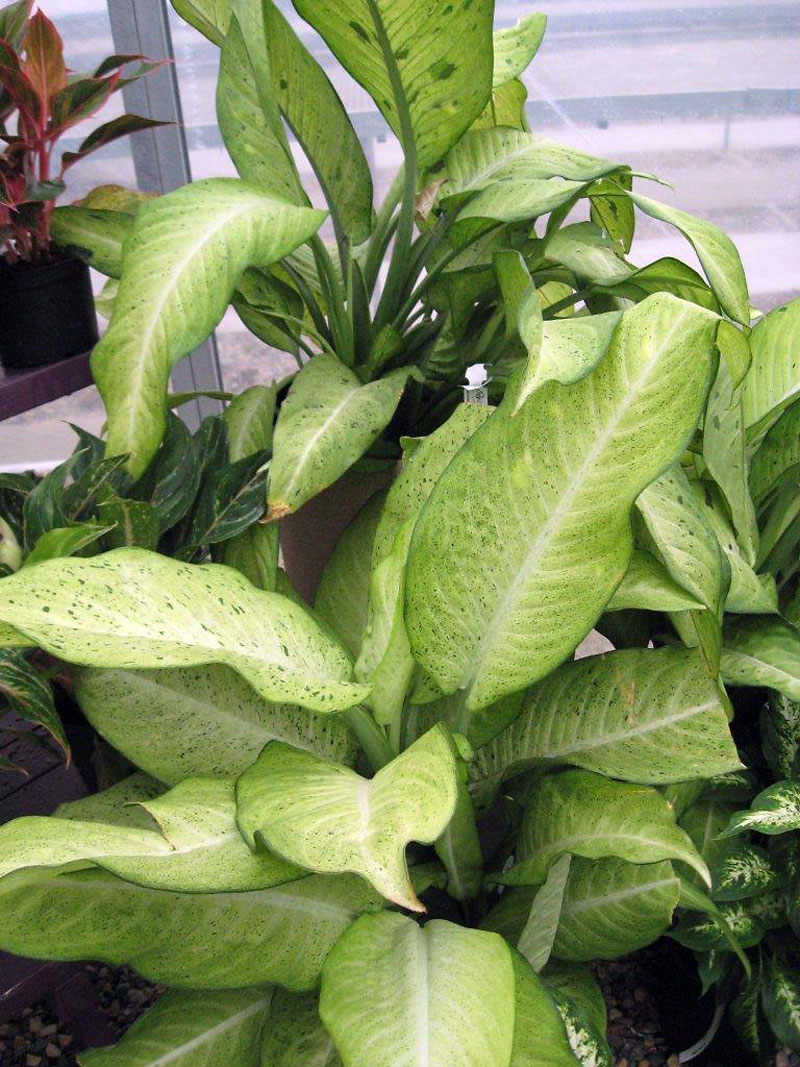
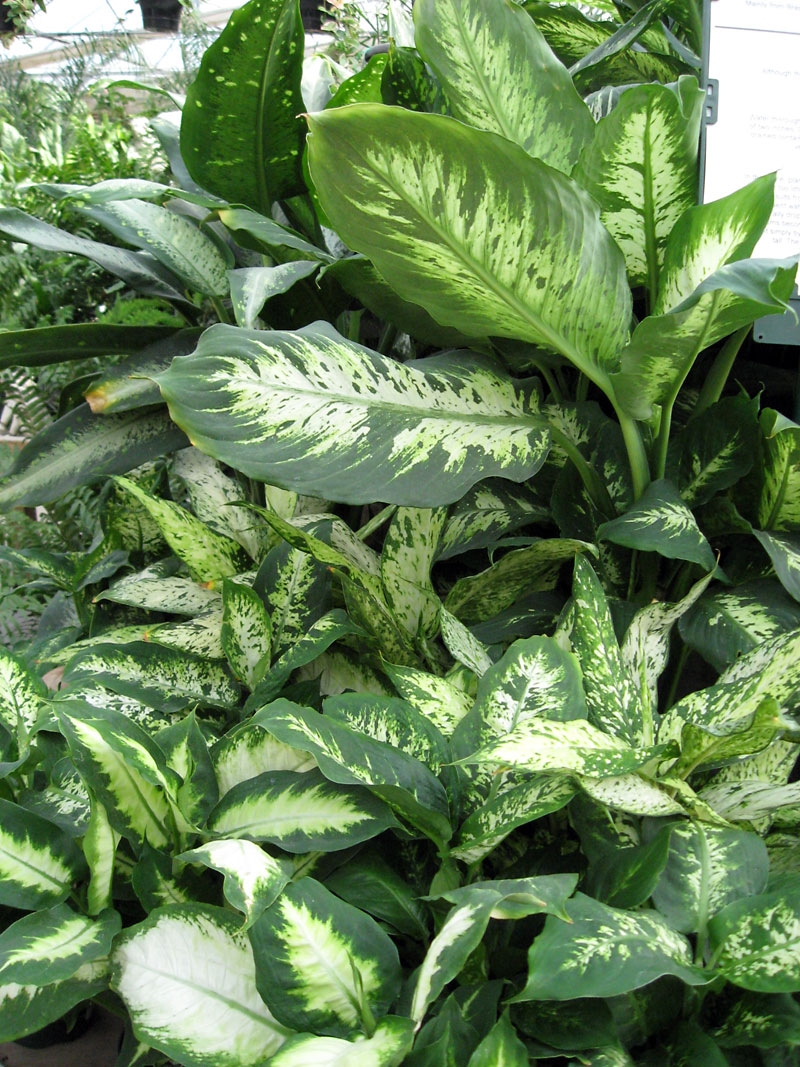
Leaves of dieffenbachia are its claim to fame; they are wonderfully patterned and very showy. The leaves will have white, cream, ivory or white markings on their dark green surfaces — although some varieties have so much variegation that there is very little green showing.
Examples are D.’Topic Honey’, whose leaves are almost pure pale gold with a very thin green leaf margin. Another is D. ‘Picta’ whose leaves have an almost totally white mid-rib.
Leaves can have blotches or dots of colour or they can have large patches of a single colour on their surfaces. The leaves are shiny and smooth — or sometimes a bit rippled — and they are easily cleaned by wiping them with a dampened soft cloth.
Dieffenbachia is an easy care, statuesque plant that does not demand a lot of light or a lot of care. Whether it is a dwarf variety used in a dish garden or as a tabletop plant or a larger specimen sitting on the floor, a dieffenbachia plant would be an attractive addition to any interior space.
Albert Parsons lives, writes, and gardens in Minnedosa.
» communitynews@brandonsun.com