
Deer population could be in jeopardy
Advertisement
Read this article for free:
or
Already have an account? Log in here »
We need your support!
Local journalism needs your support!
As we navigate through unprecedented times, our journalists are working harder than ever to bring you the latest local updates to keep you safe and informed.
Now, more than ever, we need your support.
Starting at $15.99 plus taxes every four weeks you can access your Brandon Sun online and full access to all content as it appears on our website.
Subscribe Nowor call circulation directly at (204) 727-0527.
Your pledge helps to ensure we provide the news that matters most to your community!
To continue reading, please subscribe:
Add Brandon Sun access to your Free Press subscription for only an additional
$1 for the first 4 weeks*
- Enjoy unlimited reading on brandonsun.com
- Read the Brandon Sun E-Edition, our digital replica newspaper
*Your next Free Press subscription payment will increase by $1.00 and you will be charged $20.95 plus GST for four weeks. After four weeks, your payment will increase to $24.95 plus GST every four weeks.
Read unlimited articles for free today:
or
Already have an account? Log in here »
Hey there, time traveller!
This article was published 12/01/2017 (3568 days ago), so information in it may no longer be current.
It’s not a matter of if deer will die of starvation this winter, it’s a matter of when — and how many.
Hartney farmer Claude Martin believes wildlife, particularly deer, will die in greater numbers this winter in southwestern Manitoba, and he wants the provincial government to do something about it.
The province, he said, makes no effort to help the whitetail deer population, which dwindled in the severe winter of 2010-11. Martin wants feeding stations installed so deer will not have to scrounge through feet of snow to find brush and twigs to munch on.
Finding food is more challenging particularly during this winter, where the amount of snowfall is double the seasonal average.
“I just don’t want them to starve,” Martin said, while driving his truck along Road 31N west of Hartney, amid the forestry of Lauder Sandhills where deer congregate. “They can’t get out to their food source.”
In the winter, deer adapt by moving less and relying on the additional body fat they stored in prior months. The preservation tactics get them through the lean winter months when food is scarce and conserving calories is paramount.
A lot of the deer walk along roads and snowmobile trails to avoid trudging through heavy snow.
Even with the whitetail deer’s biological adaptations, Martin is worried. A lifelong Hartney resident, he believes the amount of snowfall in recent weeks — two to three feet — is the highest in decades, making it harder for deer to find food.
“This is just the start of it, we have three more months left,” he said.
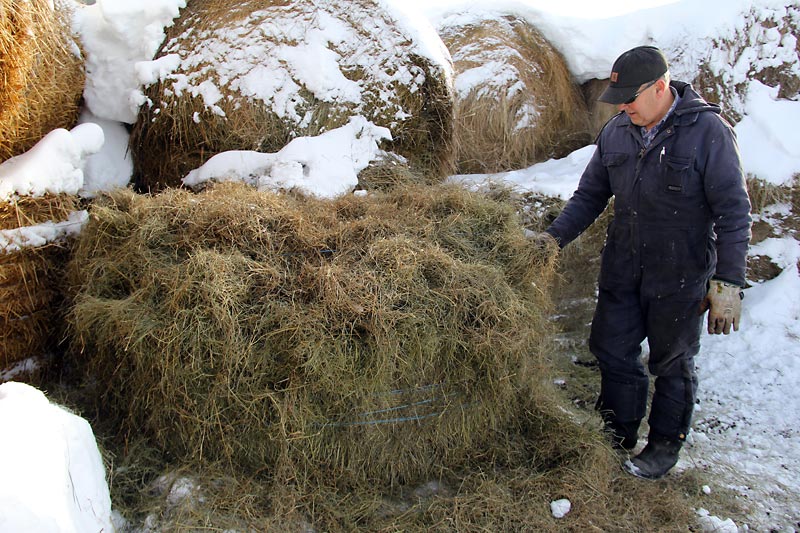
Martin has taken matters into his own hands. He places a bale of hay outside his farm every week to prevent deer from roaming on his farmland. Deer in close contact could make his livestock susceptible to disease.
He will take a hit financially by giving bales away. His insurance will not fully compensate him for his losses.
“It’s us livestock producers that get the deer through the winter,” Martin said, suggesting the province’s Sustainable Development department and Nature Conservancy are among the organizations that should step up.

Martin doesn’t intend to shame any group by speaking out, but he wants people to know dozens of deer will die within the Lauder Sandhills Wildlife Management Area this winter alone unless help is provided.
“It’s just to let people know that this is happening,” he said.
Brian Joynt, manager of Game, Fur and Human Wildlife Conflict with the province’s wildlife and fisheries branch, sympathizes with people trying to assist.
“We empathize with them, the public who want to help wildlife, that’s fantastic,” he said, “but it’s a potentially misdirected use of very finite dollars. A better use of financial resources would be putting it into habitat improvements or habitat conservation programs that would provide long-term benefits to all sorts of species.”
Financial considerations aside, Joynt said installing feeding stations concentrates wildlife in greater numbers than a habitat can support, increasing the likelihood of disease transmission and detrimentally affecting the habitat’s long-term viability for all species. Human intervention can also make wildlife less fearful of humans and attract unwanted species like coyotes.
No matter what nature lovers try, human intervention only does so much, Joynt said — deer will die every winter, after all.
“Winter carries the trump card, winter will always dictate how many deer we have in Manitoba.”
Years ago, the province placed wildlife feeding stations outside in the winter but that has long ended. Joynt did not know when that practice lapsed.

Though the heavy snowfall in Westman may already be worrisome, Joynt said deer with normal body reserves, sufficiently prepared for the winter, are only at risk if the landscape is covered by approximately 45 cm of snow or at least 60 days of snow. That may happen this year if the winter stretches into spring.
Martin, though, doesn’t buy the argument that humans should do nothing. Without him intervening, deer would gorge on his farm’s bales. By moving bales off his land, he’s at least stopping some of that, preventing more deer from succumbing to the winter, he thinks.
“What’s the difference, right? What I’m trying to do is stop them from coming into my farmyard by taking those bales out there, so they stay out there, and they don’t have to walk through the snow to get to my hay.”
» ifroese@brandonsun.com
» Twitter: @ianfroese