
English Language Conversation Group focuses on shared experiences
Advertisement
Read this article for free:
or
Already have an account? Log in here »
We need your support!
Local journalism needs your support!
As we navigate through unprecedented times, our journalists are working harder than ever to bring you the latest local updates to keep you safe and informed.
Now, more than ever, we need your support.
Starting at $15.99 plus taxes every four weeks you can access your Brandon Sun online and full access to all content as it appears on our website.
Subscribe Nowor call circulation directly at (204) 727-0527.
Your pledge helps to ensure we provide the news that matters most to your community!
To continue reading, please subscribe:
Add Brandon Sun access to your Free Press subscription for only an additional
$1 for the first 4 weeks*
- Enjoy unlimited reading on brandonsun.com
- Read the Brandon Sun E-Edition, our digital replica newspaper
*Your next Free Press subscription payment will increase by $1.00 and you will be charged $20.95 plus GST for four weeks. After four weeks, your payment will increase to $24.95 plus GST every four weeks.
Read unlimited articles for free today:
or
Already have an account? Log in here »
Hey there, time traveller!
This article was published 03/05/2018 (2924 days ago), so information in it may no longer be current.
Vinod Teraiya’s education on Canadian cuisine didn’t include a lesson on smothering a heaping of French fries and cheese curds with gravy.
So when Teraiya heard about poutine at his English Language Conversation Group — a delicacy not native to his home in India — he had to inquire.
“Putin?” interjected Oleh Zayvoda, jokingly. “It’s the president of Russia.”
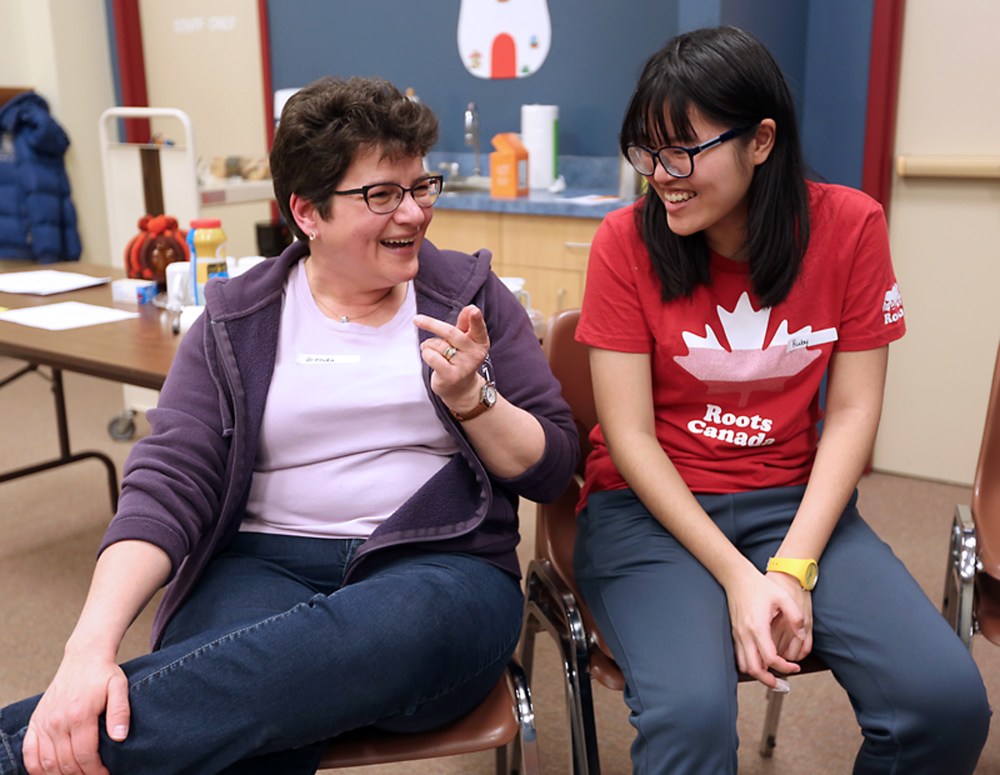
Beginning in March, the Western Manitoba Regional Library in Brandon began facilitating such conversations, where talk of high-calorie dishes transitioned to the Wheat Kings, every Saturday. The library offers an English Language Conversation Group free of charge to newcomers wanting to improve their conversational skills in the predominant dialect of their new country.
They speak with each other and native English speakers who volunteer their time to improve the students’ pronunciation, vocabulary and confidence speaking in another language.
It might be the first class you’ve seen where nobody leaves the room until 20 minutes after it’s done.
“We have a tough time getting them out of here,” said Brenda Robinson, one of the volunteer instructors.
The newcomers may have grown up thousands of kilometres from each other, but their shared experience unites them.
“They’re seeing the same struggles, the same issues,” Robinson said. “They’re not alone. That’s an important thing to realize.”
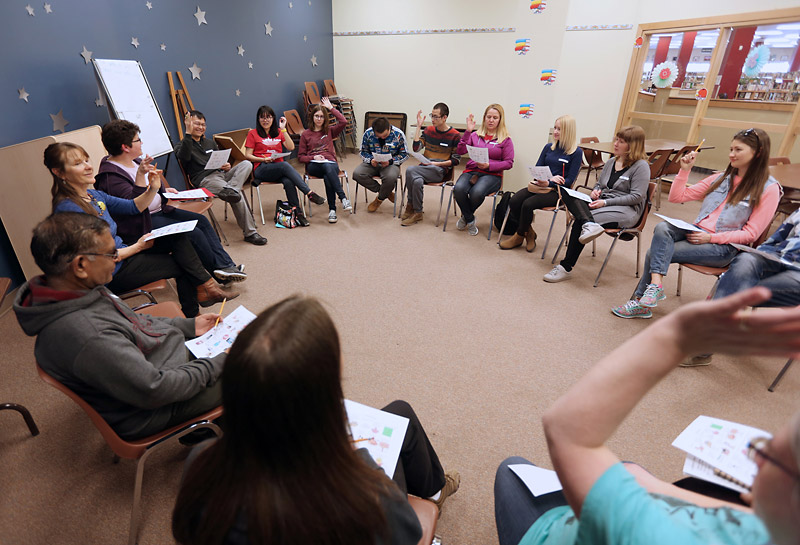
Yuliya Zayvoda, Oleh’s wife, squeezes time for the weekly conversation program after her dishwashing job.
She makes it work “because I know it’s necessary.”
“It’s difficult if you have a job and you need to spend time away from the family,” her husband added, “but at the same time it’s opportunity for us to be together and improve (our English) in the same time, to connect with people, meet new people.”
Victor Li, an international student at Brandon University, said the conversational group is a pressure-free way to practice his English.
There are no assignments or instructor spouting knowledge from the front of the class. They learn through activities. They played a form of Bingo where they match life experiences, like whether they’ve tasted a Tim Hortons’ double-double, instead of numbers.
“We can learn the language in a relaxed way,” said Li, who is studying business administration. “We can talk and we can have games and then people can share their experience of how they came to Canada.”
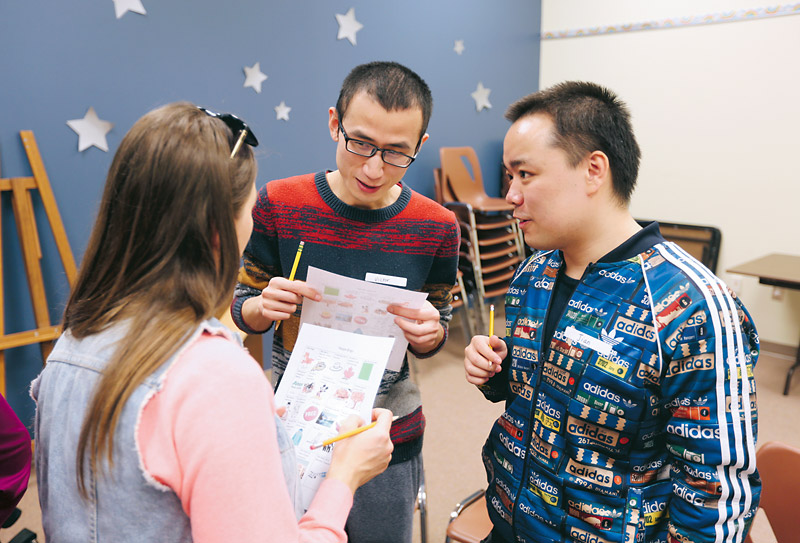
Danielle Hubbard, programming and outreach librarian, said the new program was partially launched in response to federal funding cuts, which shuttered some of the English as an Additional Language classes offered at Assinibone Community College.
Other organizations, like Samaritan House and Westman Immigrant Services, also offer language training, she said, but they can’t invite everyone due to funding restrictions
“There are people that fall through the cracks,” Hubbard said.
Even if the students attend a class, the formalized setting isn’t a way to replicate a friendly chat with a neighbour, said Dianna Morris, a volunteer instructor.
“If they work at a place where there’s other people from their own country, they’ll sort of hang out together,” she said. “This is an opportunity for cross-cultural integration and conversing in a relaxed, friendly way.”
Students are encouraged by the group’s camaraderie, Morris said.
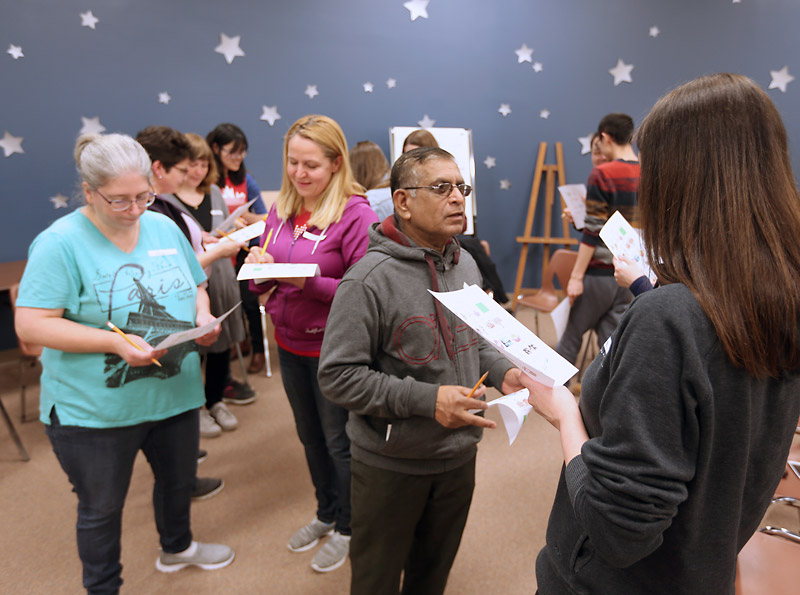
“No one’s going to be rude to them here,” Robinson said. “It’s a safe place to practice — they ask to be corrected.”
» ifroese@brandonsun.com
» Twitter: @ianfroese