
Gone Gardenin’ — Mandevilla cines are the perfect social climber
Advertisement
Read this article for free:
or
Already have an account? Log in here »
We need your support!
Local journalism needs your support!
As we navigate through unprecedented times, our journalists are working harder than ever to bring you the latest local updates to keep you safe and informed.
Now, more than ever, we need your support.
Starting at $15.99 plus taxes every four weeks you can access your Brandon Sun online and full access to all content as it appears on our website.
Subscribe Nowor call circulation directly at (204) 727-0527.
Your pledge helps to ensure we provide the news that matters most to your community!
To continue reading, please subscribe:
Add Brandon Sun access to your Free Press subscription for only an additional
$1 for the first 4 weeks*
*Your next subscription payment will increase by $1.00 and you will be charged $20.00 plus GST for four weeks. After four weeks, your payment will increase to $24.00 plus GST every four weeks.
Read unlimited articles for free today:
or
Already have an account? Log in here »
Hey there, time traveller!
This article was published 24/05/2018 (2859 days ago), so information in it may no longer be current.
For a number of years mandevilla vines have been popular patio plants, where they are found either growing up a wall or planted in a container large enough to accommodate a tall trellis on which the vines climb. They are sometimes used in hanging baskets but their tendency to climb rather than to trail makes them less suitable for this purpose. The plants are tropical, originating in South American tropical areas, and in our area the mandevilla is treated as a summer annual. They like warmth and are not at all tolerant of frost or cold temperatures.
Many gardeners try to winter their mandevillas, with limited success. Not every gardener has the appropriate indoor environment to produce a positive outcome. Also, like many tropical plants confined to an indoor habitat during the winter, insect problems often occur and the battle is too often won by the bugs, not the gardener.
Whether you were lucky enough to over winter your mandevilla or whether you purchased one this spring at a garden center, you will treat them both the same outdoors. It can be planted in the ground or in a container although be careful not to over-pot a mandevilla as this will reduce the amount of bloom the plant produces. Keep the soil which should contain lots of organic matter and be well drained evenly moist. To encourage an abundance of bloom use a soluble fertilizer high in phosphorus.
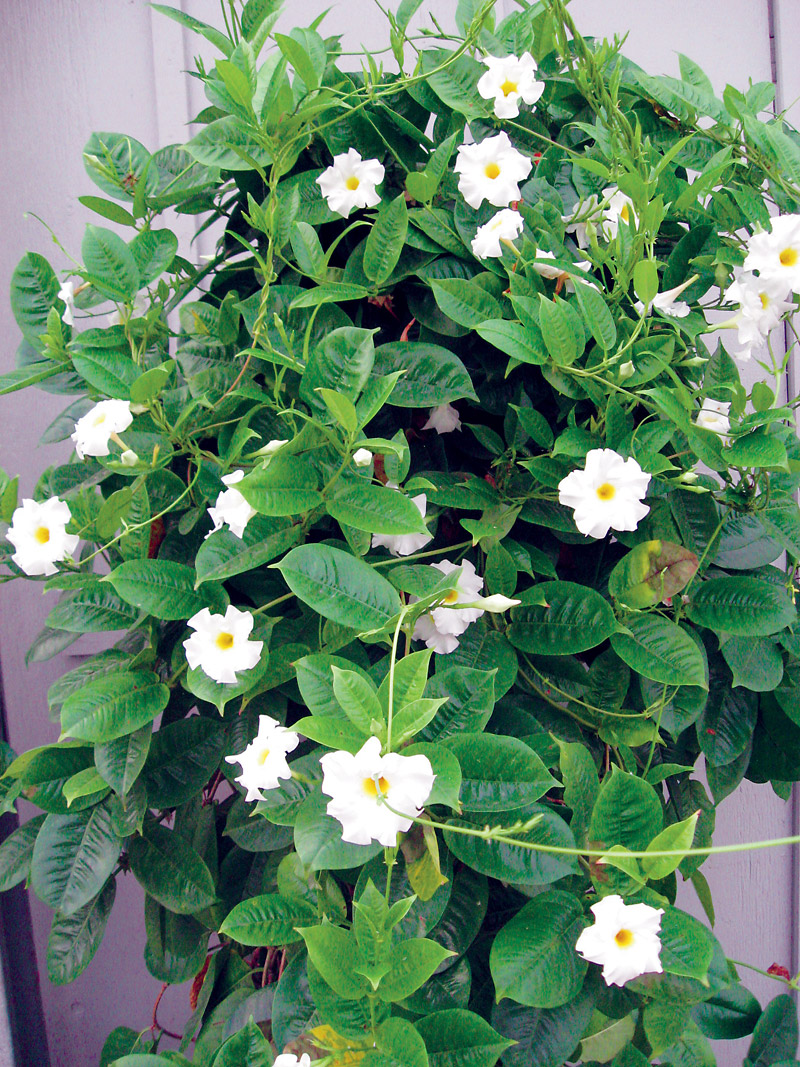
Most people grow their mandevillas in full sun but if you can offer the plant protection from strong mid-day sun, it will appreciate the respite from the sun’s harsh noontime rays. If the foliage starts to burn, move the plant to a location with a bit more shade but be warned that too much shade will reduce the amount of bloom the plant produces.
Mandevilla plants are attractive because of both their foliage and their flowers; the shiny leaves are oval and dark green, and their blooms are funnel-shaped and from five to 10 cm in diameter. The usual colors are white, pink and red. There is a yellow variety but I have never seen one in any of our local garden centers. If the plants start to become a bit rangy, the tips of the stems can be pinched to encourage branching. The fast growing stems might also need some gentle encouragement to climb the supports you provide for them as the stems do not have tendrils like sweet peas do.
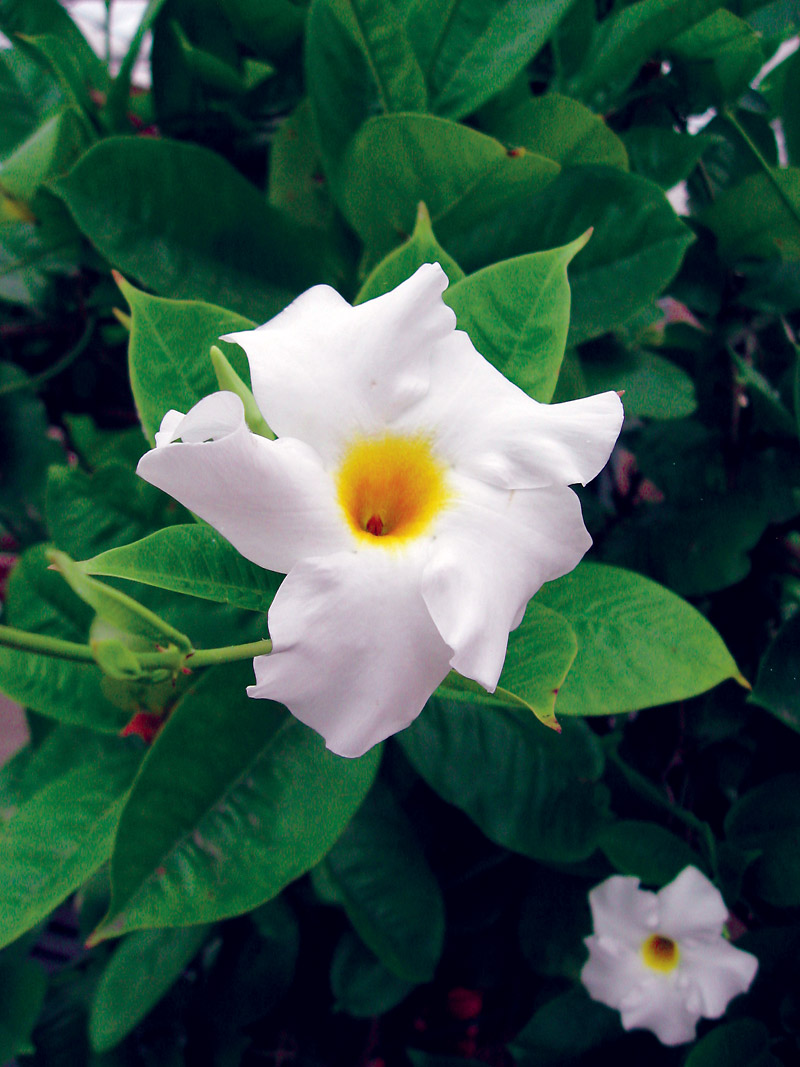
The mandevilla flower in composed of five overlapping petals in rich red, bright pink or pure white and the throats of the flowers tend to be deep and are often colored an attractive shade of yellow. The flowers are held away from the foliage on long stiff stems that are up to six cm in length so that the plant can look like it is frosted by bloom.
Climbing plants can add a vertical element to the landscape and create color and interest at an entirely different level. I think vines also add an exotic, almost tropical touch to an outdoor patio area. Mandevilla, like that other popular climbing vine, the morning glory, will attract hummingbirds.
The trumpet-shaped flowers are exactly the kind of flowers hummers like.
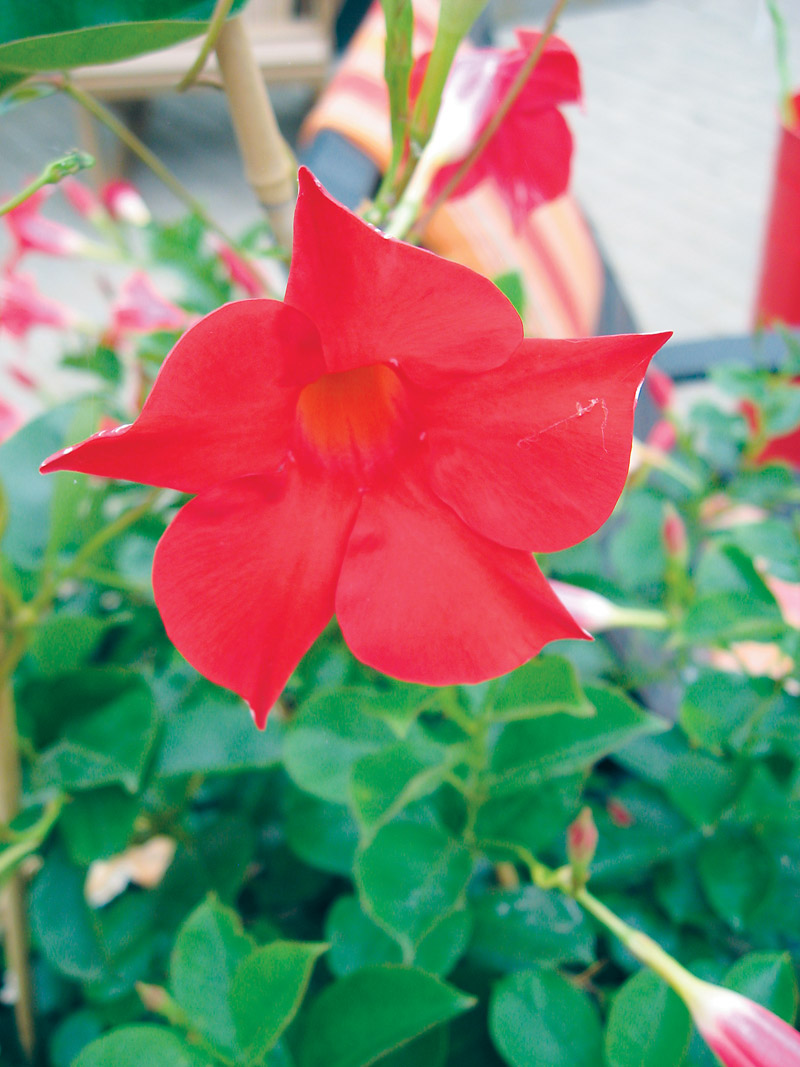
Not everyone, however, wants a climbing plant; not all gardeners have a suitable location to display a climbing plant near the sitting out area which is where you want to locate a mandevilla so that the spectacular plant can be appreciated and enjoyed while you are enjoying your patio area. Such gardeners were ecstatic a few years ago when a shrub-like mandevilla was introduced. When I first encountered these plants in a garden centre I was sure that they were mandevillas but when I examined the plant care tags the name on the tags was ‘Dipladenia’. I was puzzled until I was able to do some research.
Sure enough, dipladenia is a very close cous in of the mandevilla. In fact, some of the plant tags read Mandevilla dipladenia sanderii or Mandevilla spp. Dipladenia is different from mandevilla in that it has a shrub-like growth habit and is not a climbing plant. This makes it much more versatile and gardeners can use it in so many more ways. It can be combined with other plants in a mixed container or used as a focal point plant in a pot all by itself.
The dipladenia can even be used in a mixed border or as a specimen plant wherever one is wanted. Other than the fact that its leaves are slightly smaller than those of the mandevilla, the pants are identical in both appearance and in the care they require. Grow dipladenia in the same way that you grow mandevilla.
White seems to be a much more popular color for dipladenia than it is for mandevilla and the white variety does indeed make an impact, whether combined with other plants or grown on its own as a specimen plant. Like the mandevilla the dipladenia can be pinched to create an even bushier specimen.
If you have not included a mandevilla in your planting plans this summer, perhaps you will head to a garden center and look at the dipladenias that they may still have in stock. You will not be disappointed at how much beauty this plant will add to your landscape.
Albert Parsons lives, writes, and gardens in Minnedosa.
» wtw@brandonsun.com